
|
sailorBOYpress ~ Wisconsin |
Share this page: |
| Jeff Morin: "In my work, I cannot help myself. It is like talking to oneself while others listen. It is compelling to listen but there is also that discomfort because there is a sense that these are not public conversations. These are confessions. I do feel like a fool at times as I search for meaning through materials or a narrative. It is such an antiquated way to think that perhaps it is naively quaint." | |
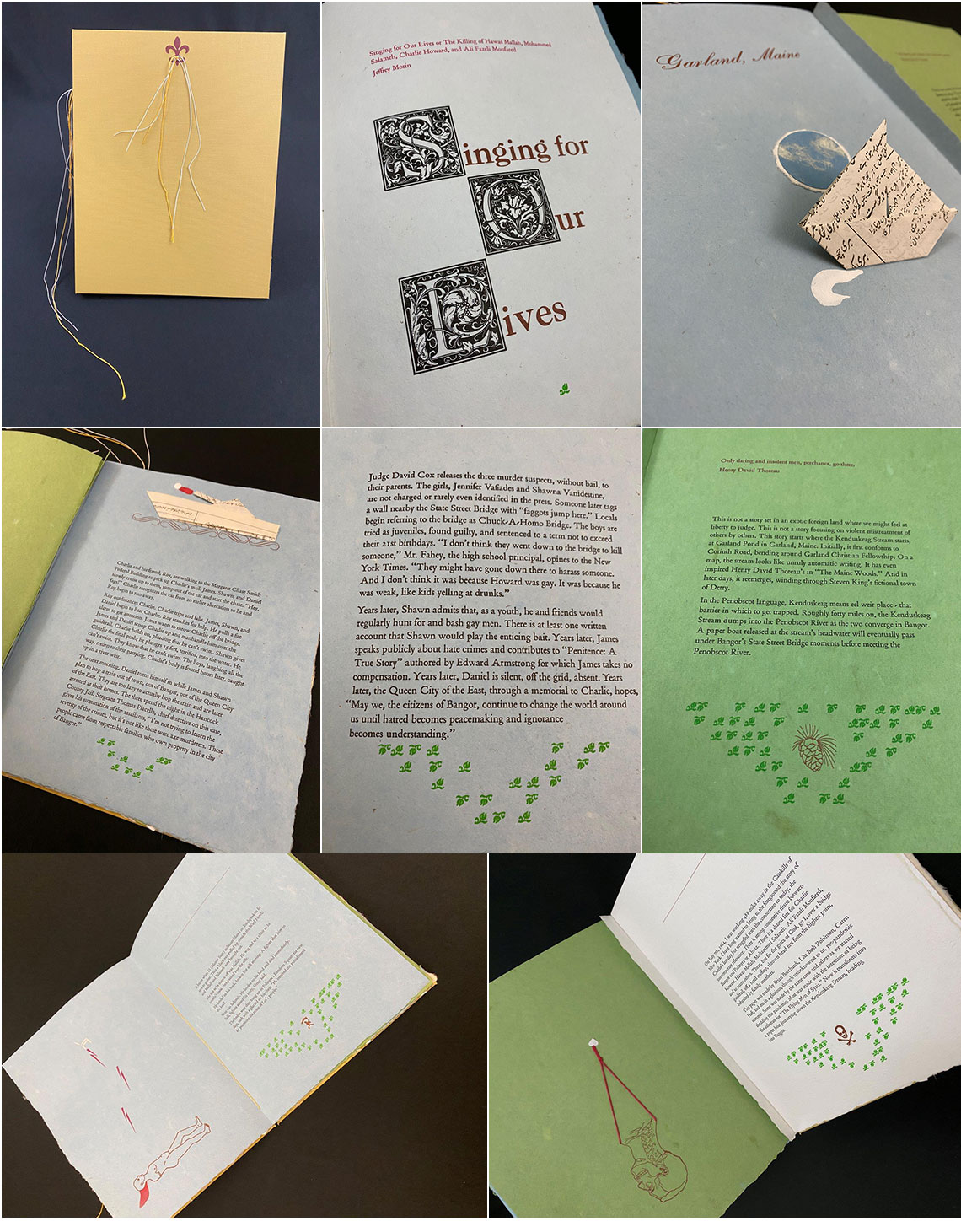
Singing for our Lives. 8.5 x 11”; 25 pages (unnumbered). Letterpress printed on handmade paper. Bound in paper covered boards with exposed sewn binding. Colophon: “The text type for this book is Poliphilus, initially cut by Francesco Griffo, circa 1499, for Aldus Manutius and redesigned by Stanley Morrison for the Monotype Corporation in 1923. The body of this book was set at the press and letterfoundry of Michael Bixler in 2021.” Press numbered. Jeffrey Morin: " I am writing this in the summer of 2021, a time of pandemic, cries for social justice, and what can only be described as batshit crazy politicians trying to deny the election of a US president. I grew up in Madawaska, Maine, 205 miles north of Bangor. Madawaska is another town on a river with a bridge. I was born 99 days before Charlie Howard, who shares my husband’s birth date and year. “On July 7th, 1984, I was working 488 miles away, in the Catskills of New York. I have long wanted to bring to the foreground the story of Charlie's last day but struggled with the connection to today, the contemporary relevance. There is strong connective tissue between Bangor and Palmyra or Ahvaz. There is a shared fate for Charlie Howard, Hawas Mallah, Mohammed Salameh, Ali Fazeli Monfared, and so many others. There, but for the grace of God, go I, over a bridge guiderail, off a hotel rooftop, thrown head first from the highest point, beheaded by family members." Morin lays out in “Singing for our Lives” three instances in which young men were murdered because they were not, in what some in society, considered sexually normal. In Palmyra, Syria, two men were thrown off a roof by IS militants for what they said was “the punishment for practicing the crime of Lot’s people.” In 1984 in Garland, Maine, three male teenagers chase Charlie Howard, beat him, throw him off a bridge knowing he cannot swim. On May 5, 2021, in Ahvaz, Iran, an attractive 20-year-old man was beheaded when his family learned of his sexual orientation. Colophon: “This paper was made by Brian Borchardt, Lisa Beth Robinson, Caren Heft, and me in a glorious, though unbeknownst to us, pre-pandemic summer. Some was made by the same crew and others as we started shedding this pandemic. Most was made with the intension of being the substrate for ‘The Flying Men of Syria.’ Now it transforms into a paper boar journeying down the Kenduskeag Stream, heading into Bangor. … This book … is for the gentle, angry people singing, singing for their lives.” |
 Click image for more |
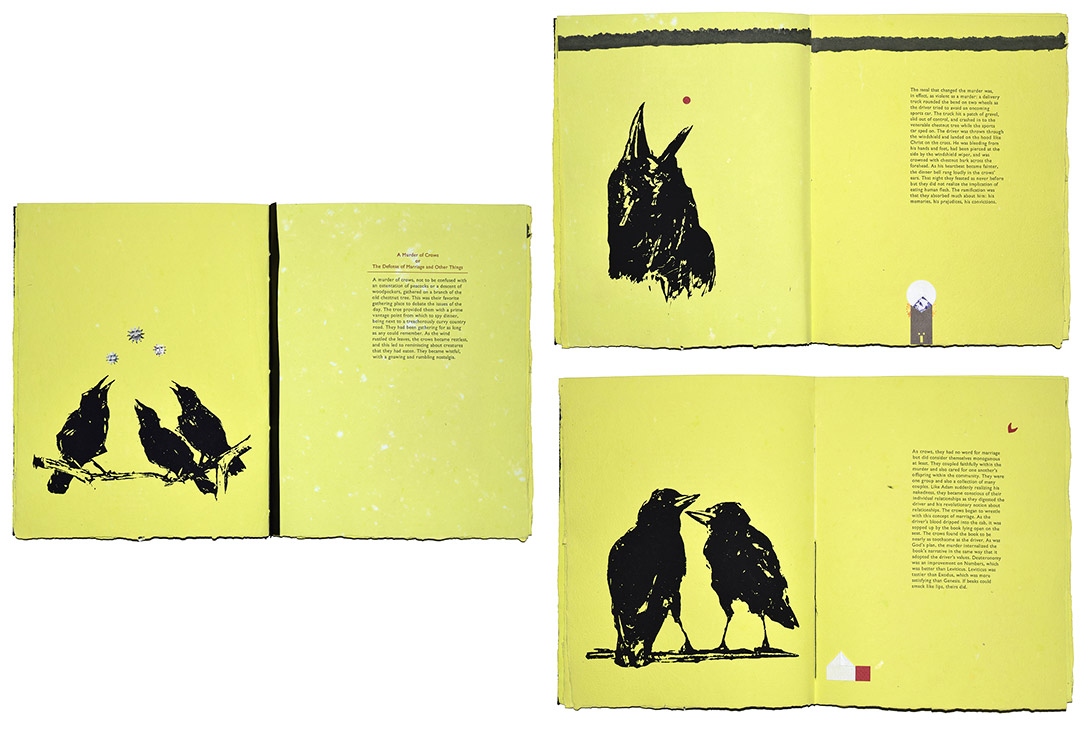
A Murder of Crows 9 x 11"; 28 pages. Text type: Gill Sans. Display type: Hobo. Paper: handmade by Brian Borchardt, Lisa Beth Robinson, Caren Heft, and Jeff Morin. Crow images started as monoprints, which were translated into serigraphs at the Milwaukee Institute of Art & Design (MIAD). Courtney Parbs editioned each of the crow images in January of 2016. Paper tip-ons throughout. Bound in a textured cloth over boards with embossed images of crows on front cover. Numbered and signed by the artist. Colophon: "Levi articulates much from the Old Testament and the Book of Leviticus in particular. Woven into the text is common sense, wisdom, and idiosyncrasy. Discerning betwixt the relevant, out-of-date, and simple prejudice becomes the challenge to the faithful and apostate alike. Many who profess to be devout 'cherry pick' the text to make an argument against equitable marriage but ignore other strictures which no longer seem relevant or would simply be inconvenient to adopt. "Surely, the faithful don't cut their sideburns, eat shellfish, or wear blended fabrics. Right? Surely the apostates don't believe in sex between siblings. Right? Surely, some amongst the faithful marry divorcees, plant gardens with more than one food type, or eat pork. Right? Surely the apostates don't have sex with animals. Right? "Marriage between two men or two women should not lead to their deaths. Right? Marriage between two people should remain a quiet, resilient bond between them. The beech does not judge. The crow does not judge. The chestnut does not judge. The dove does not judge. Men and women do judge. They should exert all of God's wisdom lest they disappoint God and experience his flood of disapproval, forcing us to wait upon the crow and the dove, again. "The text was written in 2014 to enshrine the national debate over marriage equity. " |
|
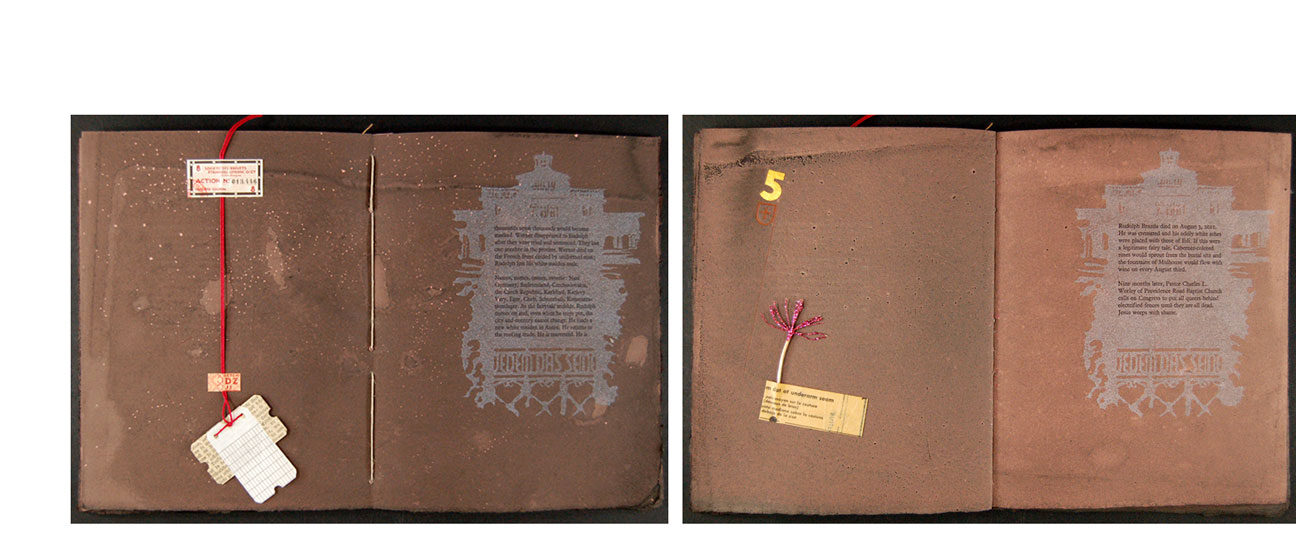
| The White Maiden Male By Jeffrey W. Morin Stevens Point, Wisconsin: sailorBOYpress, 2012. Edition of 50. 11 x 9"; 28 pages. Letterpress printed with Plantin type. Printed on Barcham Green and other handmade papers. Sewn binding with matching paper covers. In 11.75 x 9" lidded aluminum box with embossed titles. Signed and dated by artist. This is the story of Rudolph Brazda, who when he died in 2011 was the last known survivor of the Nazi concentration camps who had been incarcerated because he was a homosexual. Forced wear a pink triangle, Brazda survived 3 years in Buchenwald. After his liberation, Brazda lived in Alsace until his death. Morin overlays Brazda's story with the German folktale of The White Maiden. Jeff Morin, Colophon: "The White Maiden is the tale of a hunter who wishes for the ancient wines of the cellars at Thurnberg in a moment of great thirst. His wish is granted by the White Maiden but, as a result of drinking his wine, she forever plagues him with a sense of wanting, an inability to take satisfaction in anything. He sees her in everything and everyone. his life is spent in pursuit of her. Historically, the term 'maiden' is gender neutral and simply means one whose virginity is intact. Happiness becomes as elusive to Brazda, who finds his maiden and loses him. His life becomes an unending search for his maiden and his world unleashes a curse that attempts to rob him of any pleasure or sense of being quenched. "Sitting in a hospital waiting room, I reached for a Time magazine, only to discover Rudolph Brazda through his obituary. I have chosen to weave the true-life story of Brazda with the German folktale of 'The White Maiden.' In a recorded interview, Brazda delivers a frank and rather clipped recounting of the horrific acts swirling around his early life. He makes simple, declarative statements that should boggle the soul and cause us to weep. He was perhaps the last person alive to have worn the pink triangle as a Nazi concentration camp detainee." $900 |
|
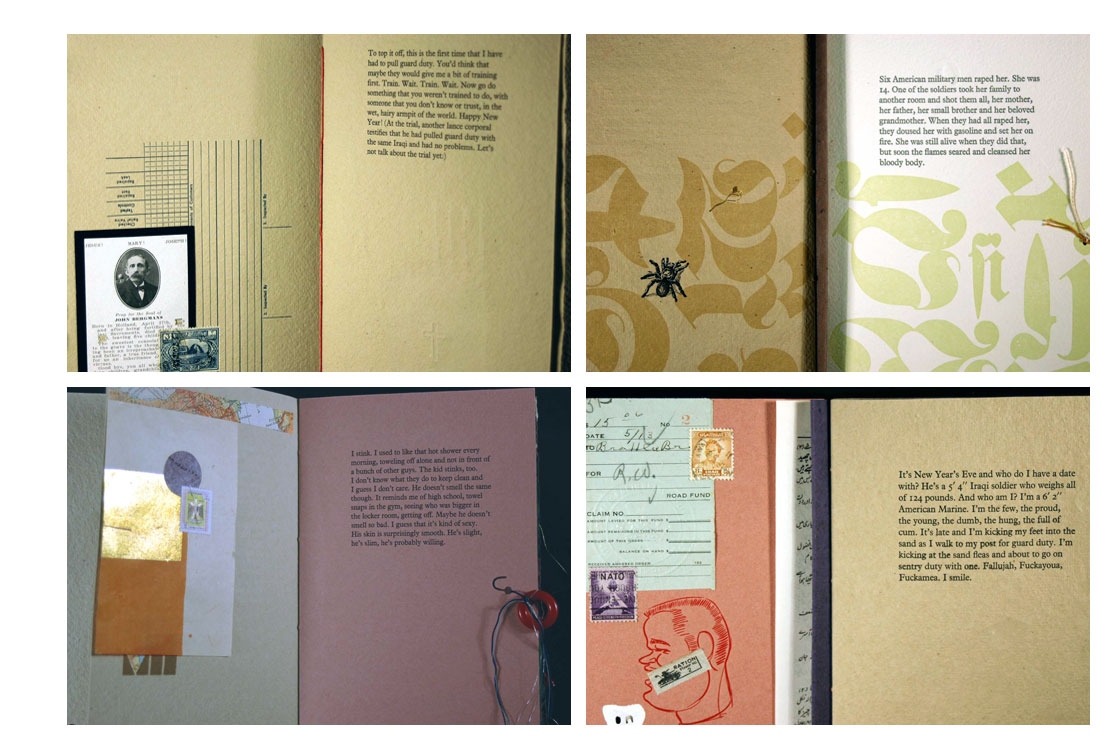
| Crossing the Tigris By Caren Heft, Jeffrey Morin & Brian Borchardt Stevens Point, Wisconsin: Arcadian Press / sailorBOYpress / Seven Hills Press, 2011. Edition of 60. 6.75 x 10.5 x 2" box containing three books each with 36 pages. Letterpress printed. Type: Plantin. Collage and inclusion elements. Handmade paper. Handsewn binding. Four sided drop letterfold container with twine tie closure. Jeff Morin: "A narrative in three books recounting soldier's stories from the Iraq War. This is a collaborative project between Jeffrey Morin, Caren Heft, and Brian Borchardt. The collaborators each found stories in the media that recount horrific situations that are inconceivable to those who work regularly with current or former soldiers who happen to be students or artists." Statement by the presses: "The container for this collaboration is meant to embody the conundrum of this person who transforms into a beast capable of horrendous acts against innocents. The outside of the container is collaged in the same way that a boy might decorate his hiding place for treasures found. The elements, like currency, targets, or stamps, are in the realm of childhood values. The inside of the container sets the stage for juvenile battle. These are the props for pretend war. When confronted with the grittiness of war, do these ill-prepared young men simply break with reality? Are they taught that they are above the law? Or do they learn to devalue what is not obviously American? Neither the container nor the three books answer the questions posed above. We all know young soldiers who have served or those who could serve. This collaboration is intended to catalyze a conversation about the nature of change that allows potentially decent people to commit indecent acts." $2,100 |
|
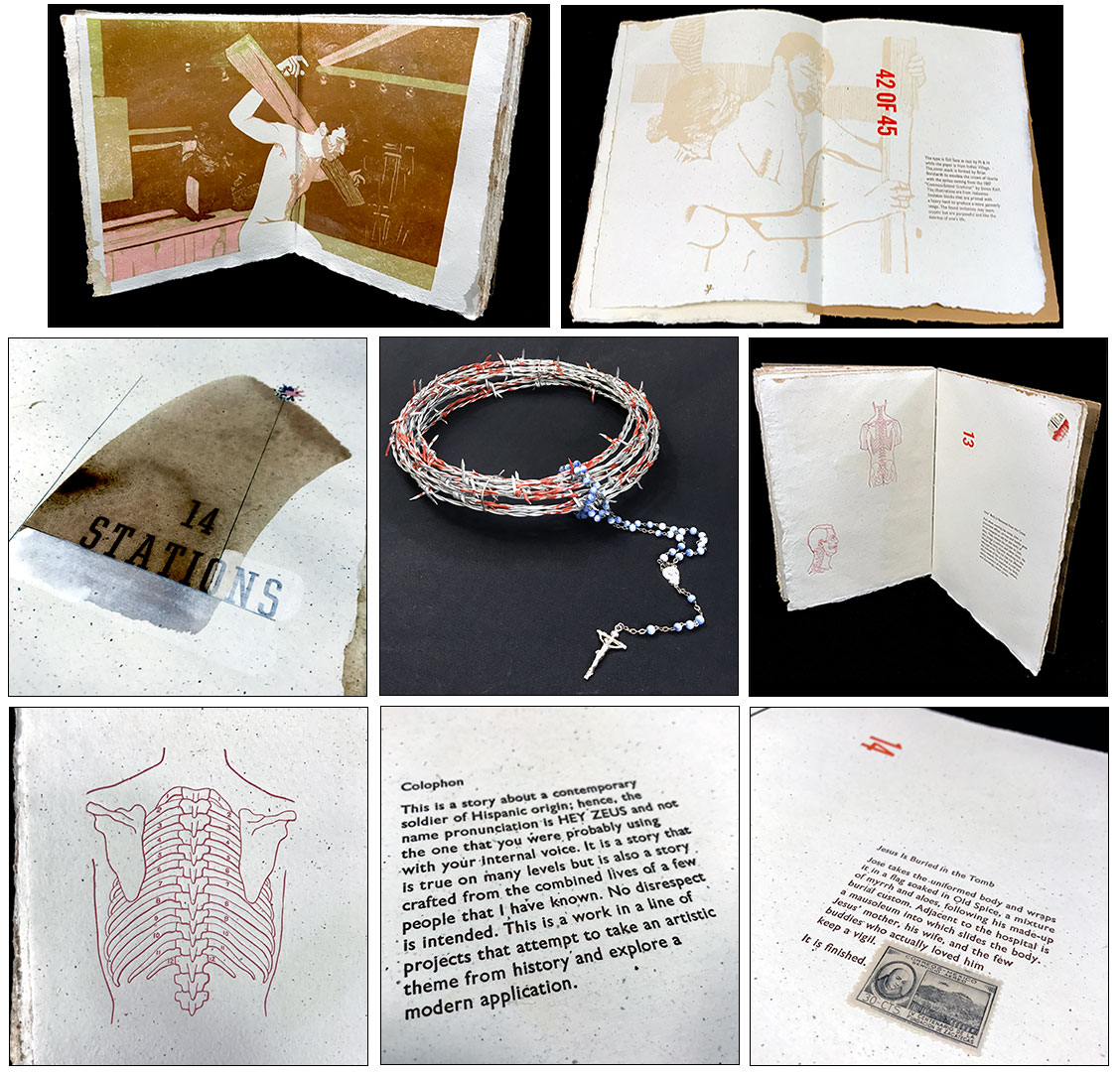
14 Stations 9.75 x 12.25 x 3": 56 pages.Type: Gill Sans as cast by Mackenzie & Harris (San Francisco). Outer papers by Caren Heft and Brian Borchardt, inner papers are Indian Village. 14 reduction linoleum prints with two additional variations for the title and colophon. Metal crown of thorns a with a rosary intertwined and book housed in black leather box with removable lid. Colophon: "This is a story about a contemporary soldier of Hispanic origin; hence, the name pronunciation is HEY ZEUS and not the one that you were probably using with your internal voice. It is a story that is true on many levels but is also a story crafted from the combined lives of a few people that I have known. No disrespect is intended. This is a work in a line of projects that attempt to take an artistic theme from history and explore a modern application.... "The cover stock is formed by Brian Borchardt to emulate the crown of thorns with the spikes coming from the 1867 Common-School Grammar by Simon Kerl. The illustrations are from reduction linoleum blocks that are printed with a heavy hand to produce a more painterly image. The found inclusions may seem cryptic but are purposeful and like the detritus of one's life." This book meshes the 14 Stations of the Cross with a story of a modern Jesus (of Hispanic origin and hence pronounced Hey Zeus) who is dying of aids. The mix is so skillfully done – in text and in image supplemented by "inclusions," which include stamps and clip-art type images that are debossed into the prints — that a third layer emerges subsuming both. A passionate story in many senses, but not a polemic. The tone is one that nurtures tears of understanding. |
|
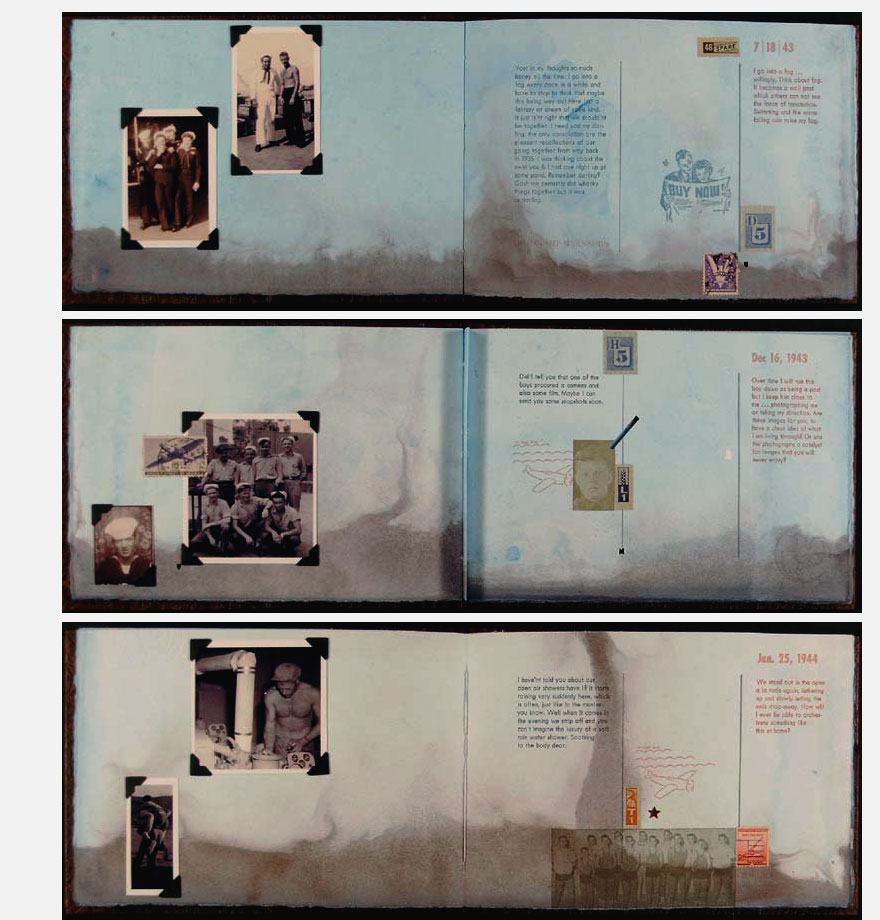
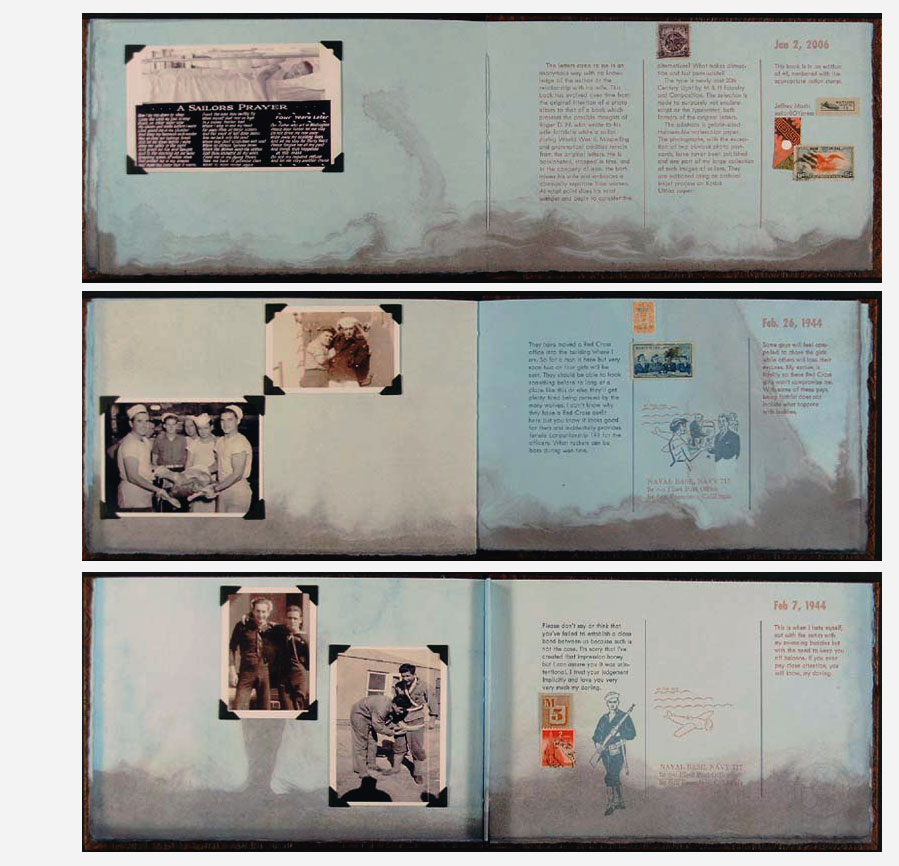
my darling, my reason 7.75 x 10.75 x 1.25"; 25 pages. Type: 20th Century Light. Designed to look like a photograph album with black photographic album corners used to tip in photographs. Bound in brown mottled paper endboards with postage stamp adhered to front board. Ration stamp used for edition numbering. Housed in brown cloth dropback box. my darling, my reason appears to be a photo album with text from letters written home by a World War II sailor. His thoughts – unexpressed, or at least not included in his letters to his wife – provide the subtext and tension .Colophon: "The substrate is gelatin-sized Hahnemühle watercolor paper. The photographs, with the exception of two obvious photo postcards, have never been published and are part of a larger collection of such images of sailors. They are editioned using an archival inkjet process on Kodak Ultima paper." Jeffry Morin, Colophon: "The letters came to me in an anonymous way with no knowledge of the author or the relationship with his wife. This book has evolved over time from the original intention of being a photo album to a book that presents the possible thoughts of Roger D N who wrote to his wife faithfully while a sailor during World War II. Misspelling and grammatical oddities remain from the original letters. He is opinionated, perhaps stopped in time, and in the company of men. He both misses his wife and embraces a community separate from women. At what point does the mind wander and begin to consider the alternatives? What makes distraction and lust permissible?" Excerpt:
$750 |
|
Martyr Mercury Rooster 12 x 8.75". Three individual books of handmade paper, housed in a 13 x 10 x 2.5" clamshell cloth covered box. Papers: Root River Mill cotton, Larroque, and Hahnemuhle. The Hahnemuhle gelatin sized (with pigment added-in). Typeface throughout: Cochin Light. This powerful, exquisitely rendered 3-volume collaboration between Caren Heft of Arcadian Press and Jeffrey Morin of sailorBOYpress is done in the spirit of the ars moriendi (the art of dying), 15th-century Christian texts with instructions about how to die well developed (perhaps) in response to the Black Plague. Heft and Morin use the format ironically to look contemporary scourges: suicide bombers, the destructive effect of mercury in the environment, AIDS. The woodcuts from the Middle Age-originals are replaced by an assemblage of tape, pins, stitchery, beads, and pieces of metal. The effect is powerful, even overwhelming . For images and more information see Arcadian Press |
|
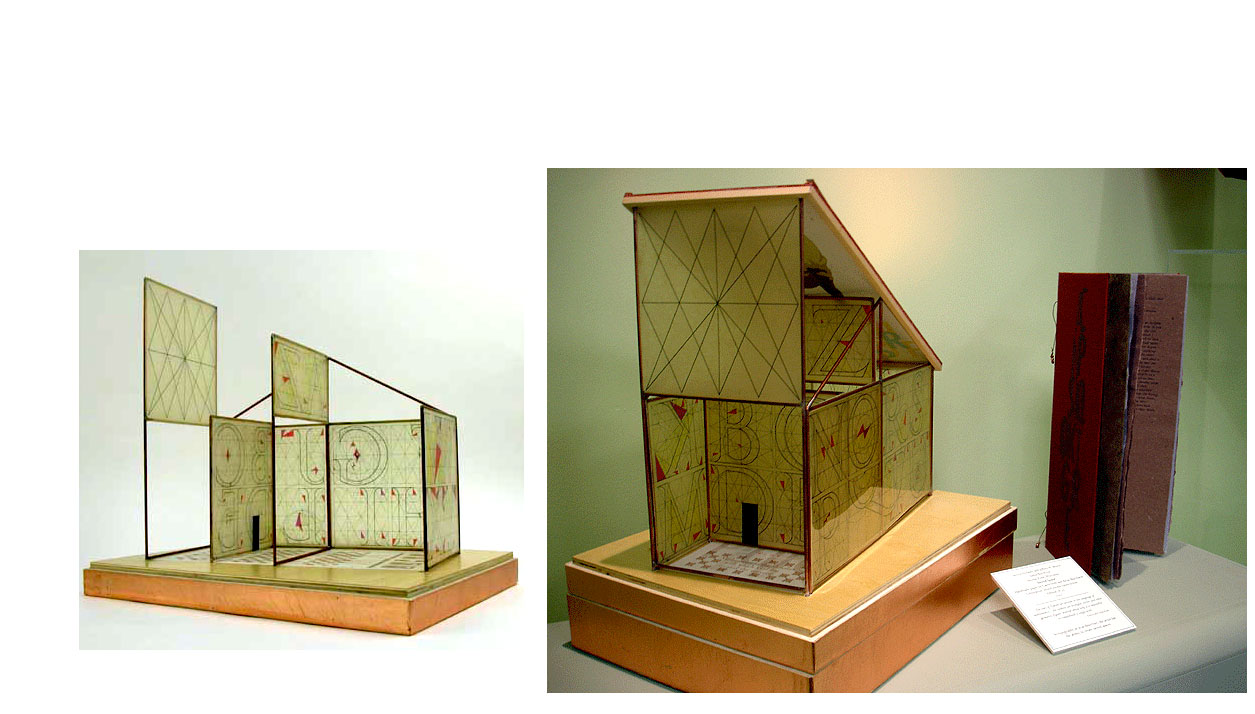
Sacred Space Book: 6 x 14.25"; 17 leaves. Sculpture base 15.75 x 11.5", height 12". Book: reduction linoleum prints with typographic illustrations using overprinting of letterforms; open spine sewn with brown cord binding; brown cloth-covered boards; title and design on front board; endpapers of handmade paper from Nepal. Chapel kit: six walls, roof, base. Walls: copper rod skeleton with Okawara rice paper skin covered with a casting resin. Book and kit housed in wooden box. Box lid becomes the base for the chapel. Brass holes in the base allow the rods to fit exactly. Print pattern on the base becomes the floor pattern. Letters indicate which wall is placed in a particular set of holes. Roof copper-leafed Davey board. Roof forms the tray in which the book rests. Box painted with copper leaf. Colophon: "Sacred Space is an extension of Steven Ferlauto's research in The Sacred Abecedarium, brought to the public's attention in the year 2000. Inspiration for the project comes from an examination of the role of geometry in the development of the Roman alphabet. With their visual characterization reminiscent of stained glass the chapel concept and design is a continuation of Seven's exploration of this sacred theme. This alphabet has been used to adorn classical architecture and now clothes an intimate chapel." Caren Heft, curator Carlsten Art Gallery, University of Wisconsin at Stevens Point: "Sacred Space is a letterpress book housed in a box that also contains the parts for a chapel, to be put together by the viewer. The chapel incorporates elements of a previous book as the stained glass windows feature the sacred alphabet….This book departs from the conventional perception of what constitutes a book by the incorporation of the 'glass' chapel kit. It looks back to do-it-yourself books, to erector sets, to a time past, before television, when people used their hands to make stuff for pleasure….This book requires that the viewer be an active participant as to fully understand the book, one must build the chapel, locate all the parts, and understand the printed book as part of the whole. In this departure from the traditional book object, Morin has also incorporated more traditional book elements. The book has a text, printed letterpress, an outdated, laborious process in which individual letters are set by hand, as Gutenberg did. He uses reduction lino prints to great advantage here as well as typographic illustrations—overprinting letterforms to make a whole that is more than the individual letters." Quotations in text by Galileo Galilei, William Bunce (former director of the Kohler Art Library), Thomas Merton, and William E. Barrett, explore the concept of Sacred Space. The laws of Nature are written in the language of mathematics...the symbols are triangles, circles, and other geometric figures, without whose help it is impossible to comprehend a single word. –Galileo Galilei. Review by Books on Books Collection $1,750 (Last 3 copies) |
|
Page last update: 04.05.2025

Home | About Us | Contact Us | New Arrivals | Fine Press & Artists' Books | Broadsides |Resource Books | Order/Inquiry
Copyright © 2021 Vamp & Tramp, Booksellers, LLC. All rights reserved.