
|
Red Parrot Press ~
California |
Share this page: |
|
|
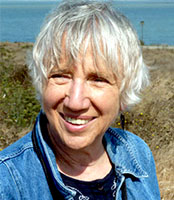
Barbara Milman: "The intimate nature of an artist's book allows me to explore ideas in a special way. Making a book for someone to pick up and read is like having a conversation, while making a print to hang on a wall is more like giving a speech. And the issues that I address in these books seem better suited to conversation than to speeches." | |
Environmental Issues Books |
||
Barbara Milman: "I spent my childhood on the East Coast, close to the Atlantic. The wide sandy beaches, the ceaselessly repeating waves, the vast waters extending beyond the horizon, all were soothing reminders of a stable world. But fossil fuels and global warming are changing everything. The world’s coral reefs are dying along with many species that live in them. Jellyfish that thrive on CO2 are invading coastal waters. Starfish, anemones and sea grasses are struggling to survive in California’s tide pools. The enormous variety of sea life found off the coast of Hawaii is threatened. This is what my current work is about. "I am both a fine print and a book artist. As I work, I go back and forth between the books and the prints, taking images and techniques from one medium and transposing them into the other. For example, I usually start the prints as linocuts – relief prints of the ocean and the life it supports. Sometimes I use the print directly in the books, but often I take digital photos of them which I combine on the computer with digital photos I have taken. Additional design elements may be added in PhotoShop. Once I have created pages on the computer, I print them with an inkjet printer on archival art paper and assemble them into handmade books. Then I frequently go back and add hand printed linocuts to complete the books." |
||
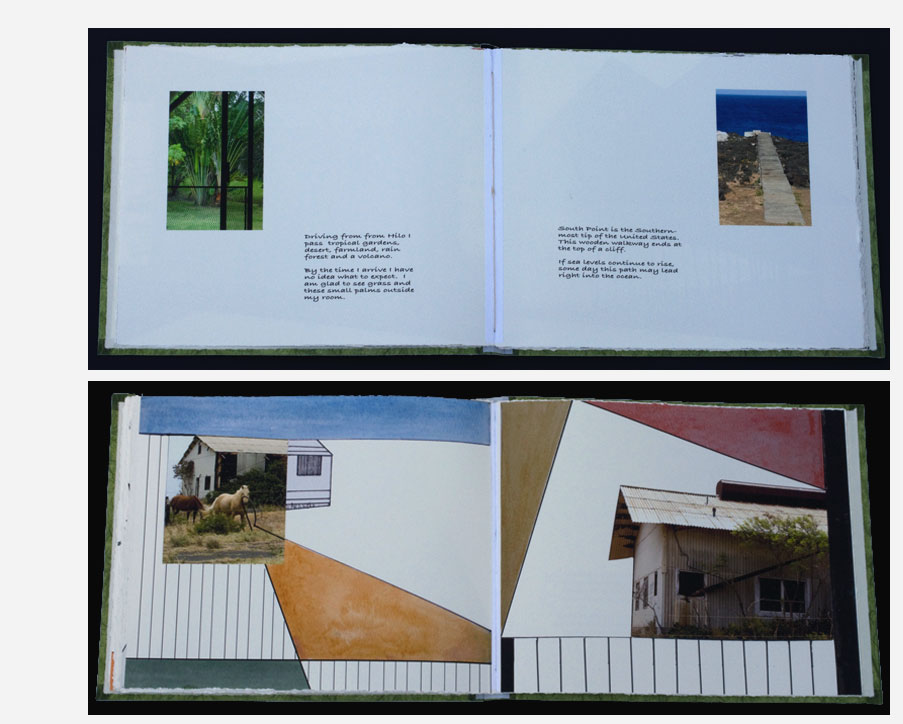
Hawaii 10.75 x 13"; 34 pages. A work of digital photographs with the artist's graphic elaborations. Printed digitally. Paper covered books with illustrated paper title on front board. A gentle and haunting look at the Big Island of Hawaii with minimal text by the artist. Barbara Milman: "In May of 2007 I was an artist-in-residence at the Red Cinder Creativity Center on the Big Island of Hawaii, where I took all the photographs in this book."
|
||
| Out of print and SOLD titles by Barbara Milman: |
||
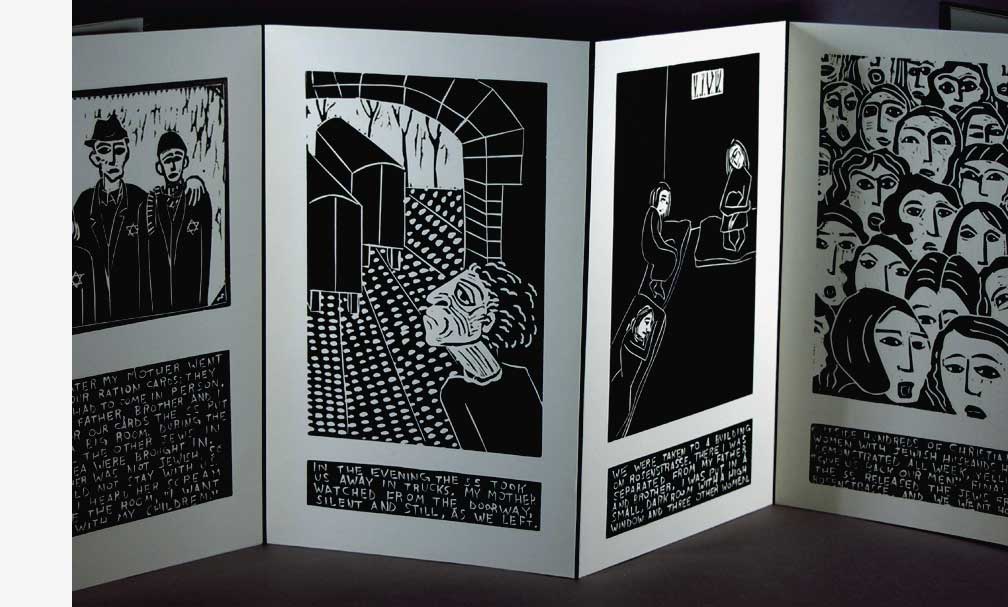
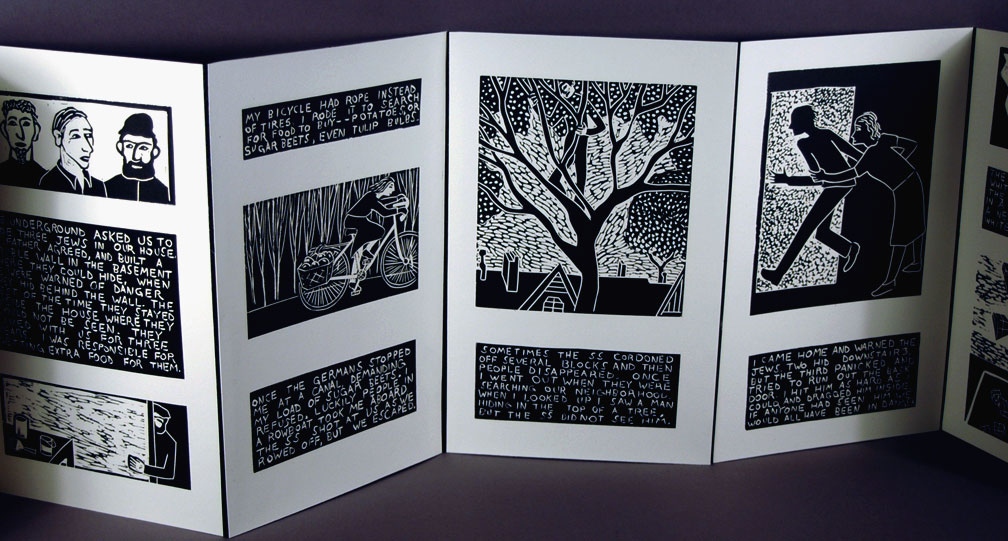
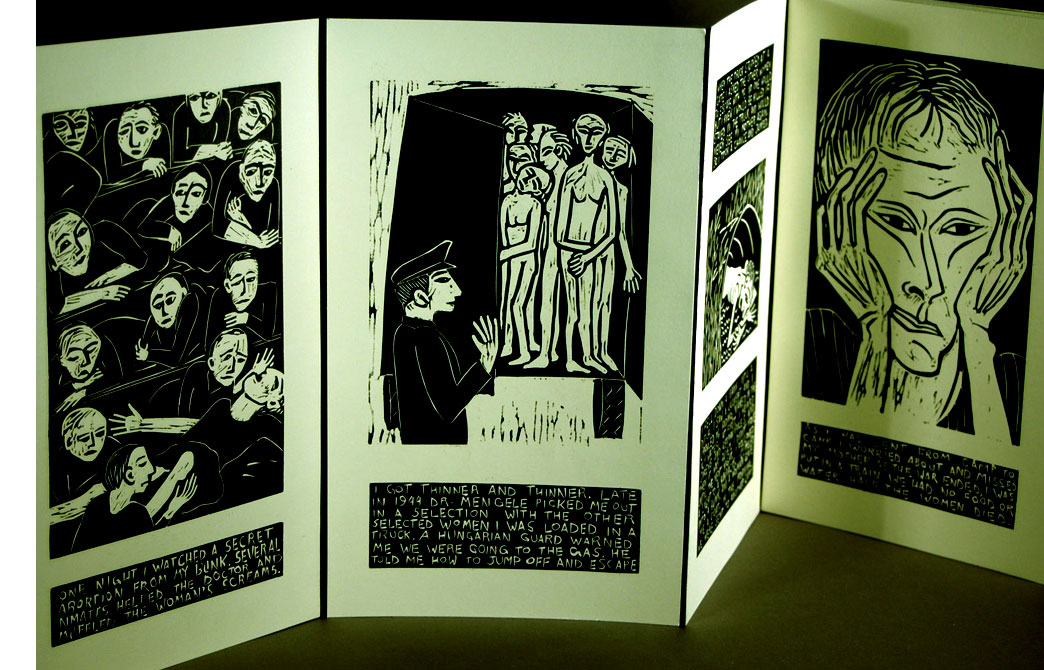
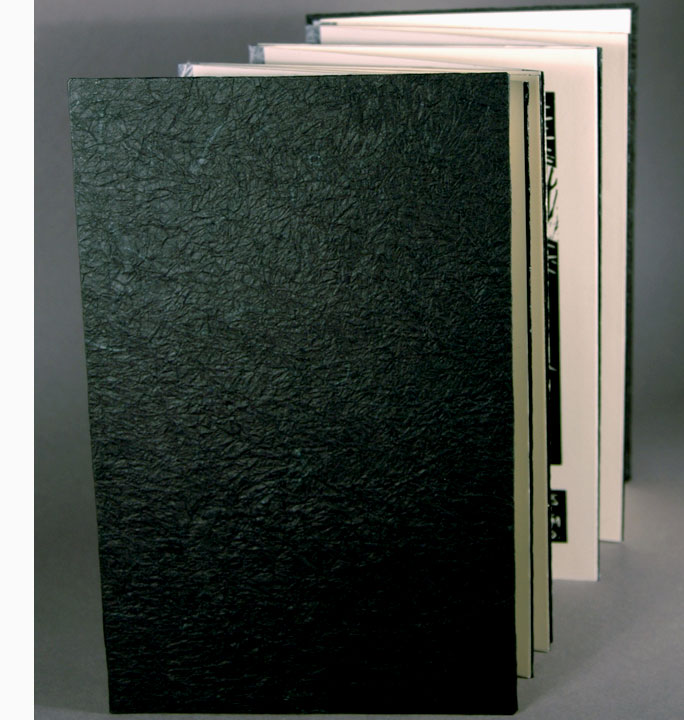
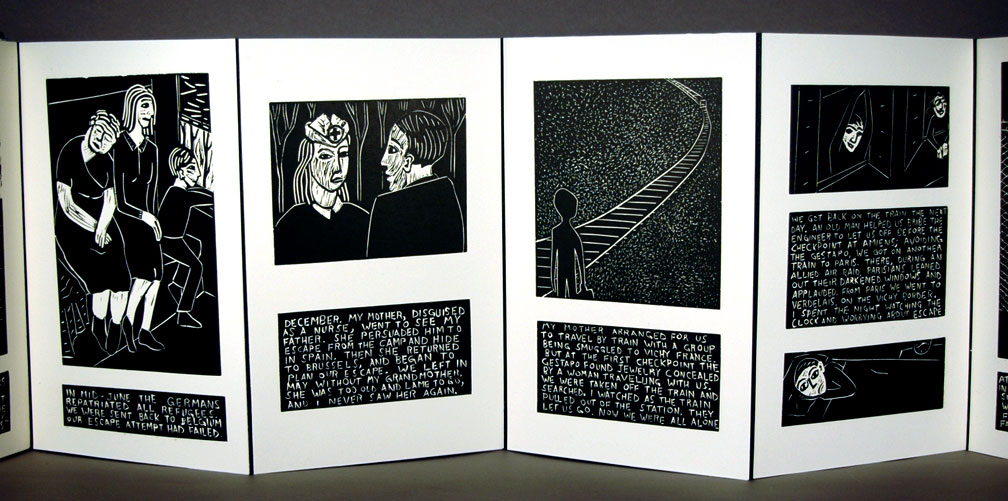
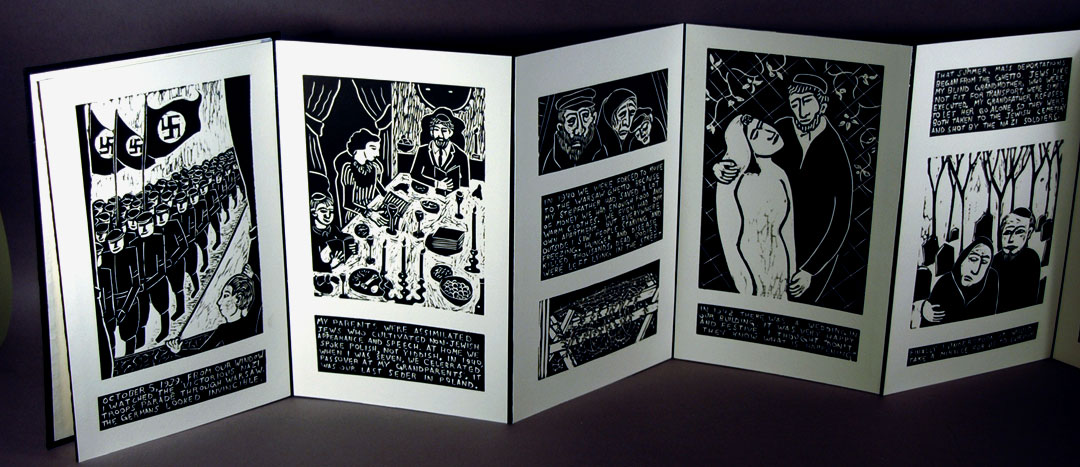
The Holocaust Series: set of five books (Only available as a set) (SOLD) Five books in a series recounting interviews with Holocaust survivors. The artist interviewed five Holocaust survivors and did 12 prints for each, telling their stories. All five are very different: four are Jews, one a young Dutch woman who worked for the Dutch underground. Five stories, each in an edition of 25. 8.5 x 13.5”. Accordion structure. Text and images in linocut. Bound in black covered boards. Barbara Milman: "In 1994 I decided to interview Holocaust survivors and create a series of prints based on their stories. I then approached the San Francisco Holocaust Oral History Project, which graciously put me in touch with several survivors. Two of these individuals, Rita Kuhn (Berlin) and Gloria Lyon (Auschwitz), were the first of my interviewees. Subsequently, other subjects were suggested by friends and acquaintances, and I interviewed three more individuals: Peter Schrag (Escape), Alexander Groth (Warsaw), and Hielke Sheneman (Holland).... "It is my hope that telling these stories today, one-half a century after they happened, will make it less likely that similar stories will have to be told in the future.". |
||
Auschwitz A Hungarian child survives the largest death camp Barbara Milman: "Upon arrival at Auschwitz, Jews were divided into two groups. The elderly and infirm were sent directly to the gas chambers. The young and healthy were sent to the forced labor section of the camp." Gloria Lyon: "We were in Auschwitz. Heads shaved, arms tattooed, we were sent to barracks. Next morning my mother, my sister and I were set to work sorting and packing clothing, shoes, glasses for shipment to Germany. Night and day thick black smoke filled the camp with an awful stench. After a few days I completely lost all my sense of smell."
|
||
Berlin A child's view of pre-war persecution in Germany Barbara Milman: "Rita Kuhn was born of a Jewish father and a mother two who had converted to Judaism after marriage. Rita and her brother were raised as Jews. In 1933, the first legal definition of a Jew (non-Aryan) was enacted: any person with one Jewish parent or one Jewish grandparent was so classified. This definition was refined in 1935, after passage of the Nuremberg Laws, to distinguish between "full Jews" (persons who had at least three grandparents who were "full Jews by race") and Mischlings (offspring of mixed marriages, who had one full Jewish parent and one Aryan parent). However, a Mischling was treated as a full Jew if, like Rita, the person was a member of the Jewish religious community when the law was enacted in 1935 or if certain other criteria applied.... "Since Jews were defined by race, a non-Jew like Rita's mother, who had married a Jew and converted to Judaism, was still considered Aryan and as such not subject to deportation with her family. The demonstration by Christian German wives of Jewish men on Rosenstrasse in March 1943 was one of the few incidents of public resistance to anti-Jewish actions by German citizens. In the face of this resistance, the Nazis backed down and released hundreds of Jewish husbands and children. Rita and her family were among those released, and they were not arrested again for the duration of the war." |
 Click image for more |
|
Escape Fleeing Germany Barbara Milman: "Approximately 525,000 Jews lived in Germany when Hitler became that country's Chancellor in 1933. As soon as the Nazis assumed power, anti-Semitic policies were established, and Jews were increasingly barred from schools, businesses, and professions. Jewish businesses were boycotted and Jews were subjected to mistreatment and arbitrary arrest.... "With the implementation of the Nuremberg Laws, Jews with means began to leave their homeland. Peter Schrag and his family were among those Jews who fled Germany in 1935. By 1939, the year in which the war began, over 280,000 German Jews had managed to escape or emigrate to neighboring countries such as Luxembourg, which borders Germany on the west, and Belgium, which borders on Luxembourg.... "Peter Schrag and his family were among those Jews who escaped first to Vichy France, and then to Spain and to Portugal. From Lisbon, the Schrag family came to the United States, arriving in New York City In June 1941." Escape is the remembrance of Peter Schrag as his family evaded capture by German patrols as the traveled across Europe. They slept in haylofts, hid in cellars, jumped off trains, and walked though dark fields to wall through a hole in a fence towards freedom. Peter Schrag:" After days of bombs and gunfire, there was a sudden silence. We did not know who had won. Then the cellar door was opened by soldiers yelling, 'Alle Raus.'" |
|
|
Holland Working in the Dutch resistance Barbara Milman: "At the time of the German invasion there were 140,000 Jews in Holland, and by the summer of 1943 the Germans estimated that there were approximately 20,000 Dutch Jews in hiding. About 18,000 of the hidden Jews survived the war, including at least two of the three Jews hidden by Hielke Sheneman and her family. Holland had more 'righteous gentiles' than any other European country. By 1990 over 3,200 Dutch citizens had been honored by the State of Israel for helping Jews escape the Holocaust, often by hiding them from the Nazis." Hielke Sheneman moved to Amsterdam and joined the underground. She delivered the underground newspaper, scavenged for food, and hid Jews. Sheneman: "When the Germans killed someone we put flowers on the sidewalk where they died. Toward the end of the war the killings increased so much that the sidewalks were always full of flowers." |
 Click image for more |
|
Warsaw Surviving the ghetto Barbara Milman: "Hitler invaded Poland on September 1, 1939. However, Warsaw, the country's capital, did not fall until September 27, 1939 and German troops waited for several more days before entering the city. At first, Jews such as Alexander Groth and his family continued to live in their prewar homes. They were still there n the spring of 1940 for the celebration of Passover, but it was not long before Polish Jews were segregated from the rest of the population. "The first Polish ghetto was established in Lodz on May 1, 1940 and at its peak had a population of 445,000. This meant that 30% of the city's total population, plus any Jews transported from other cities, was confined to 2.4% of the city's total area. By the middle of 1941, nearly 5,000 Jews a month were dying of illness and starvation." The Groth family was forced to move the ghetto in 1940. They were more fortunate than most because they had money, food and warm clothing as well as their own apartment. But mass deportations began as well as executions of those considered not fit for work or transport. Groth's blind grandmother was shot - as well as her husband who refused to leave her side. It was then that Alexander Groth understood that "it would take a miracle for us to survive." The Holocaust Series: set of five books (Only available as a set) |
|
|
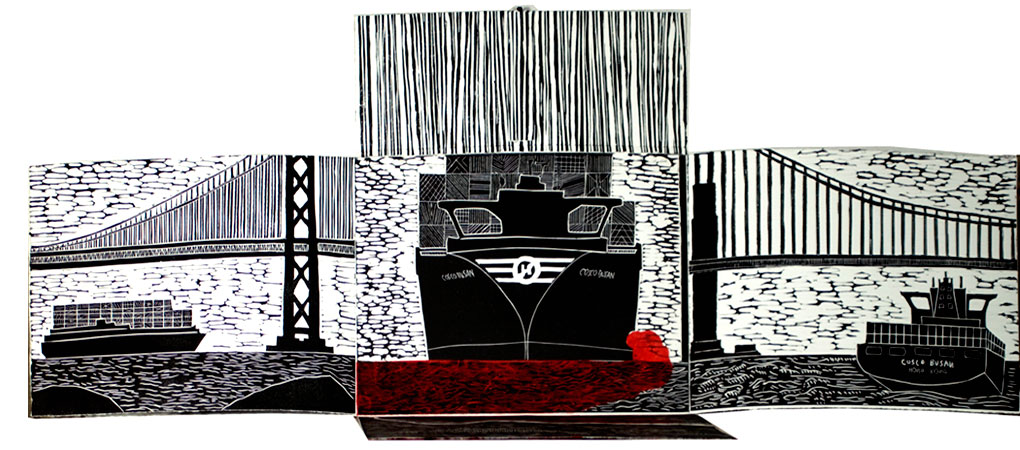
Accident 12 x 9" closed; 36 x 23" open. When open, it is cross-shaped, a horizontal and vertical foldbook with a common page. Linocuts. Tie closure. Milman's second book about the oil spill in the San Francisco Bay on November 9, 2007. On that day the container ship Cosco Busan rammed the Bay Bridge and spilled 58,000 gallons of fuel. With a blot of red paper over the black-and-white linocuts, there is no doubt where Milman's sympathies lie – certainly not with the oil companies. |
 Click image for more |
|
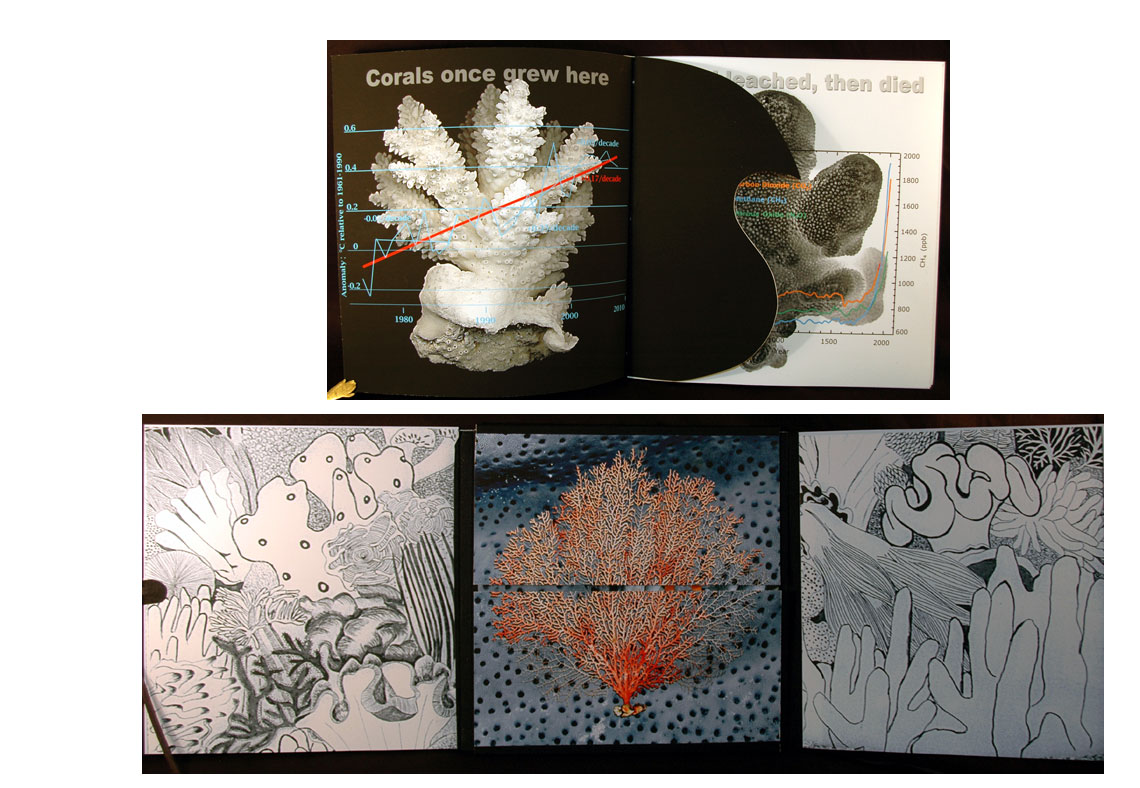
Coral Ghosts 12.25 x 12.75"; 20 pages. Digital printing on MOAB Entrada Rag Paper. Laid in letterfold case printed on coated, archival, Strathmore illustration board with black tie closures. Barbara Milman: "The subject is obvious: the destruction of coral reefs by global warming. The warmer water kills the small creatures (algae) that live in the coral and give it the bright colors of healthy coral. When these algae die from the heat, the coral 'bleaches.' Then the second step of climate change takes over. The increased CO2 in the air is absorbed by the oceans, which become more acidic as a result. The increased acidity dissolves the coral shells (as it dissolves shells of other small ocean creatures like plankton), and the coral will eventually disappear. The scientific charts in the book are taken from the internet, and are about greenhouse gases, ocean warming and sea levels." |
 Click image for more |
|
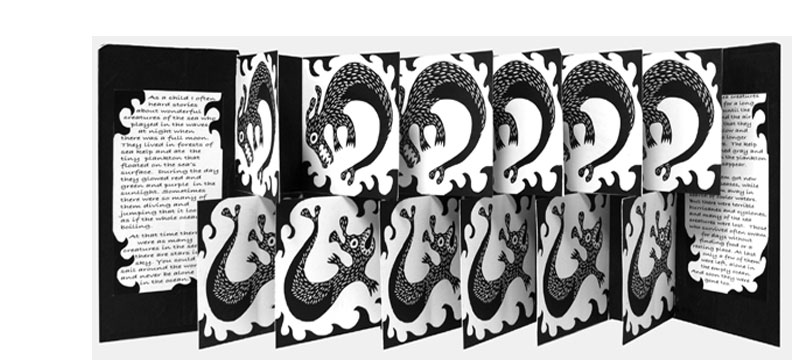
Creatures of the Sea 4.5 x 8.5" closed; 21.5 x 8.5" fully opened; 14 pages. Flagbook structure. Linocuts with digital text. Bound in black paper with printed paper title tipped on front cover. A cautionary tale of the effects of climate change bookends this vision of havoc in the seas. Barbara Milman: "Currently I am interested in climate change, and in particular about its effects on the ocean. My prints of the California Coast are a starting point for work about an area that is close to home. I have also been using these prints as the basis of artists' books about specific issues of global warming." |
|
|
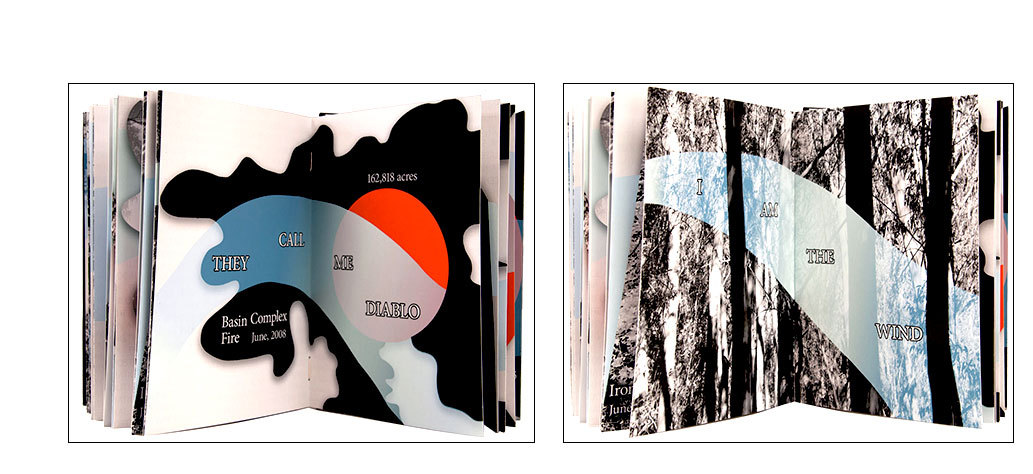
| Devil Wind By Barbara Milman El Cerrito, California: Red Parrot Press, 2014. Edition of 15 + 2 AP. 5 x 7"; 32 pages. Sewn booklet with 8 signatures. Inkjet printing with archival pigment inks. Printed on Moab Entrada Rag paper. Images, design, and original text by Barbara Milman. Signed and numbered by the artist. Barbara Milman: "This book is about the effect of climate change on California wildfires. Forest fires in California are caused, or made exponentially more violent, by the hot, dry 'devil winds' — the Santa Monica and Diablo Winds that blow in from the desert. With climate change, these winds are becoming stronger and more frequent. Devil Wind contains pages on each of the 20 biggest forest fires recorded in California since 1932. More than half of them have occurred since the year 2000, and they have been steadily increasing in size. Climate change is the most important issue humanity faces today. Unchecked, it will threaten the existence of our cities, decimate the world food supply, destroy the ecological balance of the earth, and create global political instability. Yet it has gotten very little attention, and even less action, from our political leaders. My books express these concerns about climate change in concrete artistic terms." (SOLD/ Out of print) |
 Click image for more |
|
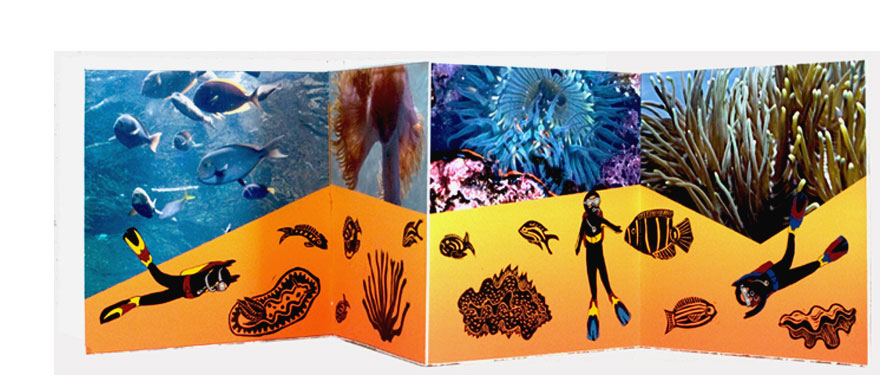
Exploring the Coral Reefs with the Last Chance Divers 8.5 x 8.5"; 20 pages. Double-sided accordion. Digital print with collage. Linocut cover. Wraparound cover with handsewn binding. One side of the accordion combines vivid underwater photographs with a collage of cartoonish divers and underwater forms in silhouette; the other side is a run-on sequence of news about the threat of global warming, in the main warnings that while ubiquitous have little effect. Barbara Milman: "I made several ... books in Hawaii using photos printed on photo paper and with similar designs on folded sheets of watercolor paper. Text is from news articles and headlines about global warming - but chopped up so that it is hard to make out the details."
|
 Click image for more |
|
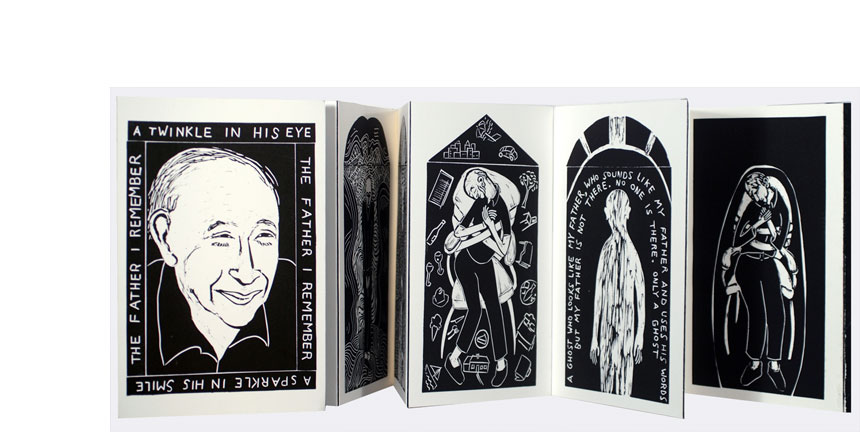
| The Father I Remember By Barbara Milman El Cerrito, California: Red Parrot Press, 2000. Edition of 5. 8.25 x 12.25"; 8 panels. Accordion structure. Linocuts. Reinforced panels for covers with linocuts. Signed and numbered by the artist. This book of hand-printed linocuts is about the artist's father who had Alzheimer's disease. The prints were subsequently published with poems by Victoria Sullivan in a trade edition as Alzheimer Dreams by Red Parrot Press in 2002. Barbara Milman, text: "A ghost who looks like my father, who sounds like my father and uses his words but my father is not there. One is there. Only a Ghost." (SOLD) |
 Click image to enlarge |
|
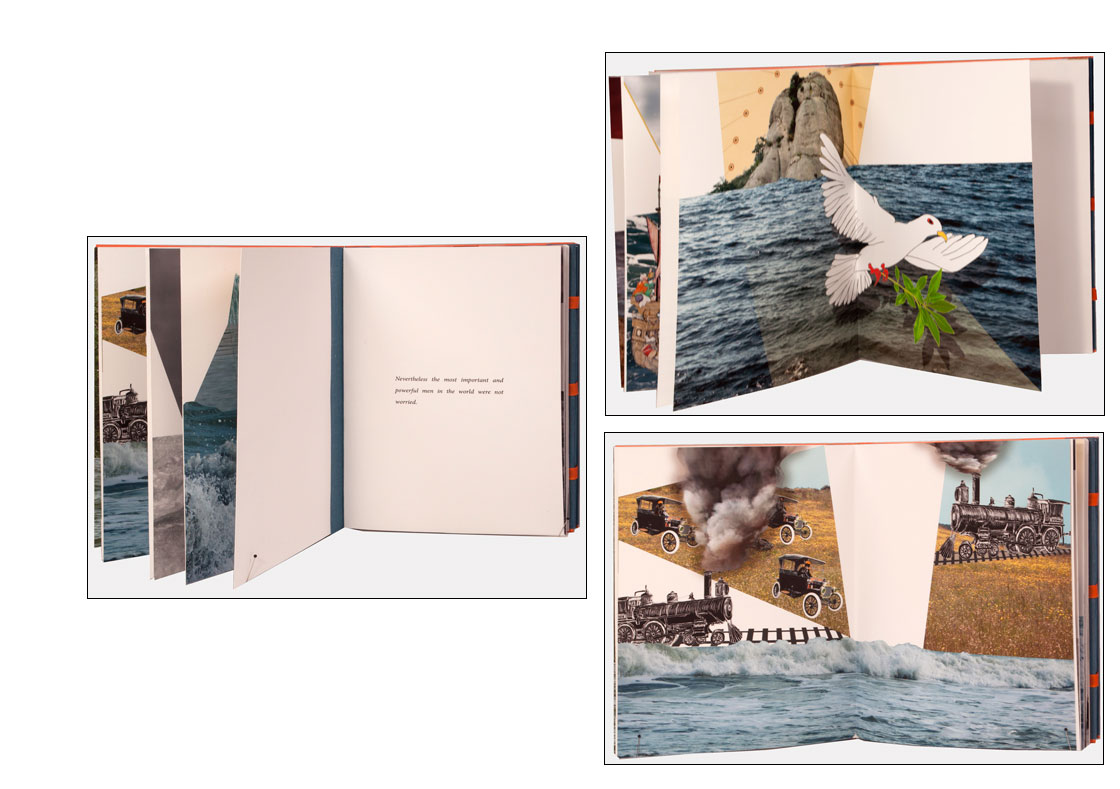
| Great Floods By Barbara Milman El Cerrito, California: Red Parrot Press, 2013. Edition of 10 + 2 artist's proofs. 10 x 8 x 1"; 72 pages. Dos-a-dos binding. Inkjet printed on Moab Entrada paper. Signed and numbered by the artist. Living in the San Francisco Bay Area, Milman sees the effects of climate change on the oceans and marine life. Her current body of work continues to deal with these observations. Barbara Milman: "A double artist's book. One side is a book about stories every culture tells about how the first humans, by their bad behavior, caused the gods to bring forth great floods that nearly destroyed the human race. The second book is about the great floods that we can expect in the near future, again caused by bad human behavior, in this case the profligate use of fossil fuels." (SOLD) |
 Click image for more |
|
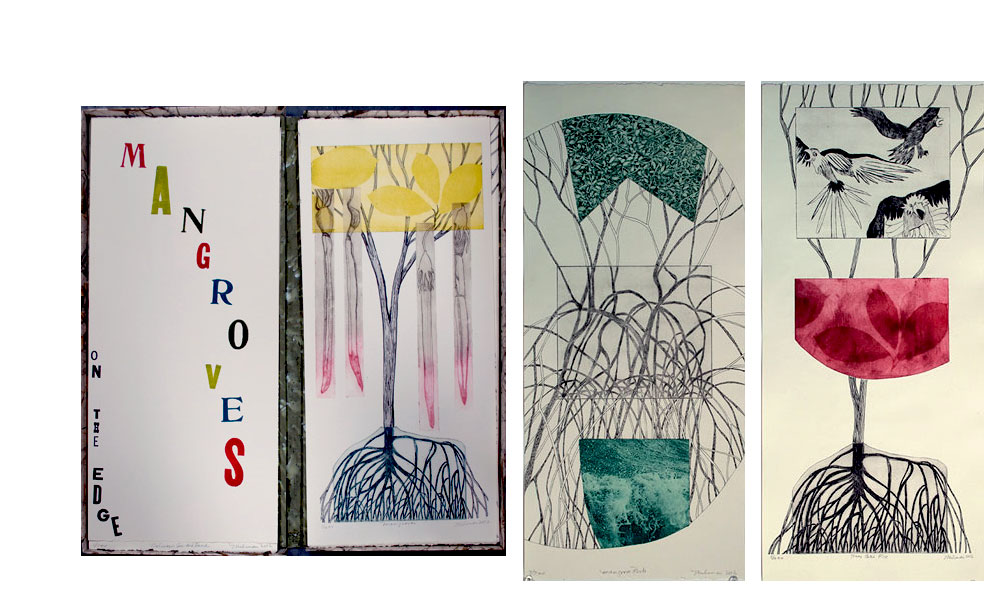
Mangroves on the Edge
|
 Click image for more |
|
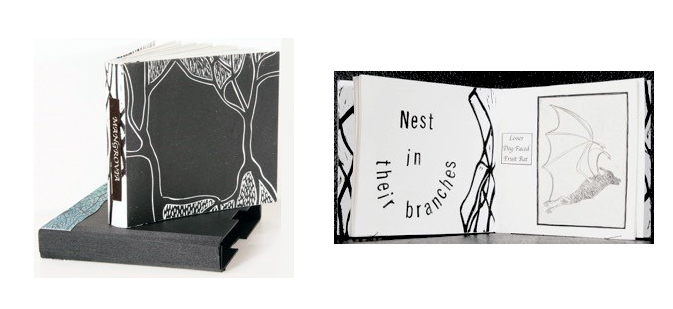
| Mangrovia By Barbara Milman El Cerrito, California: Red Parrot Press, 2014. Edition of 5 variants. 5 x 5.75"; 20 pages. Linocut and hand-stamped type on Stonehenge paper. Eight drypoints on handmade paper. Inkjet text on Mohawk Superfine paper. Illustrated wrappers with paper title on spine. In slipcase. Signed and numbered by the artist on the colophon. A combination of dry point etchings and linocuts captures threatened flora and fauna of the Florida coast, which are "heading north" trying "to outrun the heat." In the branches of mangroves animals nest "like passenger pigeons." The implications of climate change are unmistakable. (SOLD/Out of Print) |
||
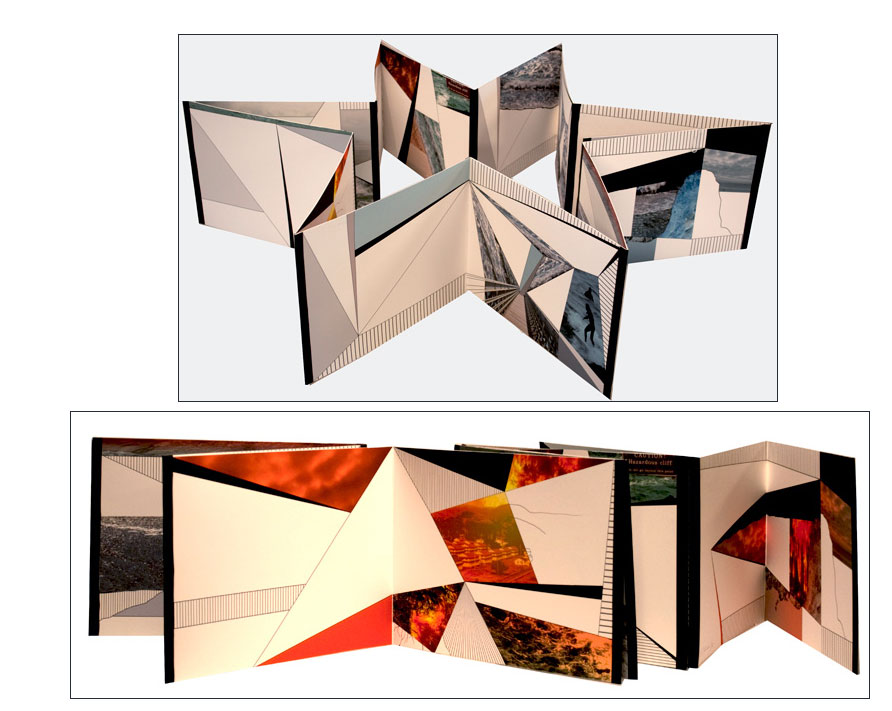
Marin Headlands 2010 16 x 11.75 x 1.5"; 26 pages. Double-sided accordion book (reversible), which can be opened into a 6-pointed star. Digitally printed. Housed in a box covered with blue-and-white cloth. Barbara Milman: "Living in the San Francisco Bay Area, I am constantly aware of the ocean. This is reflected in my current work, which is about the effects of climate change on the oceans and marine life. "These digital prints are based on photographs taken at the Marin Headlands just north of San Francisco. Abandoned military buildings, forts, and old artillery sites mix uneasily with nature trails, beaches and surfers. "One side has photographs from 2010. The other side has manipulated photos to show what 2050 is likely to look like as a result of climate change." |
 Click image for more |
|
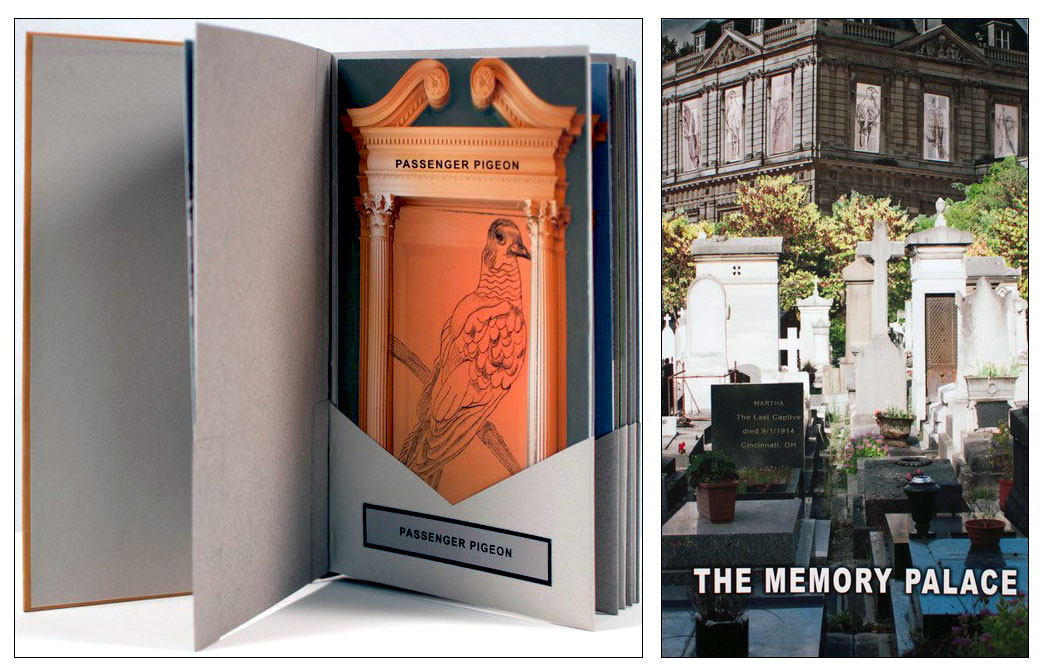
| The Memory Palace By Barbara Milman El Cerrito, California: Red Parrot Press, 2017. Edition of 5. 12 x 7"; 7 pocket pages. Original text, artwork, and design by Barbara Milman. Dry point intaglio and digital archival inkjet printed on Moab Entrada paper. Signed and numbered by the artist. Barbara Milman: "This book is about extinct birds of North America. The Memory Palace is a (fictitious) museum in which extinct birds live as if they were alive. The book has 7 bound pages, each with a pocket for the actual folded pages of the book. The first page … describes how the Memory Palace was established. There is a page for each of four extinct North American birds (Passenger Pigeon, Great Auk, Carolina Parakeet, Ivory-Billed Woodpecker - which may or may not be extinct) a page for a threatened, almost extinct California Condor, and a final page with an afterword and a colophon. Each of the pages, except the afterword, has three text components - a factual description, an interview with the bird, and a comment by the curator of the museum." (SOLD) |
 Click image for more |
|
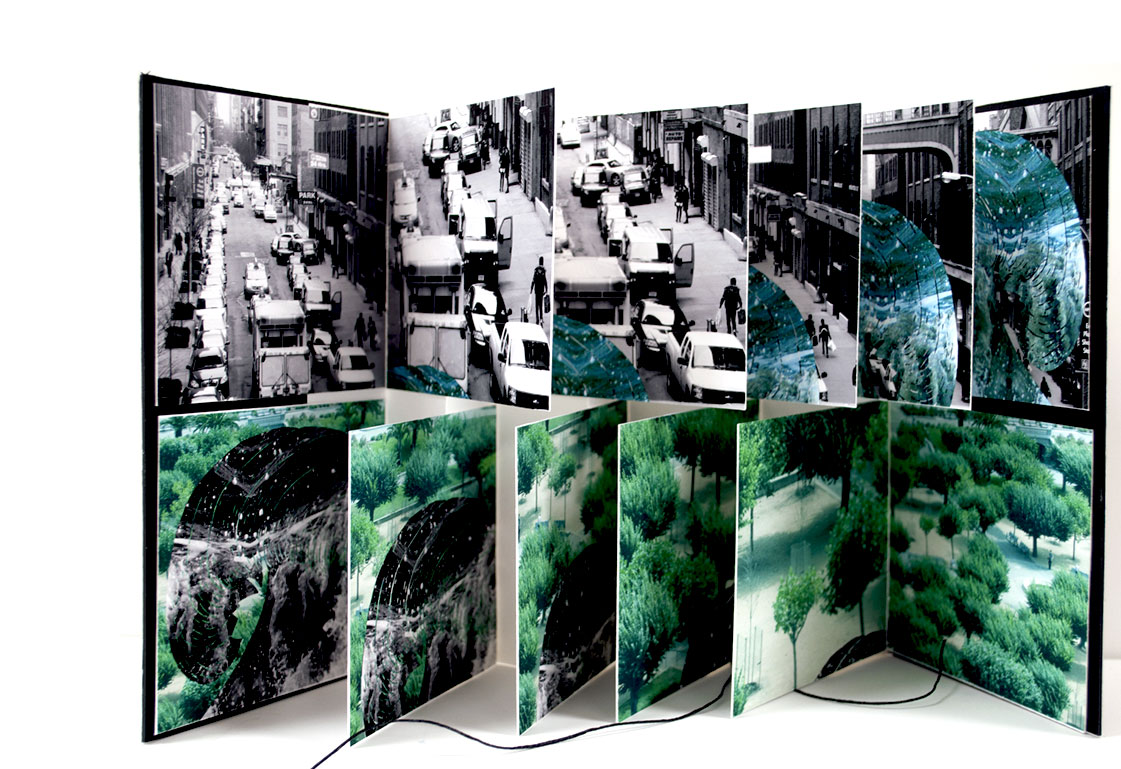
| Not Quite Drowning By Barbara Milman El Cerrito, California: Red Parrot Press, 2012. Edition of 11. 4 x 7.25"; 12 pages. Flag book structure. Digital printing. Tie closure. Signed and numbered by the artist. Barbara Milman: "The flag book is one of an edition made for a project in Australia called book art object. ... It is about the dangers of climate change - storms and floods, bi-coastal (images from San Francisco and New York City)." BookArtObject is a group of artists scattered around the world producing and sharing work based on texts. Not Quite Drowning was produced as part of the Fourth Edition of this project. Book artists were allocated one of the one hundred short story titles from Sarah Bodman's book An Exercise for Kurt Johannessen. Each artist used her title as a starting point to create a small editioned work. Not Quite Drowning, the title allocated to Milman, is title #77 on the list. (SOLD/Out of Print) |
 Click image to enlarge |
|
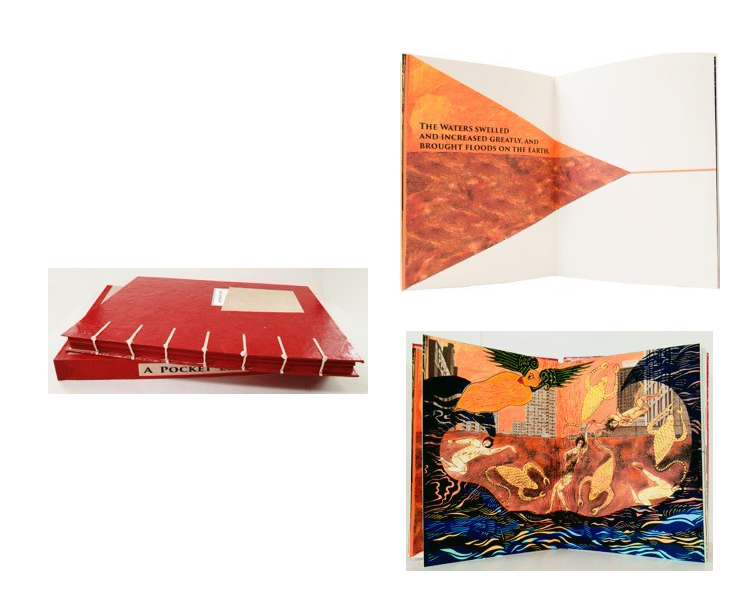
| A Pocket List By Barbara Milman El Cerrito, California: Red Parrot Press, 2015. Edition of 5 . 11 x 15"; 30 pages. Accordion extending from back pastedown. Digital printing plus linocuts and colored pencil. Incorporates images from 10th- and 11th-century Spanish illuminated manuscript version of the commentary on the apocalypse by Saint Beatus of Liebana. In slipcase. Signed and numbered on the colophon by the artist. This dire prediction is purportedly from the next millennium. Will it take that long? Barbara Milman: "This is a pun — say A Pocket List out loud & it sounds like — Apocalypse! "The title page says it is published by Revelation Press — this is a hint that the book is not factual — there is no such press, it is invented for this book only. It says it is published by Alert University in Alert, Nunavet, Canada. Alert is a real place, it is the northernmost permanently inhabited place in the world (this is explained on the colophon page). It is actually a small weather research center, with a miniscule population. Certainly no highways with addresses up to 29873. And, of course, no university where I could be a professor of ancient art and archeology. The date of my little introduction to the book is also a hint — November 2, 3491." (SOLD) |
 Click image for more |
|
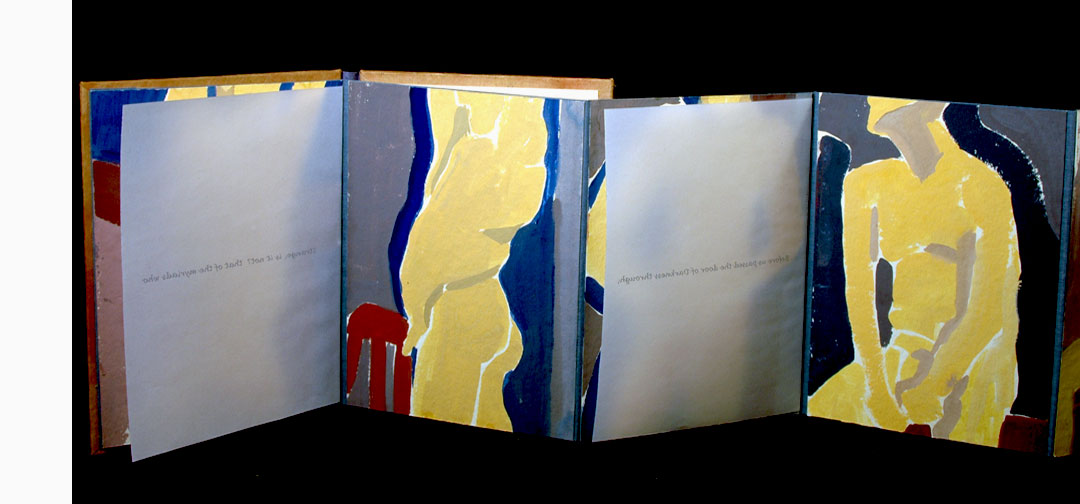
Strange is it not? 5.25 x 6.8"; 16 pages. Accordion fold. Text digitally printed. Illustrations original gouache paintings. Paper covered boards. Lines from the Rubáiyát of Omar Khayyam translated by Edward Fitzgerald paired with paintings of a male model. Text pages are printed on translucent paper so paintings are visible and surround the text.
(SOLD) |
 Click image for more |
|
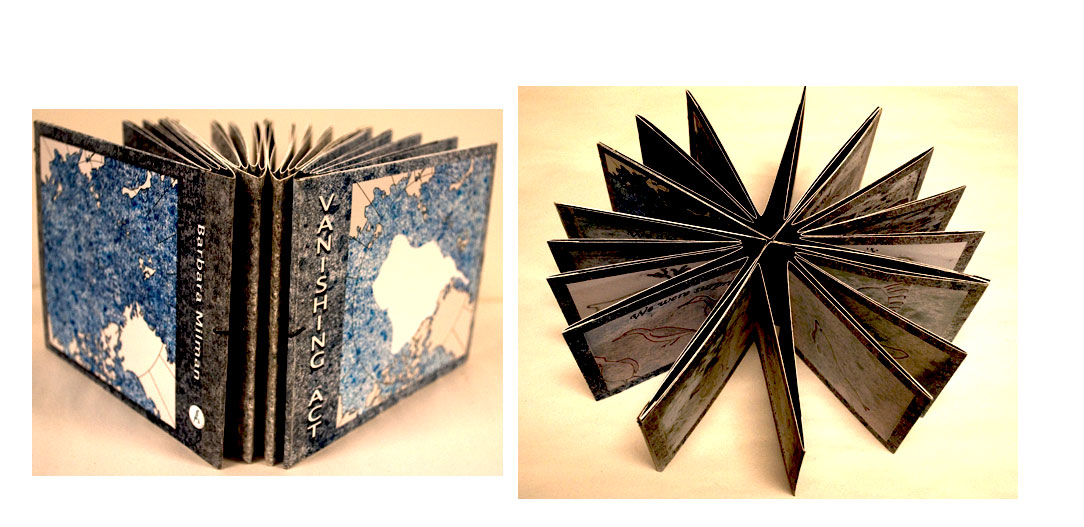
Vanishing Act 5.5 x 4.5 x 1.5"; 28 pages. Digitally printed. Modified star carousel structure. Ribbon closure. Barbara Milman: "This book is about how along with the vanishing of the summer ice in the Arctic due to climate change, many arctic species will be vanishing due to loss of habitat. Some of them need summer ice for breeding, some need cool temperatures to thrive, and others will not be able to compete with species that migrate northwards to the arctic to escape warming and drought." |
 Click image for more |
|
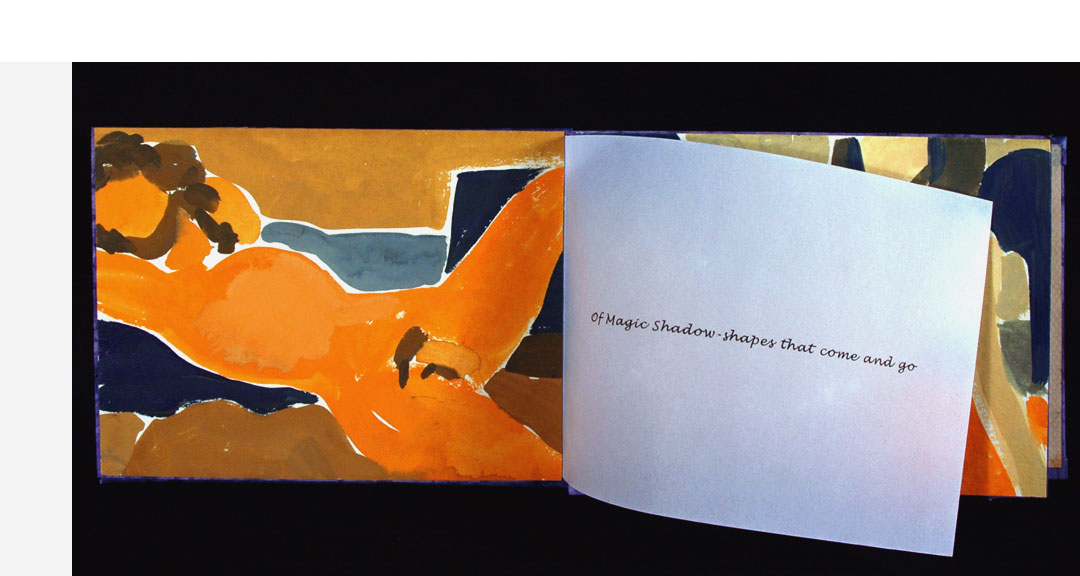
We are no more than a moving row 5.25 x 6.8"; 16 pages. Accordion fold. Text digitally printed. Illustrations original gouache paintings. Paper covered boards. Lines from the Rubáiyát of Omar Khayyam translated by Edward Fitzgerald paired with paintings of a female model. Text pages printed on translucent paper so paintings are visible and surround the text.
(SOLD) |
 Click image for more |
|
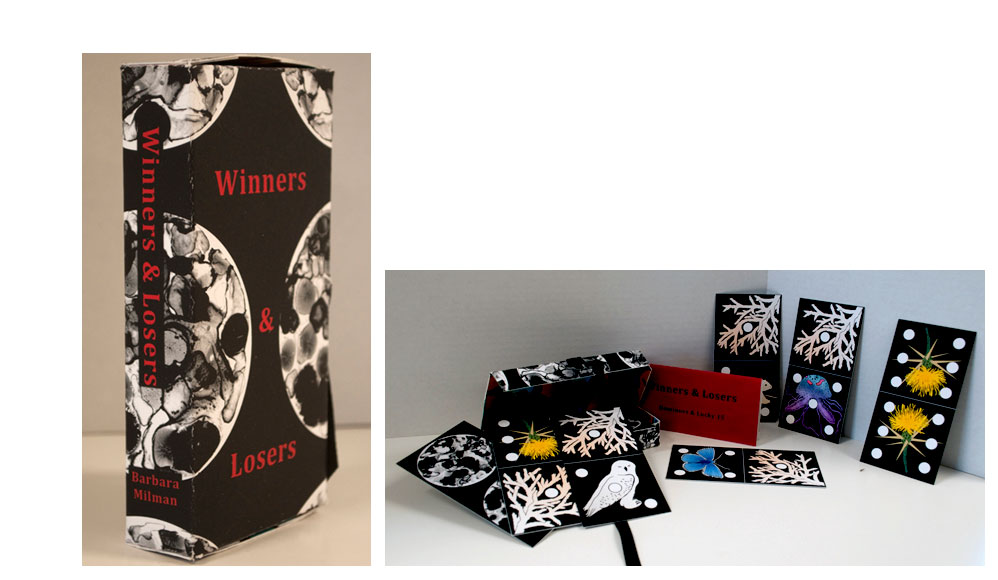
Winners and Losers 3 x 5.5 x 1" box with pamphlet and 28 double-sided cards. Black grosgrain ribbon closure. Digital printing. Pamphlet: 2.6 x 5.3"; 10 pages. Signed and numbered on the colophon in the pamphlet. Barbara Milman: "Winners and Losers is a set of 28 dominoes on the theme of climate change in a small box (book) with a booklet explaining the game and what the images on the dominoes are about. Each side of the domino represents a living thing threatened by climate change." "Climate Change is expected by scientists to increase the earth's "This will produce both winners and losers. Some species will thrive in hotter, more extreme climates, while many others will experience great difficulty adapting to more hostile environments. Losers will decrease in number, some to the vanishing point; winners will multiply and take over the world. Winners include yellow star thistles, mauve stinger jellyfish, and adonis blue butterflies. Losers include snow owls, polar bears, staghorn corals, and, of course, humans." |
 Click image for more |
|
Page last update: 03.12.2025

Home | About Us | Contact Us | New Arrivals | Fine Press & Artists' Books | Broadsides |Resource Books | Order/Inquiry
Copyright © 2021 Vamp & Tramp, Booksellers, LLC. All rights reserved.