
Purgatory Pie Press ~ New York |
Share this page: |
|
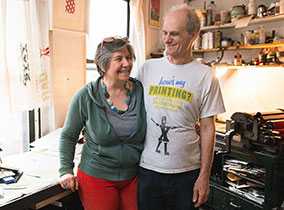 |
Richard Goodman, A Fine Press in the City: "Purgatory Pie Press is a husband and wife affair, with Dikko Faust the typographer and printer, and Esther Smith, his wife, the designer. The press is located in TriBeCa, in lower New York City, in rather cramped quarters that contain a small Vandercook Press, drawers of type safely tucked away, and everything else very much demonstrating various works in progress in different states of completion. ... The press’s work can probably be divided into two large categories: traditional books and accordion books. ... All Purgatory Pie Press books are collaborations. Esther Smith designs the books; Dikko Faust sets the metal and wood type by hand and prints on a 1930s Vandercook 4 letterpress. All are hand-stitched, hand-bound, signed, numbered, limited editions." | |
Bob & Roberta Smith books |
||
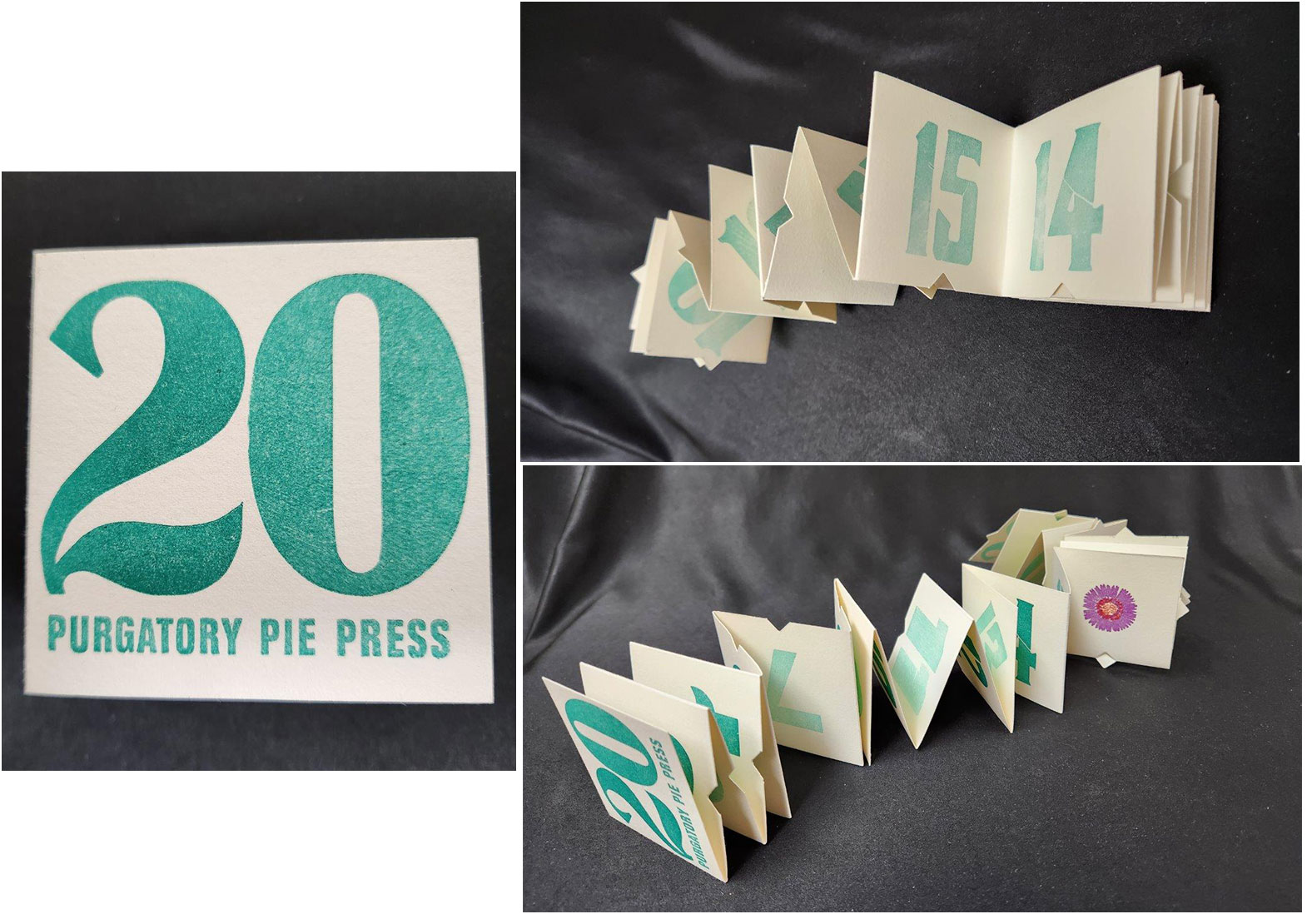
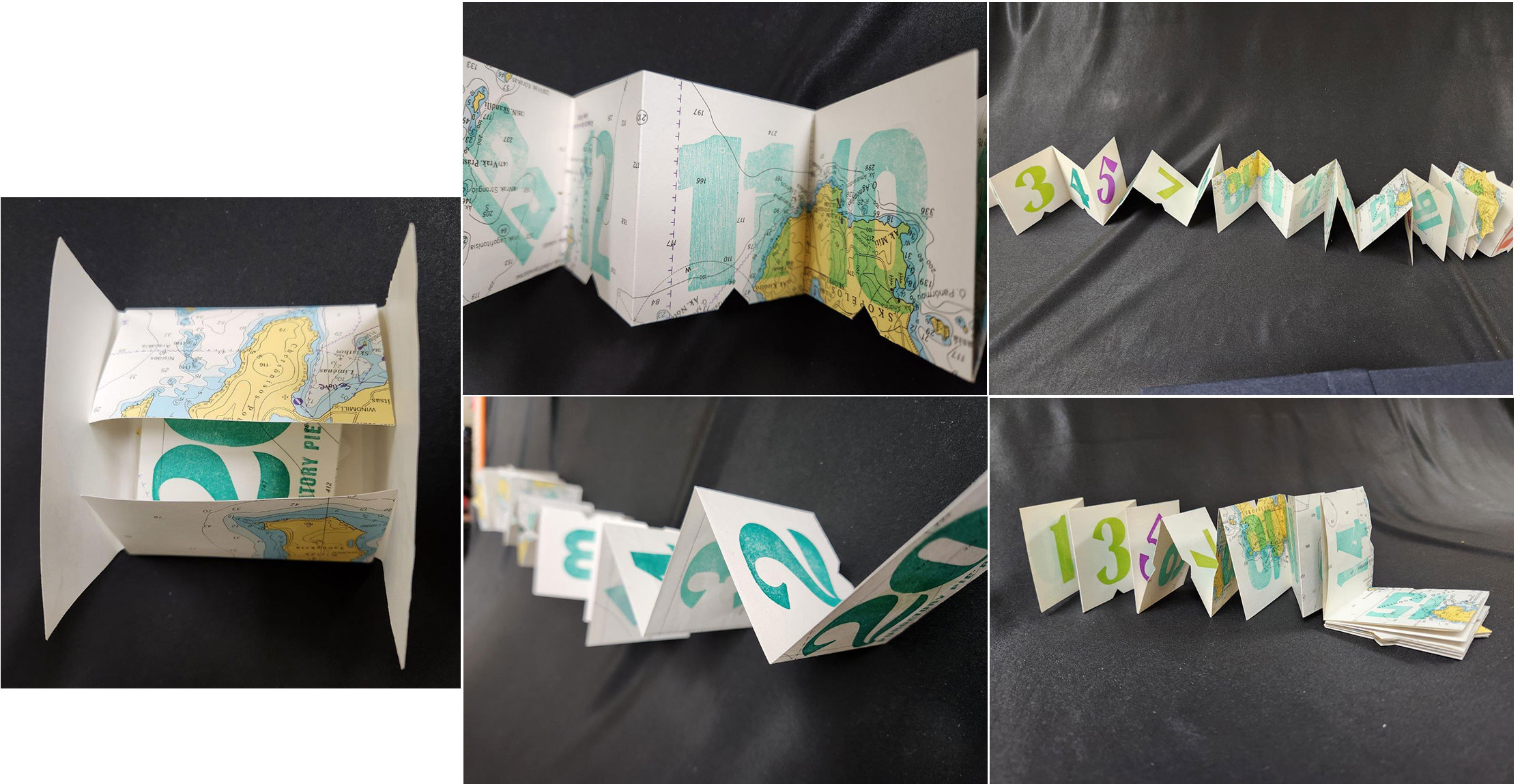
Twenty 3.25 x 3.25". Spiral accordion structure. Die cut. Wood type. Letterpress printed. Laid in folding wrapper of Greece sea charts. Concept and design by Esther K Smith. Typographer and letterpress printer by Dikko Faust. Signed by Smith. Numbered. Esther K Smith: "This project was a response to the number 20 for an exhibit we were in last summer [2024].... After our various alphabet books, we were happy to make a book of numbers." “Twenty” is another collaboration by husband and wife Dikko Faust and Esther K Smith. As Smith says “we bounce things back and forth until we are both happy.” $200 Sea Charts paper
|
Click individual image for more
|
|
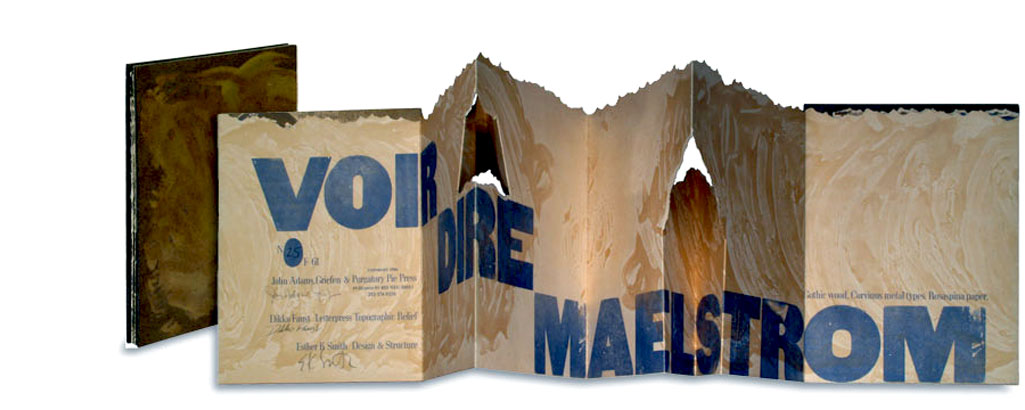
| Voir Dire Maelstrom By John Adams Griefen New York: Purgatory Pie Press, 1996. Edition of 61. 12 x 9" closed, opens to 72"; 6 pages. Accordion structure with pages attached at both ends to hand-treated masonite covers. Letterpress topographic relief on torn Rosaspina cream paper. Types: Gothic wood & Corvinus. Letterpress topographic relief by Dikko Faust. Design & structure by Esther K Smith. Voir Dire Maelstrom – collaboration between modernist artist (most know for his paintings) John Adams Griefen and book artists Esther K Smith and Dikko Faust. Can you sit on this jury? Unbiased? Non-narrative art? Modern art? Toward this … is it art? Richard Goodman, "A Fine Press in the City," Fine Books & Collections (September 2009): "... there is Voir Dire Maelstrom (1996), by John Adams Griefen, a large, appealing accordion book made of hand-treated masonite covers with hand-torn edges and pop-ups. It’s difficult to discern the author’s full contribution in this case, because the total extent of the text is the title. Nevertheless, the book somehow leaves you both entertained and bothered." $950 |
|
|
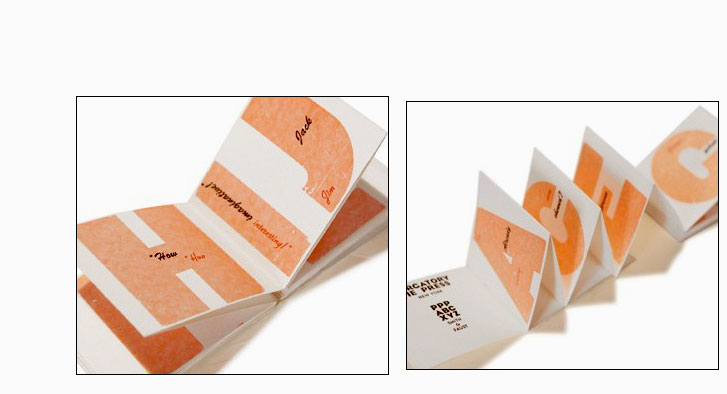
| PPP ABC XYZ By Esther K Smith and Dikko Faust New York: Purgatory Pie Press, 1989. Edition of 150. 4.25 x 3. 375"; 26 pages. Accordion. Handset and printed by Dikko Faust in Brush, Gillies Gothic, Ernhard Gothic, Eagle Bold and Anon Wood types. Printed on Prevence and Rives de Lin papers. Lexicography and design by Esther K Smith. An alphabet book from Purgatory Pie Press printed in a multitude of fonts. Comes in two paper versions - a version on white and one on recycled paper. Each version an edition of 150. $250 Prevence recycled paper $350 Rives de Lin paper |
 Click image for more |
|
| Susan Happersett has plotted numerical properties that allow her to study the characteristics of functions, sequences and series in a visual language. Using the Fibonacci Sequence which is derived by adding each new number in the series to the previous number (i.e., 2, 3, 5, 8, 13, 21...), she has developed several books demonstrating these characteristics via visual arts. | ||
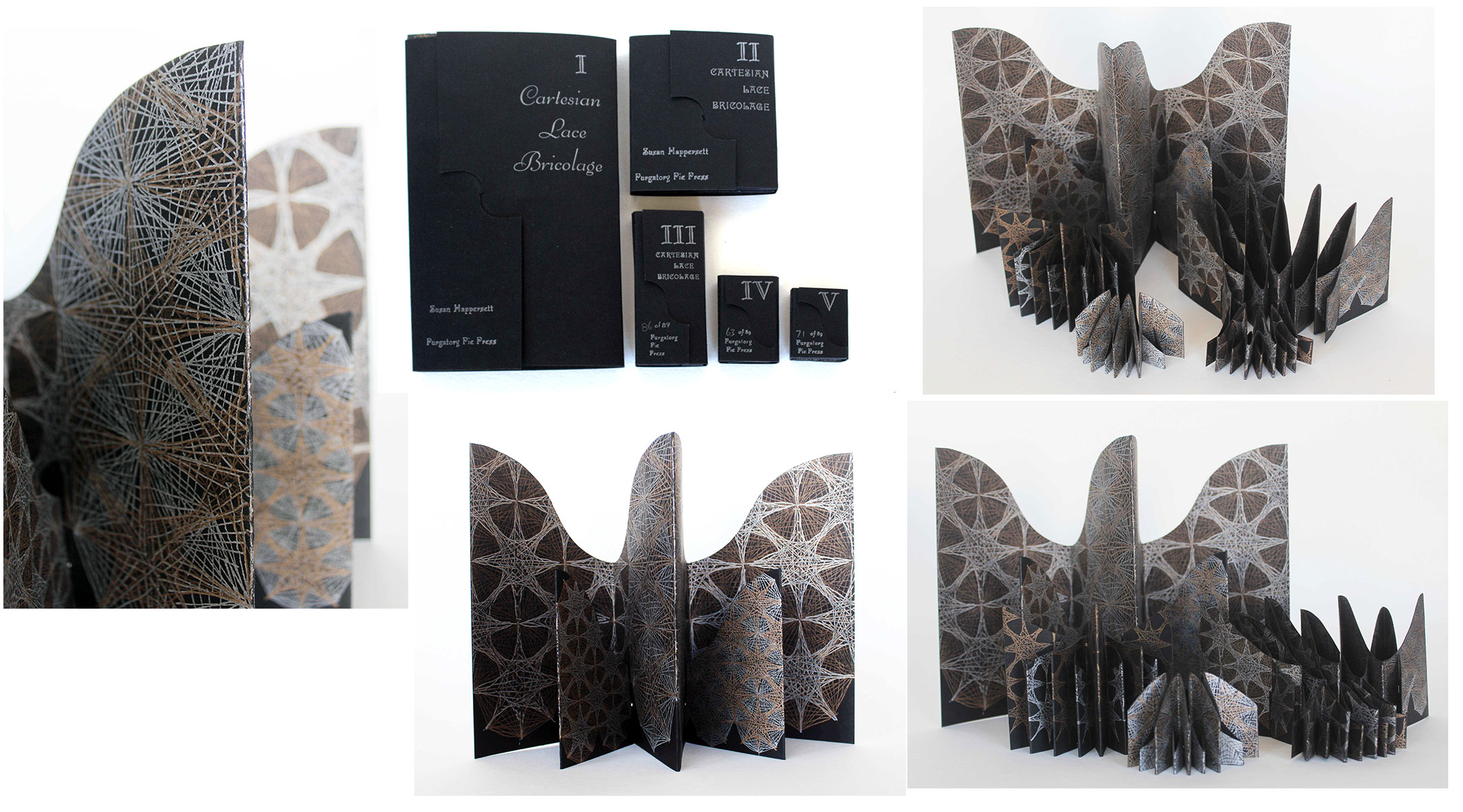
Cartesian Lace Bricolage 23 x 38 x 18 cm. Materials: Ink, Paper. 5 volumes. Drawings and engineering by Susan Happersett. Artistic direction and design by Esther K Smith. Letterpress handset type + die cuts by Dikko Faust. Numbered. Susan Happersett: "The five sculptural books feature letterpress prints of my Cartesian Lace drawings in two size scales and a variety of overlapping configurations. The construction of these pieces incorporates a new syncopated intertwined double accordion structure that I have been developing over the past year." Purgatory Pie Press: “’Cartesian Lace Bricolage’ is a collaboration between Susan Happersett and Purgatory Pie Press. This series of five limited edition letterpress artist's books features Susan's Cartesian Lace drawings. Two distinct tilings create a complex arrangement of patterns. Both tilings are grids of mappings on the Cartesian coordinate system (x, y, z axes). One is a bijective mapping, the other a non-bijective mapping. We cut and folded the prints to form a new book structure we invented: Syncopated Intertwined Double Accordions.” Susan Happersett, Semantic Scholar, Cartesian Lace Drawings: "The author explores the genesis of her new series of mathematically inspired drawings. Based on mappings between sets of points on the Cartesian coordinate system, and combining multiple elements in a single drawing, the author creates hand-drawn patterns and tessellations with a lace-like quality. This is the story of how my interest in the visualization of network mapping lead to new artwork. Technical diagrams illustrate different types of mapping phenomena. Applying graphing techniques taught in high school math classes I illustrate these basic relationships, then proceed to layer and build lace-like patterns. This work creates a link between technical diagramming techniques like network diagrams, and the traditions of hand work like lace making. The developmental process for this new type of drawing began with the axes of the Cartesian coordinate system’s two-dimensional plane. I plotted the first few sets of points on both axes bounding quadrant I. Then I proceeded to map a point from the x-axis to a point on the y-axis using a bijective mapping, drawing a line segment to connect the points." |
|
|
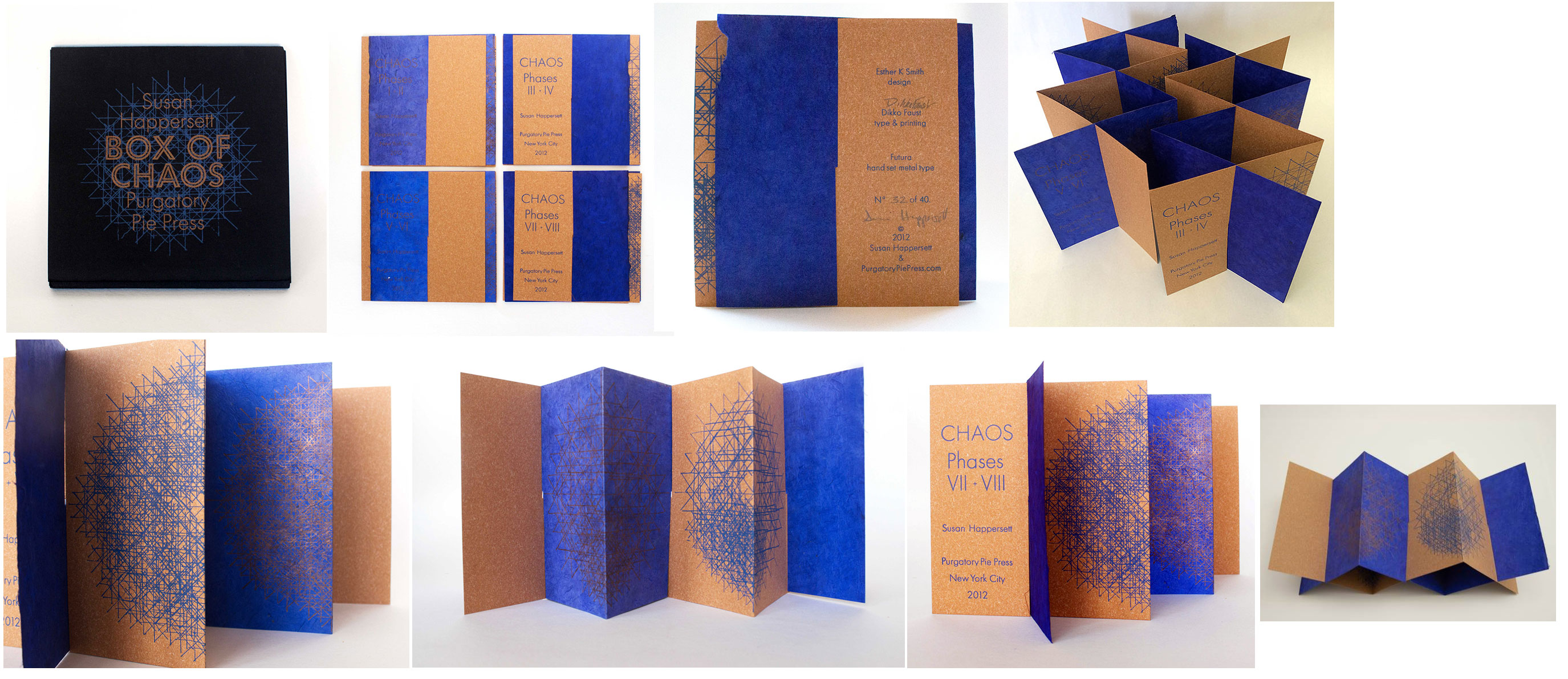
| Box of Chaos By Susan Happersett New York: Purgatory Pie Press, 2012. Edition of 40. 7" x 7"; 8 interlocking sculptural interactive accordions. 4 pieces, each 7" x 7". Standing, lined up: 21" x 7" x 4". Printed on Nepali Lokta paper in Futura handset type. Housed in a black cardstock box titled in gilt on the spine panel. Signed by designer, printer, and artist. Susan Happersett: "My Chaos Theory drawings illustrate the underlying patterns and order within what appears at first to be complete disorder or 'Chaos.' I achieve this effect by making a simple pattern through numerous iterations using a stencil. The extra space in the stencil that allows my pen to move freely creates a small margin of error which over the course of the iterations creates the cloud like chaotic patterns" Susan Happersett, blog: "My fascination with mathematics and my love of visual arts has led me on a journey to build a link between mathematics and drawing. It has become my mission to express the intrinsic aesthetic value of Mathematics in a purely visual language. I use a number of graphing and geometric plotting techniques to examine the aesthetic characteristics of functions, sequences, and series in a visual language. My drawings are an intense accumulation of lines and mark making resulting from my predisposition to counting. Through the years my drawing has become a type of meditation. "In my Chaos Theory-inspired drawings, I illustrate the order and pattern within the seemingly chaotic mass of lines. I spent many months making a stop motion video of the creation of a Chaos drawing. I would have to step away from the drawing after every line. This pause in drawing made me look at the work in progress and at numerous times I realized that the drawing was visually interesting throughout its creation. So I decided to make a book where you could see the drawing at different stages. I created a series of hand-drawn books, but my most recent Chaos project is a letterpressed edition Box of Chaos published by Purgatory Pie Press in NYC. Box of Chaos consists of four folded paper structures illustrating 8 phases of chaos." $1,200 |
|
|
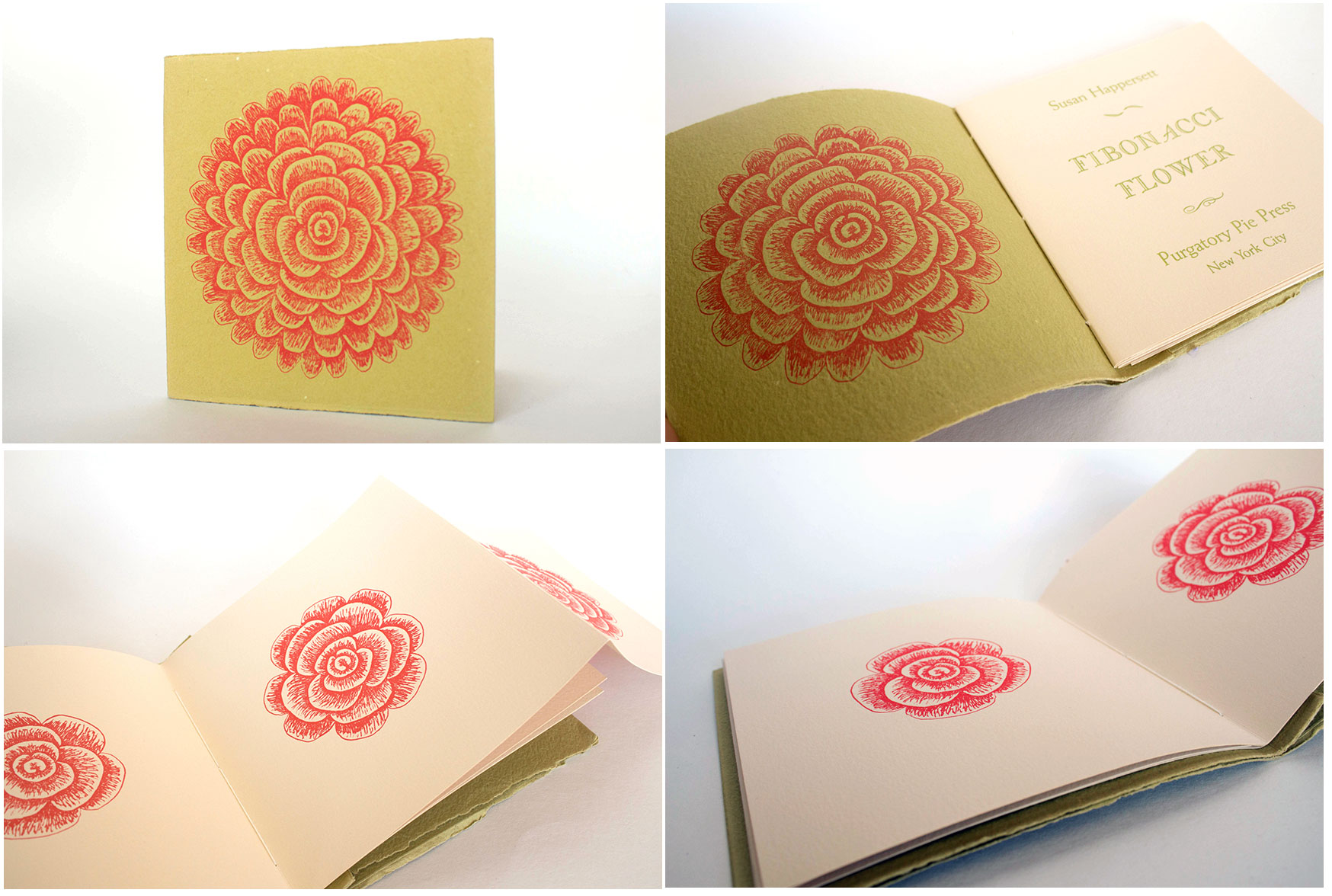
Fibonacci Flower 7.125 x 7.125"; 10 pages. Progression of hand generated flowers presented in a combination accordion-and-sewn binding that displays the Fibonacci Sequence in action. Wrapped in a folded cardstock case printed with the same flowers. Weiss Roman, Sylvan, Gallia, Raleigh Cursive, Modern #20, and Derby types. Arches and St. Armand paper. Design and structure by Esther K Smith; letterpress and hand typography by Dikko Faust; hand generated flowers by Susan Happersett. Susan Happersett: "Fibonacci Flower is an artist book made up of letterpress prints of drawings. In each drawing I have mathematically generated a flower, using the Fibonacci Sequence to determine the number of petals in the outer ring of each bloom. On the first page there is one petal inside on petal. On the next page, the flower grows with a new ring of two petals. The next page [shows a] three-petal ring, then five, eight, up to 34 petals. Fibonacci Flower has a unique structure that is a combination of an accordion and a sewn binding, that allows the viewer to see two or three consecutive Fibonacci flowers at the same time." |
 Click image for more |
|
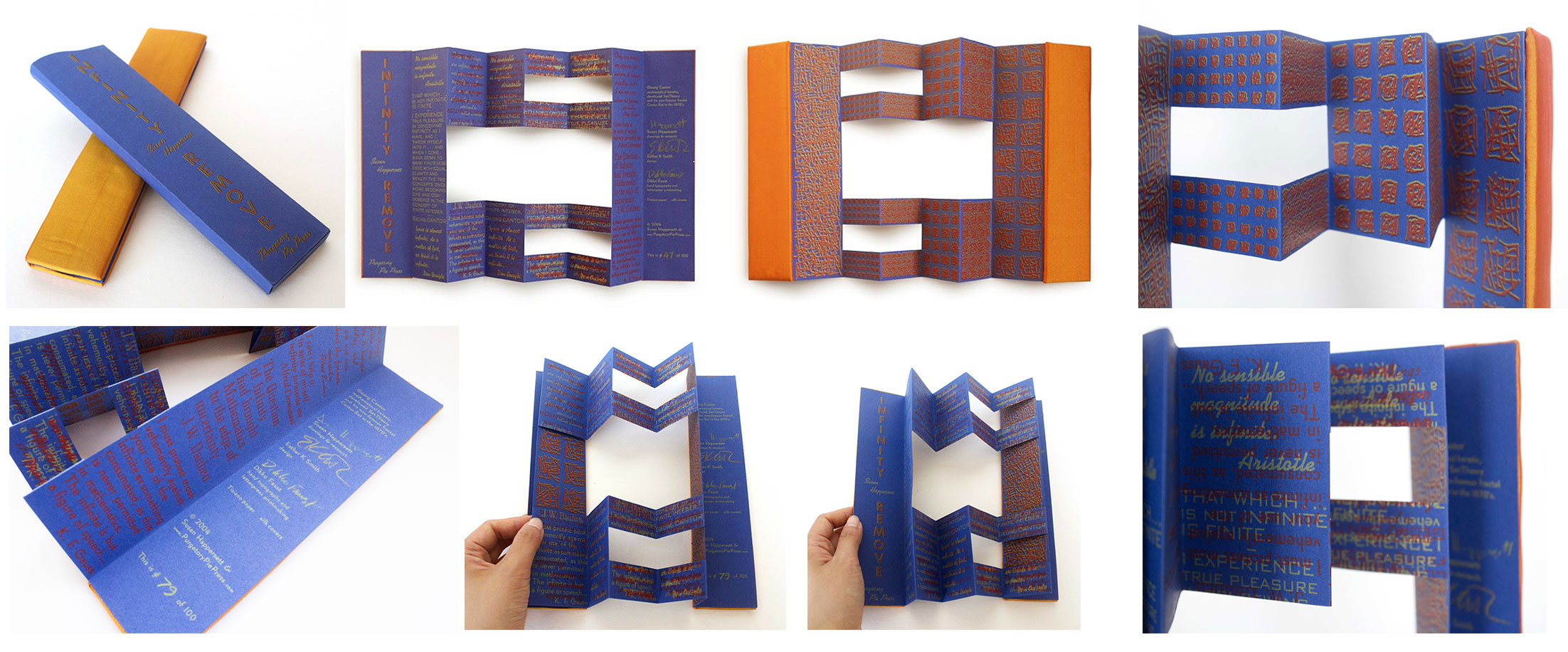
Infinity Remove 2 x 9" with six accordion cut-out pages. Bound in orange silk covers. Housed in Blue Tiziano paper slipcase with orange and yellow titles. Drawings and research by Susan Happersett. Designed by Esther K Smith. Hand typography and letterpress printmaking by Dikko Faust. This lovely orange and blue tall book includes quotes from a number of famous and infamous people on infinity including Georg Cantor. Cantor, considered a mathematical heretic at the time, developed Set Theory and his now-famous fractal Cantor Set in the 1870's. No sensible magnitude is infinite. Space is almost infinite. As a matter of fact, we think it is infinite. ~Dan Quayle I can't help it, in spite of myself, infinity torments me. That which ... is not infinite is finite. - I experience true pleasure in conceiving infinity as I have, and I throw myself into it ... and when I come back down toward finiteness I see with equal clarity and beauty the two concepts once more becoming one and converging in the concept of finite integer. ~Georg Cantor |
|
|
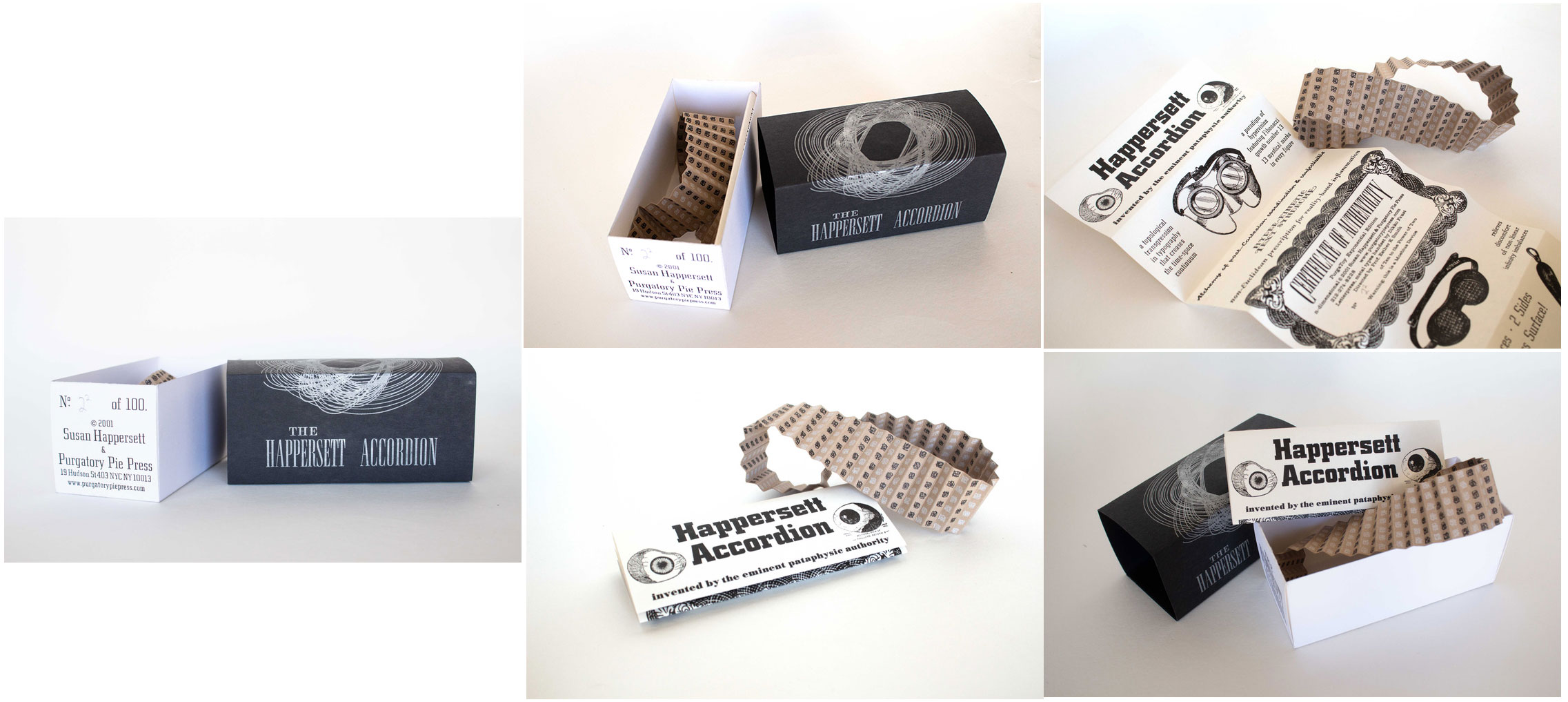
The Happersett Accordion 3-D object of one paper Möbius strip in box (15 x 7 x 7 cm). Strip of stiff brown paper with black markings on one side and white markings on the other, creased into accordion folds and glued together at the ends to form a Möbius strip. Features black markings on one side and white markings on the other side of a brown strip, with 13 markings, or strokes, per grid square. A Möbius strip, or band, is the one-sided surface that results from joining together the two ends of a long strip of paper after twisting one end 180 degrees. The new version of Happersett's Möbius accordion features black markings on one side and white markings on the other side of a brown strip, with 13 markings, or strokes, per box. A novel twist on the Möbius strip which Happersett describes as a Möbius accordion. Each unfolded copy comes with a droll certificate of authenticity along with assembly instructions and the mandatory warning that the product is a mind boggling "Möbius device." |
||
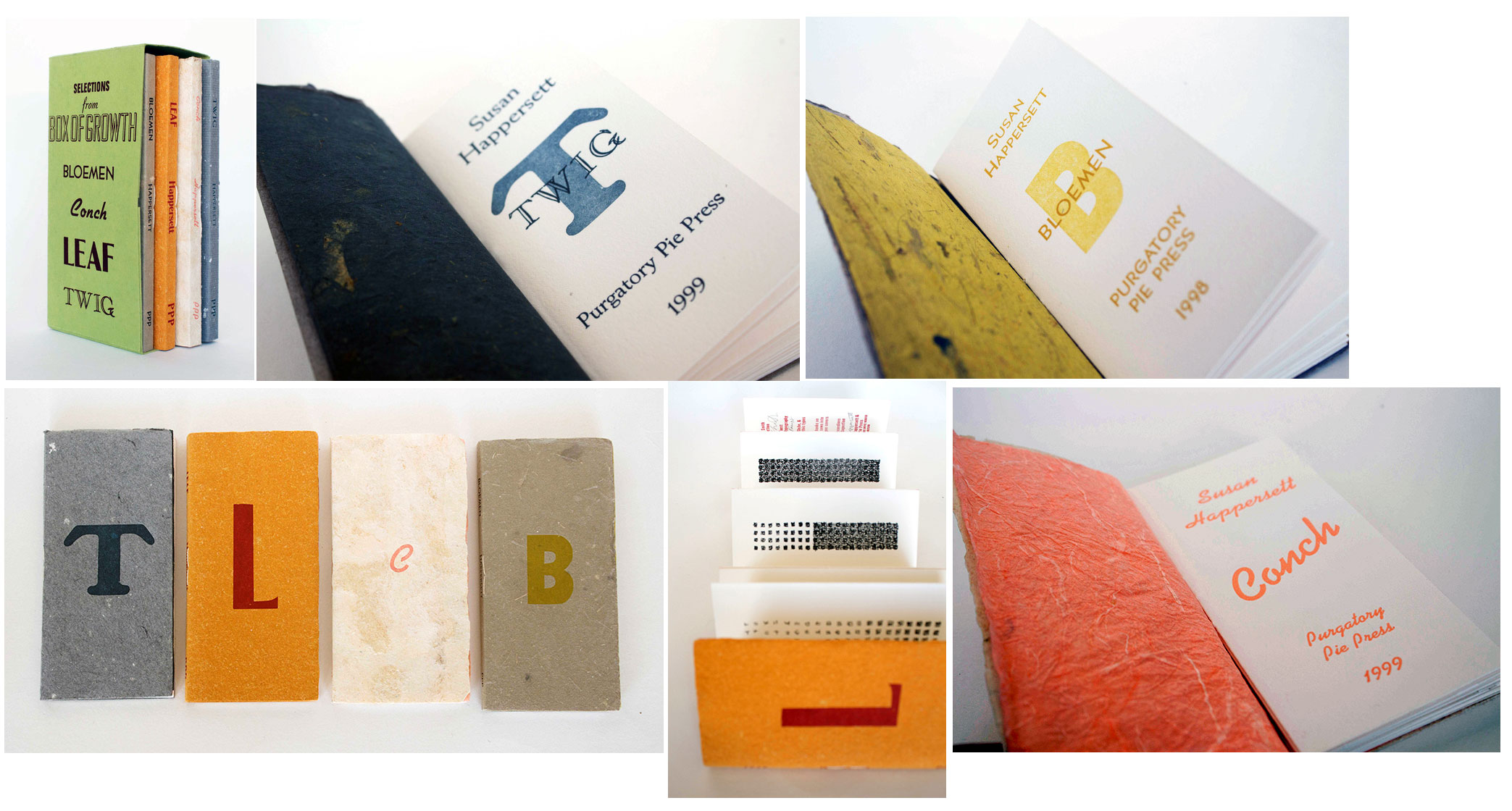
Quartet 6.4 x 3"; 4 books. Each is one sheet, accordion folded and hand-sewn into handmade paper cover. All four booklets cased in a handmade paper enclosure. Johannot rag papers. Bloemen: Bernhard Gothic type; Conch: Kaufmann Bold type; Leaf: Modified, Globe, and Alternative Gothic types; Twig: Weiss, Sylvan, and Hamilton Post Oldstyle types. Susan Happersett: "Many of the mathematical sequences in my work involve growth patterns. One series of drawings is based on the correlation between plant growth and the Fibonacci Sequence (1,1,2,3,5,8,13,21,34,...) I have also incorporated binary code, explored self-similarity, and chaos theory. Through these drawings I hope to reveal the grace and balance in the mathematics of nature and technology." Box of Growth is four handmade books, each about a particular occurrence of the Fibonacci sequence in nature: growth and decay patterns of sunflowers (Bloemen); the growth patterns of conch shells; the growth patterns of leaves; and the growth and decay patterns of twigs. The books use a visual language of grids composed of marks increasing in Fibonacci progression (1 line, 2 lines, 3 lines, 5 lines), arranged to represent patterns of growth and decay. All books use a similar abstract representation of the sequence, but each book uses different colors, fonts, paper textures, end papers, and layout on the final page — variation within pattern and repetition. |
|
|
| Books of poetry | ||
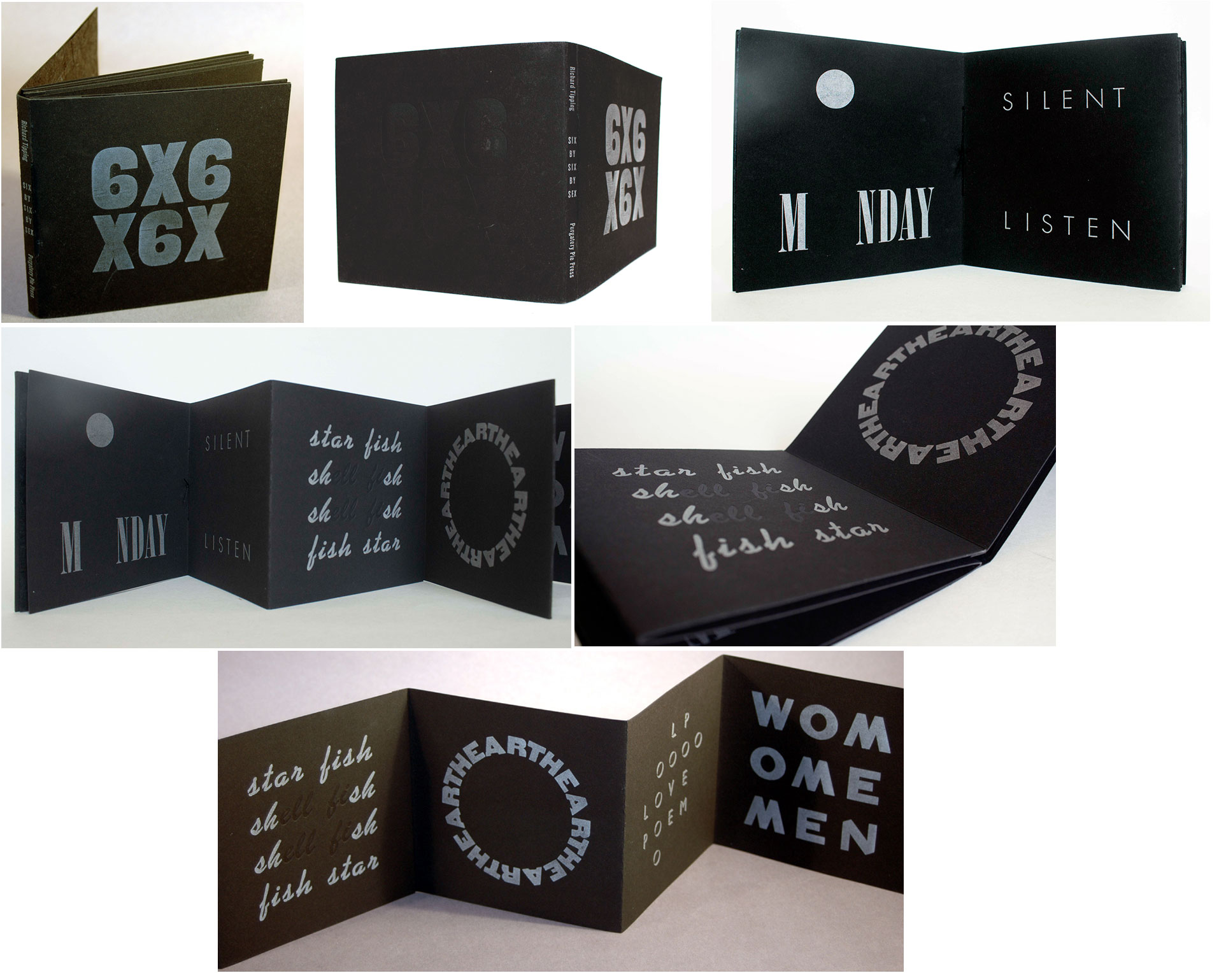
6x6x6 6 x 6"; 8 pages. Accordion book. Handset wood and metal type printed on black museum board. Titles printed on front and back covers.
|
 Click image for more |
|
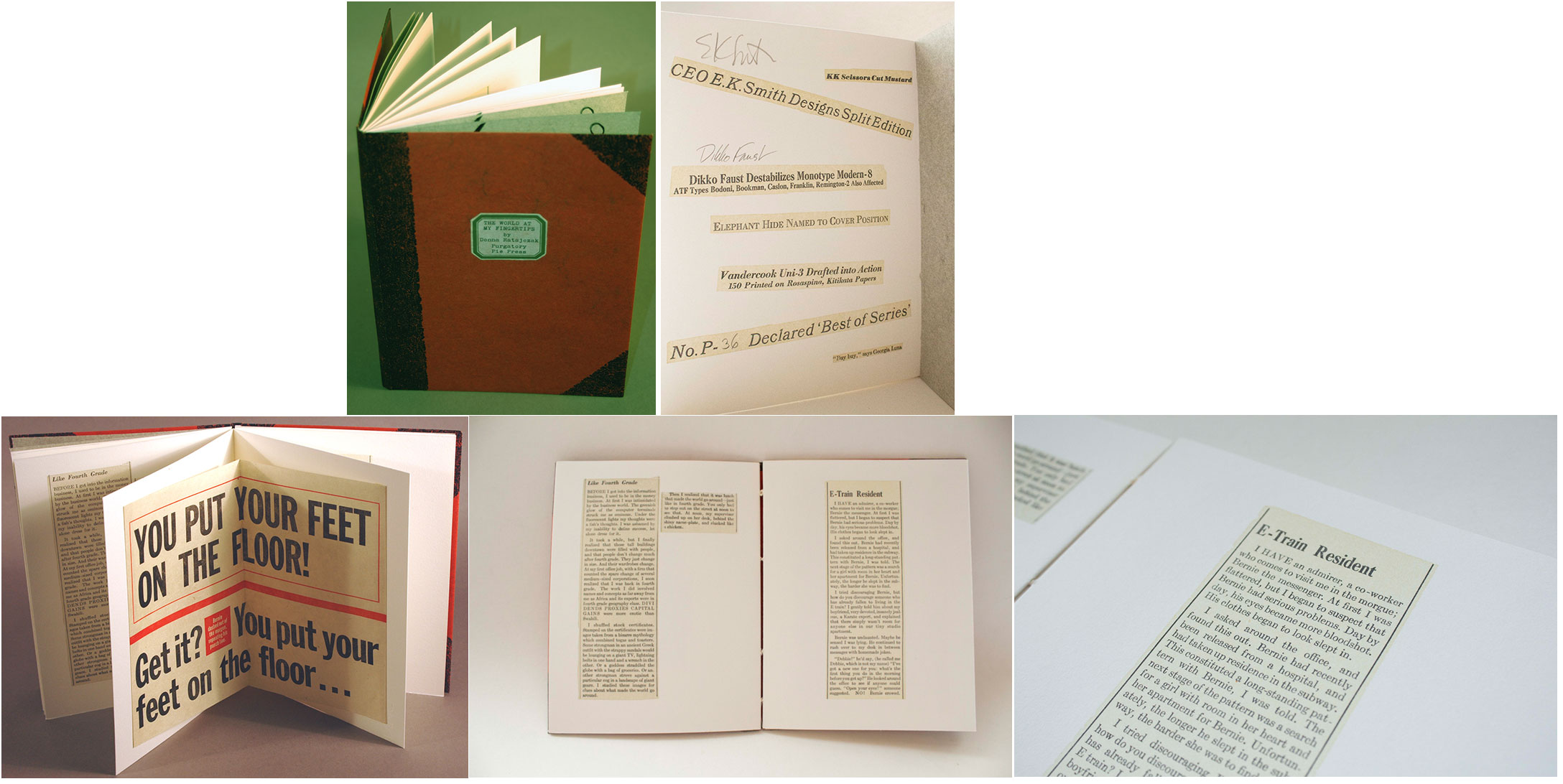
The World at my Fingertips
|
 Click image for more |
|
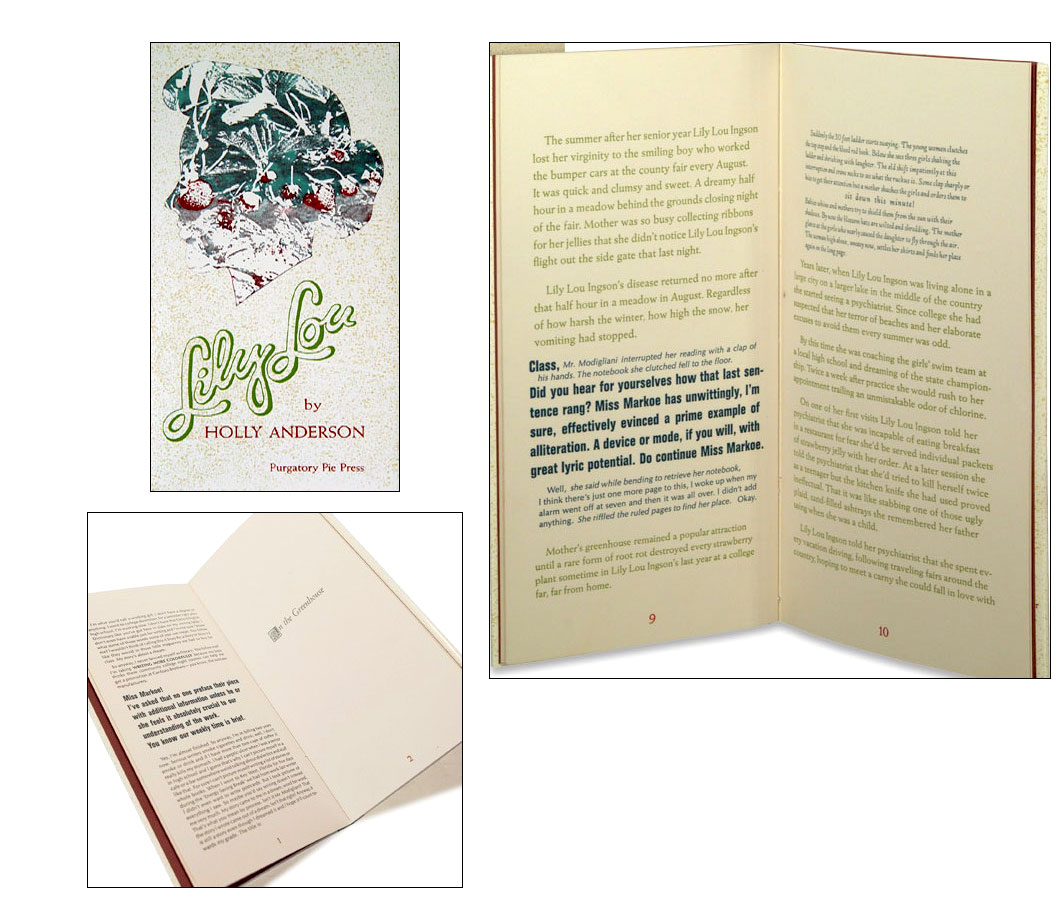
Lily Lou 12 x 6"; 16 pages. Printed letterpress using Weiss Roman foundry type on Phoenix Imperial Paper. Profile printed in two-tone Purgacolor. Background printed from Dikko-made sandpaper. Bound in paper-covered boards with illustrated dust jacket. Signed by Anderson.
|
 Click image to enlarge |
|
| Assemblages of several items by artists for Purgatory Pie Press | ||
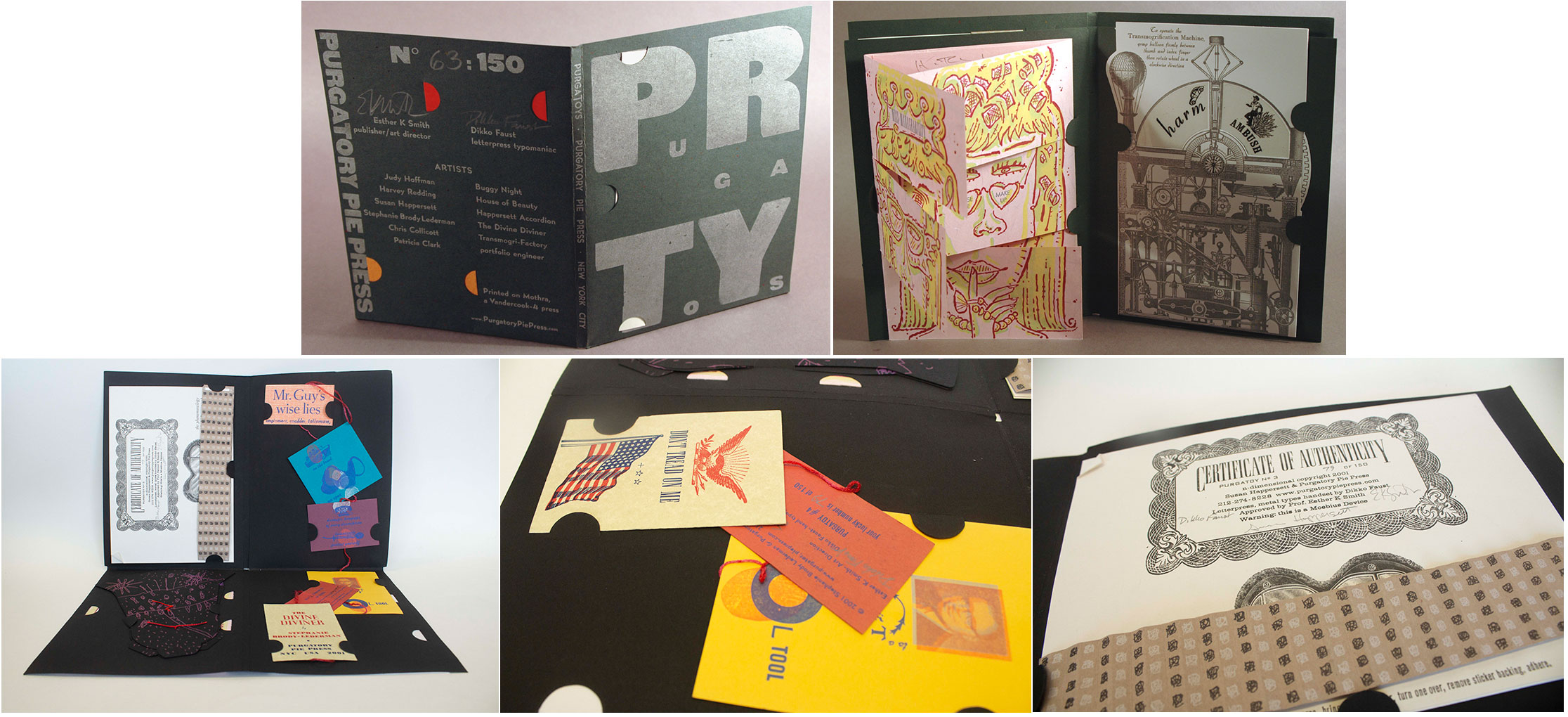
Purgatory Subscription 9.5 x 6.75" folded wrapper that holds the five toys in individual tabs made into the paper. Five toys in the set: Buggy Night by Judy Hoffman (1999) Miss Manageability by Harvey Redding (2000) The Happersett Accordion by Susan Happersett (2000), a single surface Moebius strip which folds to reveal two distinct chiaroscuro faces. The Divine Diviner by Stephanie Brody Lederman (2001), six "pages" hanging by a thread. Magic Postcard. Transmorgri-Factory by Chris Collicott (2004), a magic wheel postcard. $450 |
 Click image for more |
|
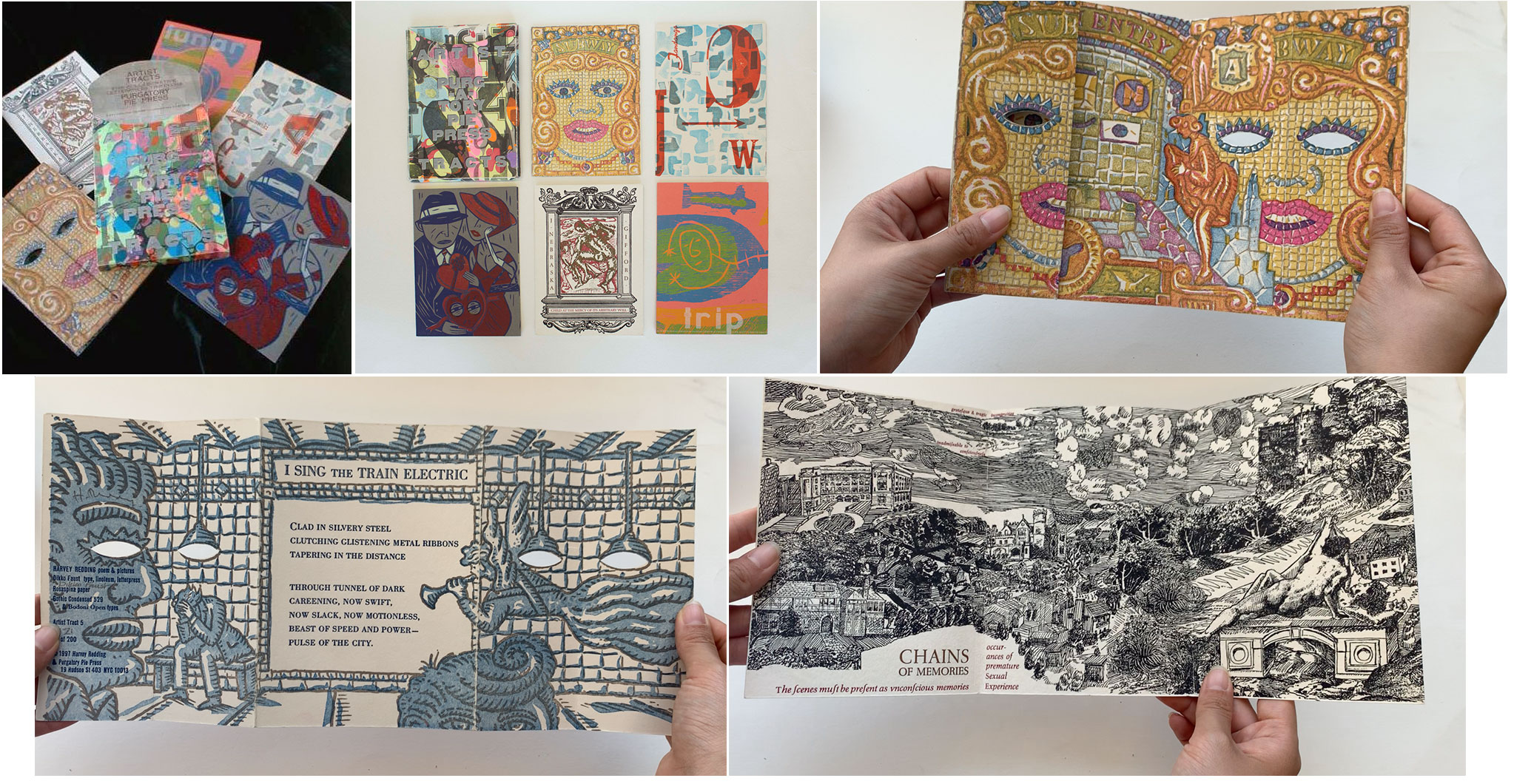
Artist Tracts Boxed set of five juxtapositional triptychs. 7 x 5" tracts open to 7 x 15". In paper box 7 x 5 x 1/2" by Lauren Rowland which is Day-Glo Rococo hand marbled over pied wood type. Signed and numbered. Concept and design by Esther K Smith. Fascinated with those folded religious pamphlets, Esther K Smith envisioned Artist tracts. Triptychs: I Sing the Train Electric by Harvey Redding Fandango by Laura Murawski Chains of Memories by J. Gifford Window Pain by Melinda Beck Flood trip map by Wim Huurman $450 |
||
| In 2004 Purgatory Pie Press began a series of Insta-Books. | ||
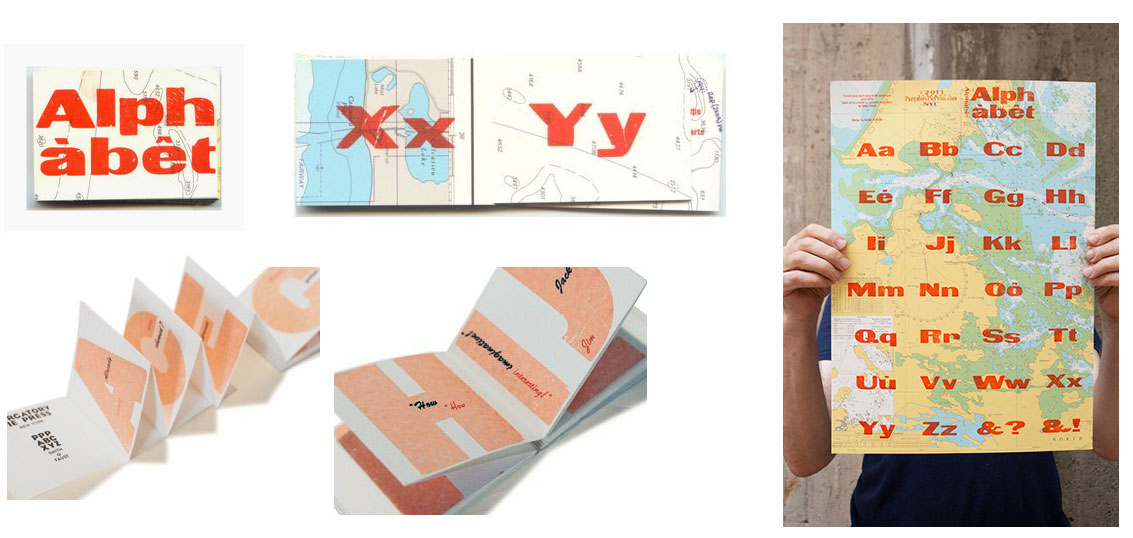
| French Alphabet By Esther K Smith and Dikko Faust New York: Purgatory Pie Press, 2011. Edition of 40. 3" x 2 .5" closed, extends to 104.25"; 32 pages including self-wraps. Letterpress with French sans serif extra wide wood type circa 1925 and printed on obsolete sea charts by Dikko Faust. Design by Esther K Smith. Signed and number by the artists. One folded continuous sheet of obsolete sea charts. Faust used extra-wide French wood type, circa 1925, to letterpress print the alphabet, printing both upper and lower case of each letter. $45 |
 Click image for more |
|
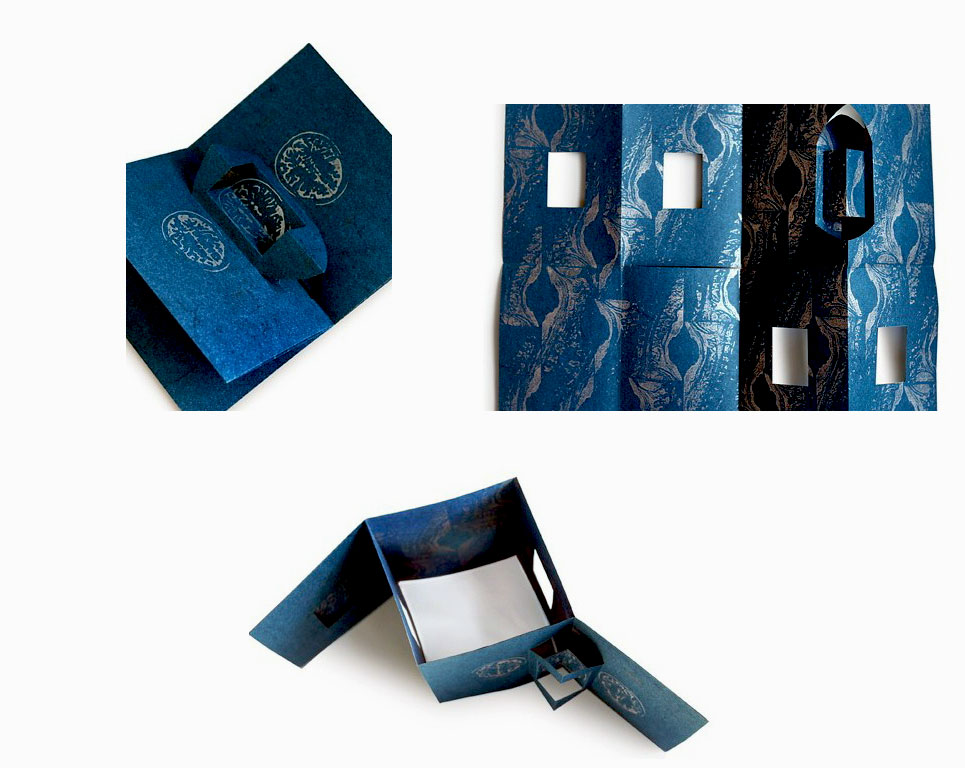
| Brains & Spines By Jesse Nebraska Gifford New York: Purgatory Pie Press, 2005. Edition of 200. 4.75 x 6.75"; 8 pages. One sheet book. Letterpress. Handset metal types: Agency Gothic Open, Bank Gothic and Horizon Italic. Jessie Nebraska Gifford (1932) artist and printmaker collaborated with Purgatory Pie Press to produce this one sheet editioned book as part of her MS Series. The book was conceived by the artist; the basis of the images and text are MRI scans of her brain and spine. Esther K Smith composed the poetic text as well as the book design. Dikko Faust handset the text from metal type and made photopolymer plates from Gifford's scans. Esther Smith: “Autobiographical artist Jessie Nebraska Gifford (1939) collaborated with Purgatory Pie Press to produce this one sheet editioned instant book. The book was conceived in a collaboration among the three artists, referencing Gifford's computer-based work she had been making with her MRI scans. The images are printed from photo-engravings made directly from MRI scans of Gifford's brain and spine. Esther K Smith wrote the poem and designed the book. Dikko Faust letterpress printed from his hand-set metal type and the photopolymer plates he made from Gifford's scans. Brains & Spines is the second book in Purgatory Pie Press's InstaBook series.” $165 |
 Click image for more |
|
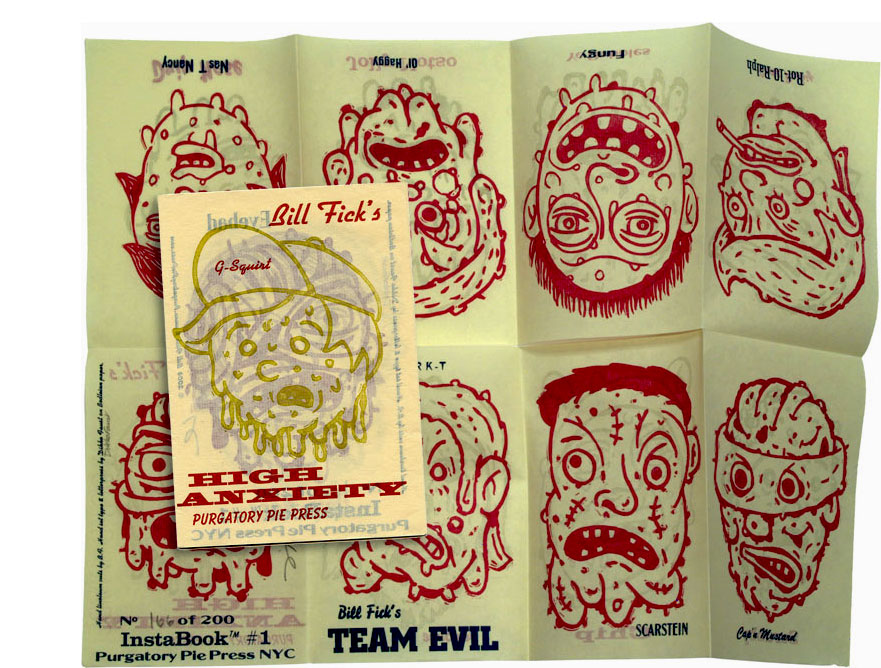
| High Anxiety / Team Evil By Bill Fick New York: Purgatory Pie Press, 2004. Edition of 200. 7 x 4. 75" closed, unfolds to 14 x 19". One sheet book. Printed letterpress on Bodleian paper with metal typefaces: Gillies Gothic, Kaufman Bold, Balloon, Craw Clarendon, Globe Gothic, Signal, Egyptian Wide, Tower, Folio Bold Condensed, Dom Casual, City Compact Bold, Brush, Wedge Gothic, Corvinus. Handcut linoleum images. The first book in Purgatory Pie's InstaBook series. The press calls this an inside out book. It is a one sheet book featuring gruesome characters. Team Evil images are printed on the inside pages and High Anxiety faces are printed on the folded pages. The Team Evil pages are not revealed until the book is unfolded. The High Anxiety faces are folded as pages to be turned through. High Anxiety images are melting faces like "Drip Nose" while Team Evil are strong prints like "Eyebad." Bill Fick is a printmaker who lives and works in Chapel Hill, North Carolina. He is currently a Visiting Assistant Professor at Duke University in the Department of Art, Art History, and Visual Studies. Bill Fick: "Printmaking has a long tradition of narrative satire. My work follows this tradition while also drawing upon elements of comics, cartoons, and popular culture. Linocut is the perfect medium for making super graphic images." $150 |
 Click image for more |
|
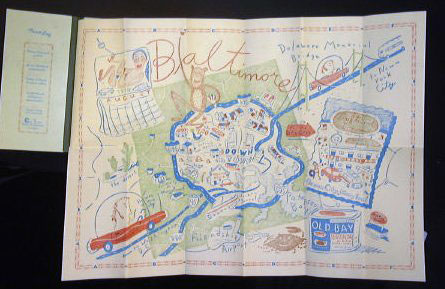
Travelog Map & Guide 18.75 x 26" map folds to 9.4 x 4.4 x .25 guide. Types used Kabel & Kaufmann Bold with green, blue & red on pale yellow Bodleian. Signed by Ratajczak; Hartland; Esther K Smith; and Dikko Faust. Join Arthur in his journey through life "Points West." Arthur is "thinking of driving cross-country in his Corolla... He gets a bunch of road maps from gas stations. He files them in the glove compartment." Travelog tells the story of a rather sad-sack parole officer named Arthur, whose movements are charted in a jaunty fold-out map. |
|
|
| Books of Bob & Roberta Smith [pseudonym of artist Patrick Brill] | ||
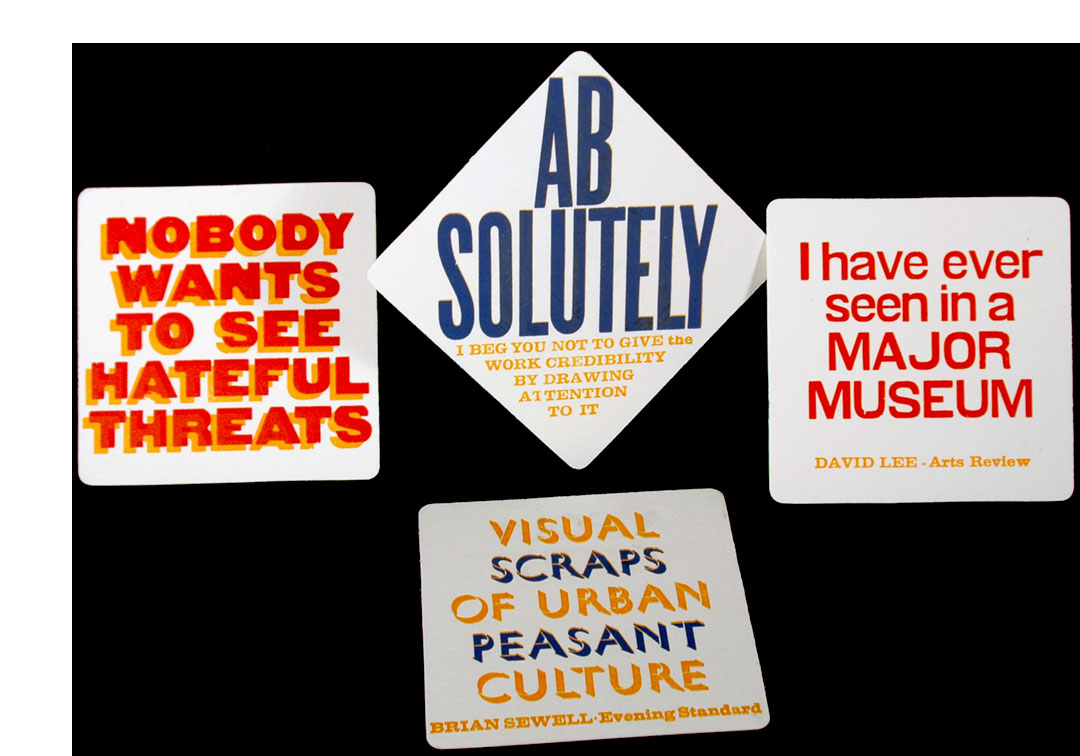
| The Critics Rave! By Bob & Roberta Smith [Patrick Brill] New York: Purgatory Pie Press, 2003. Edition of 30. 4 coasters, each 4 x 4". Both sides of each coaster letterpress printed by Dikko Faust. Band title slip on with colophon. Bob and Roberta Smith versus the London Tabloid art critics. Bob & Roberta Smith is the pseudonym of British contemporary artist Patrick Brill (born 1963). This set of four coasters introduces a new typeface by Dikko. This is one of several collaborations between Brill and Purgatory Pie Press. Aesthetica Magazine, July 2009: "He studied at the University of Reading and Goldsmiths College London. [Patrick Brill] invites us to question high art, and the role that aesthetic elitism has to play in society today. At the core of his practice Bob & Roberta Smith asserts that art can and should be an essential tool in the democratic process. He shows work internationally, with recent shows in Italy and the United States, and at Tate Britain." $150 |
 Click image for more |
|
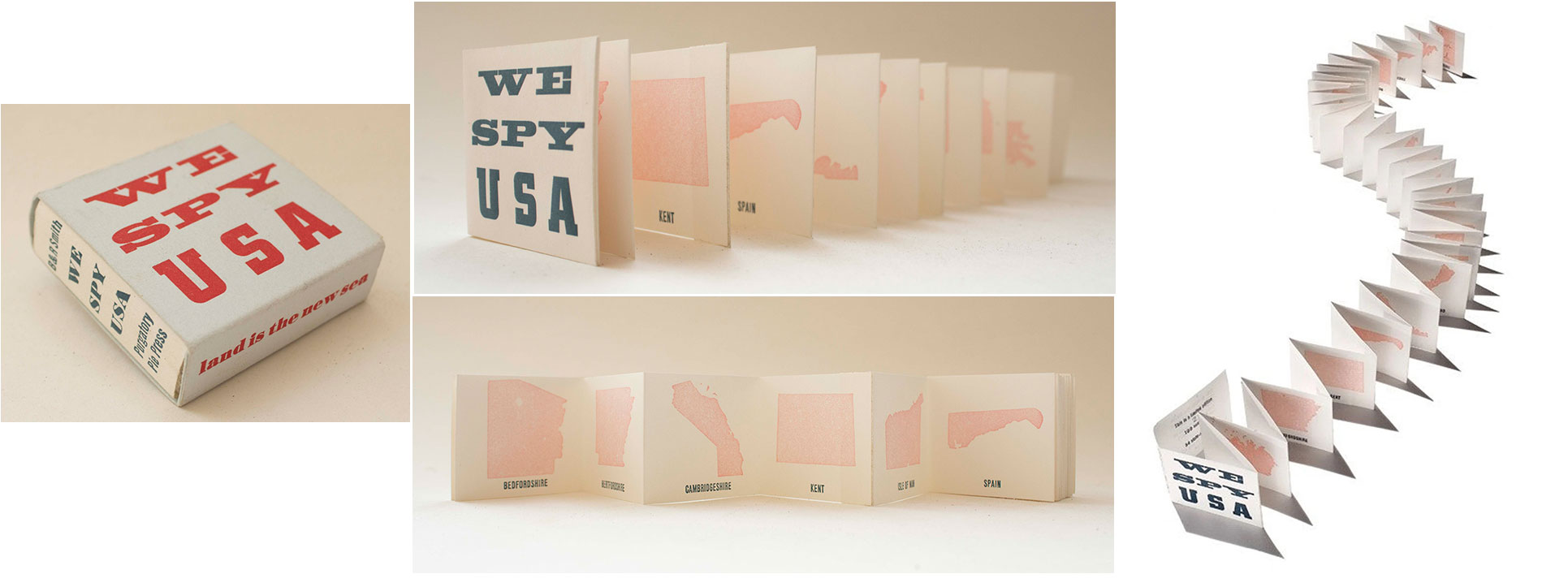
We Spy USA |
 Click image for more Click here for the link to Instagram |
|
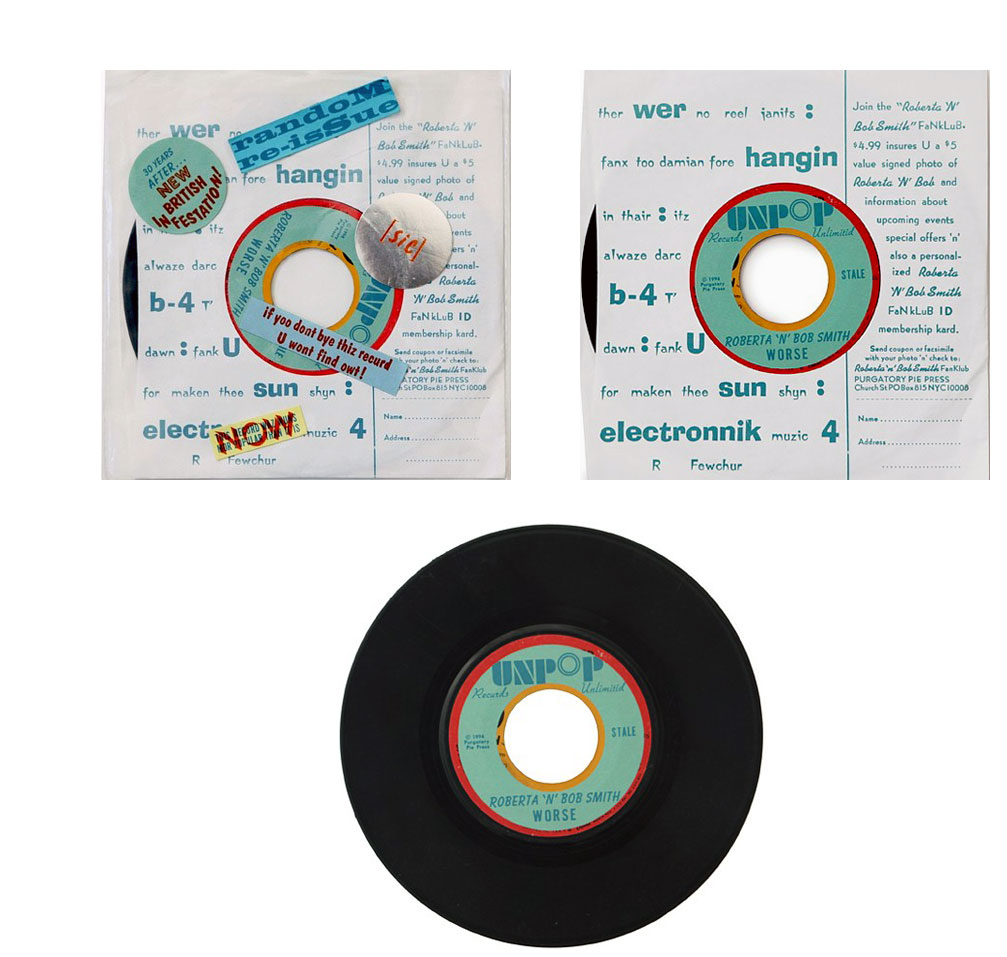
| Unpopular Recurds By Bob & Roberta Smith [Patrick Brill] New York: Purgatory Pie Press, 1994. 7 x 7" clear plastic sleeve with 45 rpm record slipped in a paper record sleeve. Letterpress printed by Dikko Faust. Text and labels designed by the artist. Designed by Esther K Smith. Signed by the artist. An original 45 rpm (of unknown titles) is appropriated and revisioned here by applying new labels. The original labels are covered by letterpress printed labels reading "Roberta 'n' Bob Smith, Lame!" on one side and "Roberta 'n' Bob Smith, Worse" on the other. Bob & Roberta Smith is the pseudonym of British contemporary artist Patrick Brill (born 1963). Brill also performs music, often with a group known as The Ken Ardley Playboys, who had their first 45 released by Billy Childish on his label Hangman Records, a British independent label. $450 |
 Click image for more |
|
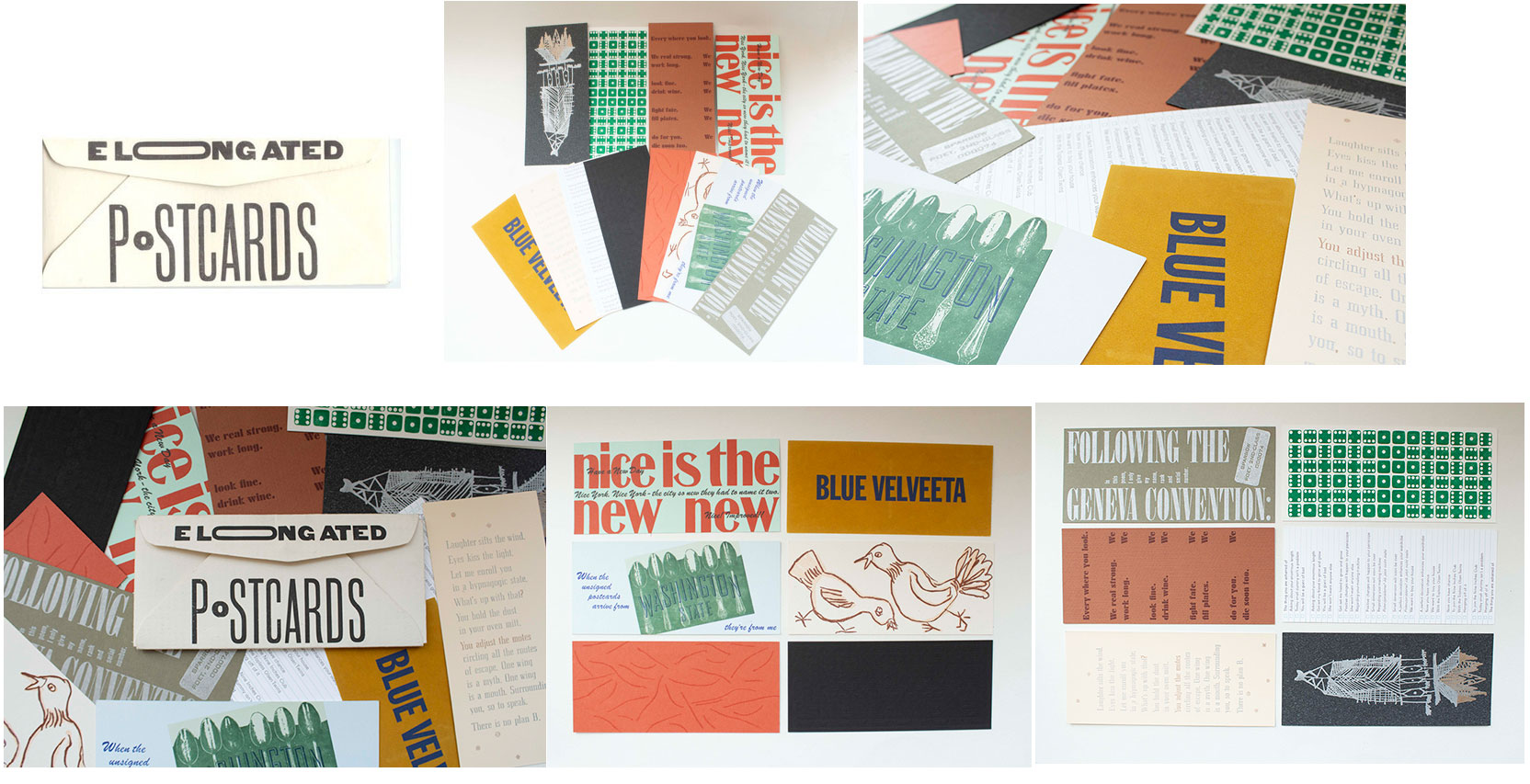
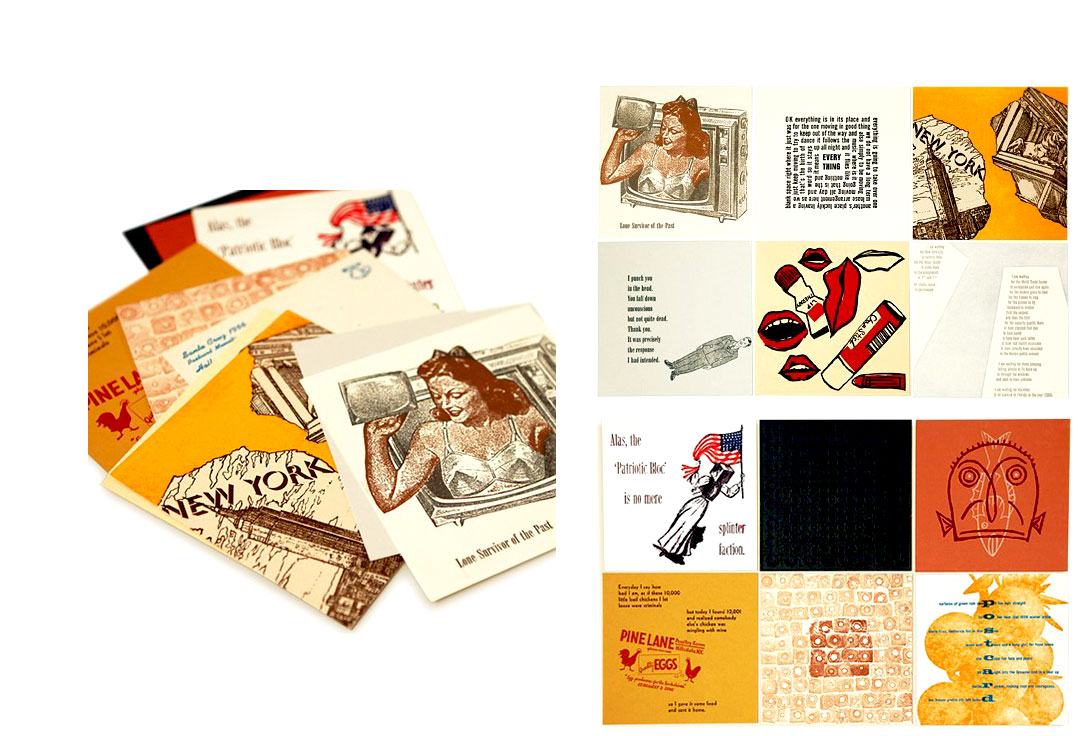
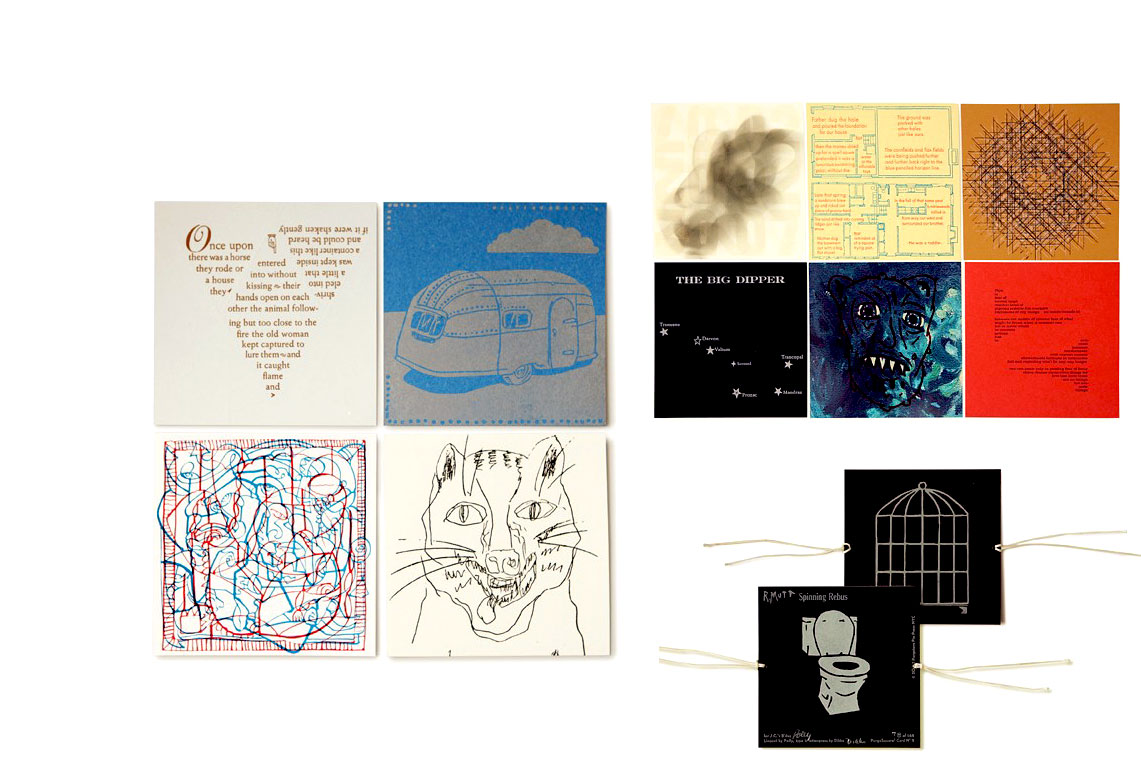
| Post card Subscription Series: Center of Book Arts, New York: "Purgatory Pie Press made its first Postcard Subscription in 1982. Collaborating with a different artist or writer each month, they continued their series for ten years and then continued with projects like a coaster subscription, Artist Tracts, Purga-Toys, and Instant Books. They began making postcards again in 2006 with their square postcards series. After 3 series of those, they moved to elongated postcards." Esther Smith, AIGA interview 2008: "I wanted to collaborate with and publish writers and artists who were not well known – New York, especially in the early '80s when I moved here, had tons of artists – so we would meet them everywhere, and if we liked their work and it seemed like it would translate well to letterpress, we would try a postcard with them. Michael Bartalos was the first illustrator we worked with and he introduced us to other illustrators. We collaborated with the illustrators as artists. We didn't give them assignments, but looked at their work to see what they were interested in doing. Most of them were not well known when we started working with them." |
||
Elongated Postcards NICE = NEW who knew? By Dikko Faust $250 |
 Click image for more |
|
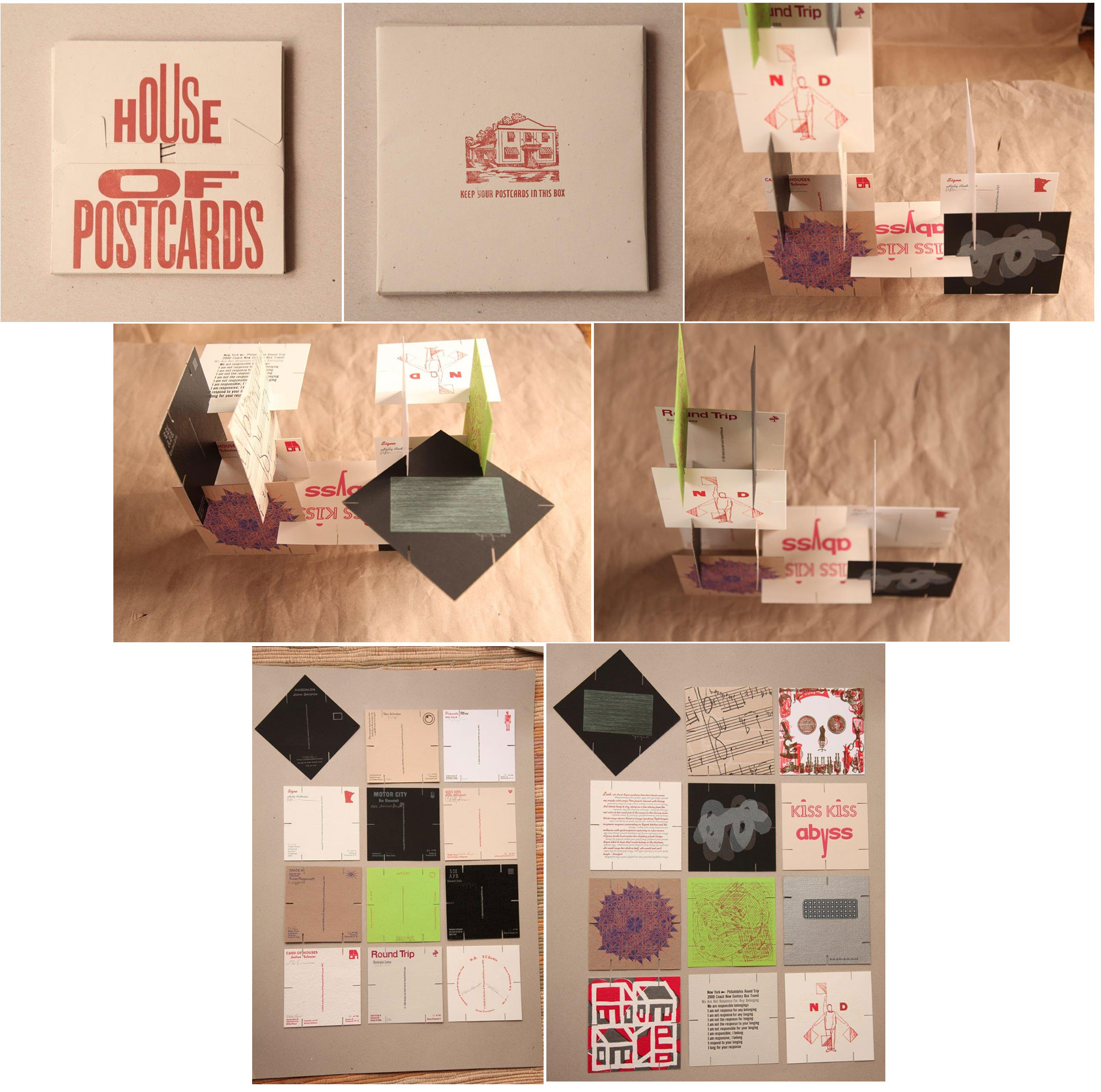
House of Postcards Card of Houses by Joshua Schreier; linoleum cut by Ashley Soliman $100 |
 Click image for more |
|
Square Postcards
$250 |
 Click image for more |
|
Square Postcards 2
$250 |
 Click image for more |
|
| Tessellation Books by printer Dikko Faust Tessellation, Wikipedia: “Tiling of a plane using one or more geometric shapes, called tiles, with no overlaps and no gaps. A tessellation or tiling is the covering of a surface, often a plane, using one or more geometric shapes, called tiles, with no overlaps and no gaps. In mathematics, tessellation can be generalized to higher dimensions and a variety of geometries. A periodic tiling has a repeating pattern”. |
||
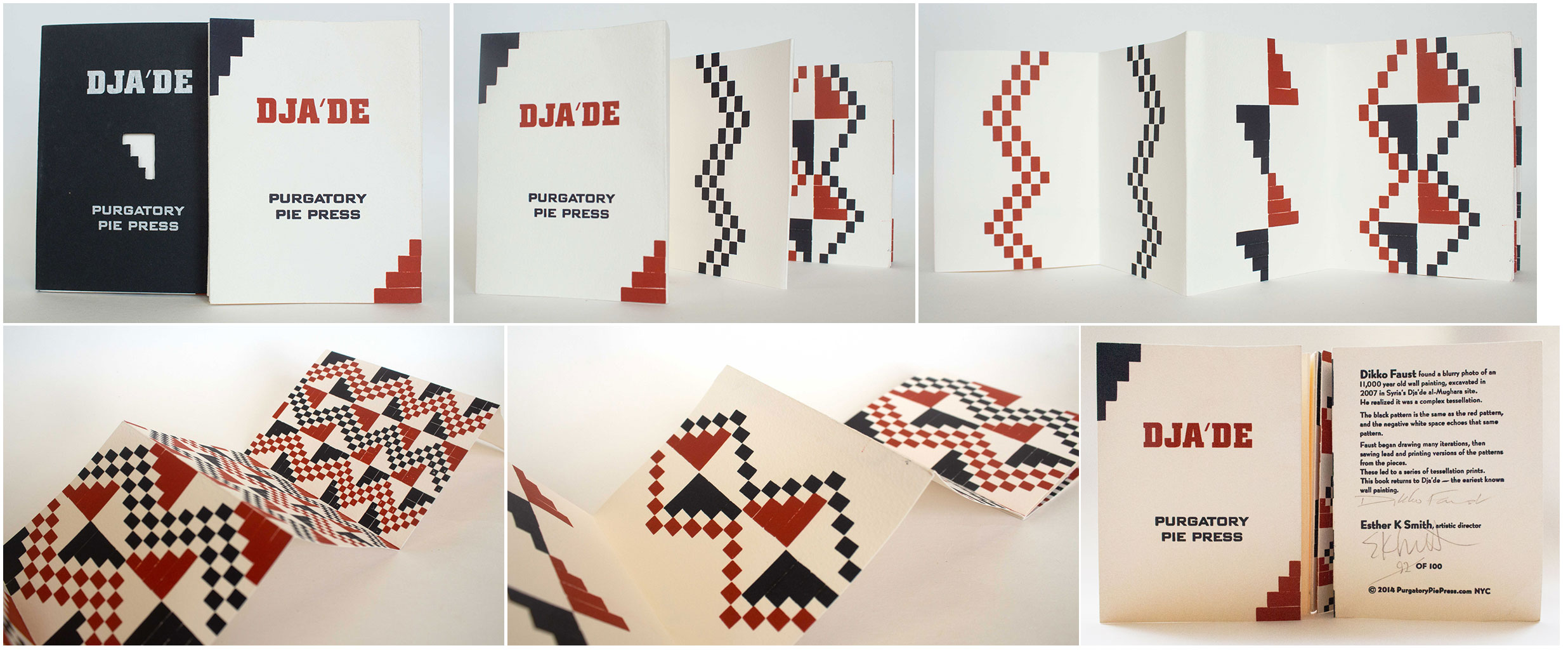
DJA'DE 12 unnumbered pages : all color illustrations ; 15 x 114 cm folded to 15 x 11 cm. Accordion folded sheet in a slipcover. Materials: Paper, wood block type, ink. Signed and numbered by Faust and Smith. Purgatory Pie Press: ‘DJA'DE’ is a series of tessellation prints designed by Dikko Faust. Faust found a blurry photo of an 11,000 year old wall painting, excavated in 2007 at Syria's DJA’DE al-Mughara site. He realized the pattern was a complex tessellation. “In this piece, the black pattern matches the red pattern. The negative white space echoes these same patterns. Faust began sketching iterations of the DJA’DE pattern. He sawed lead and printed versions of the pattern, leading to a series of tessellation prints. This book returns to DJA’DE- the earliest known wall painting. " |
 Click image for more |
|
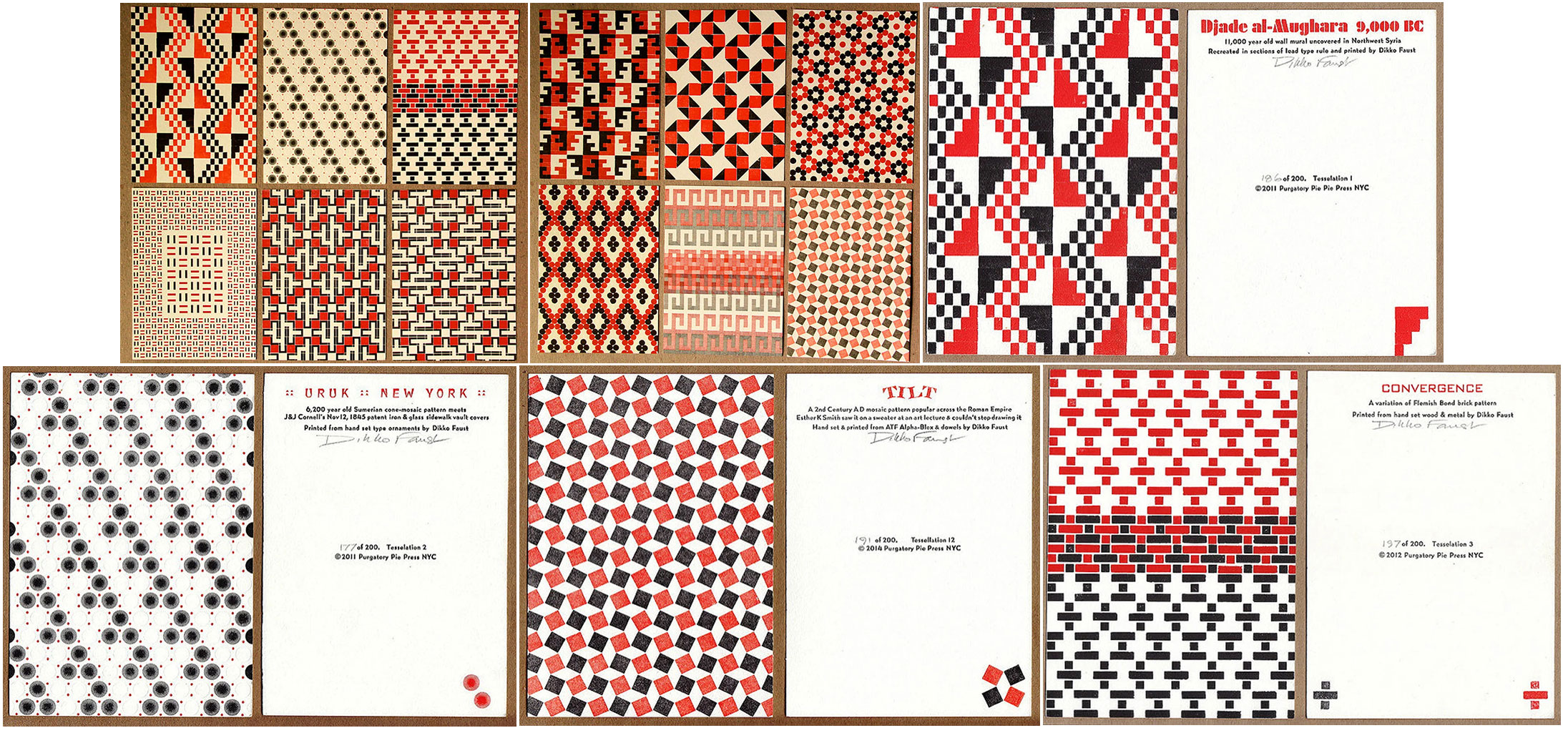
Tessellations 5 x 7". Letterpress printed. Materials: paper, type. 12 small prints in portfolio. Signed and numbered by Smith and Faust. Purgatory Pie Press: “Dikko Faust was researching for his Non-Western Art History course that he taught at City University of NY, when he found a fuzzy photo of Djade, the first known wall painting. He observed that it was a tessellation-- the red pattern was the same as the black pattern, which was the same as the negative space white pattern. He began sketching it and then hand-setting pieces of typographic material to proof different versions. Esther asked if he'd like to make a subscription series of 12 different patterns derived from archeological sources. He said YES-- and ‘Tessellations’ emerged.” |
 Click image for more |
|
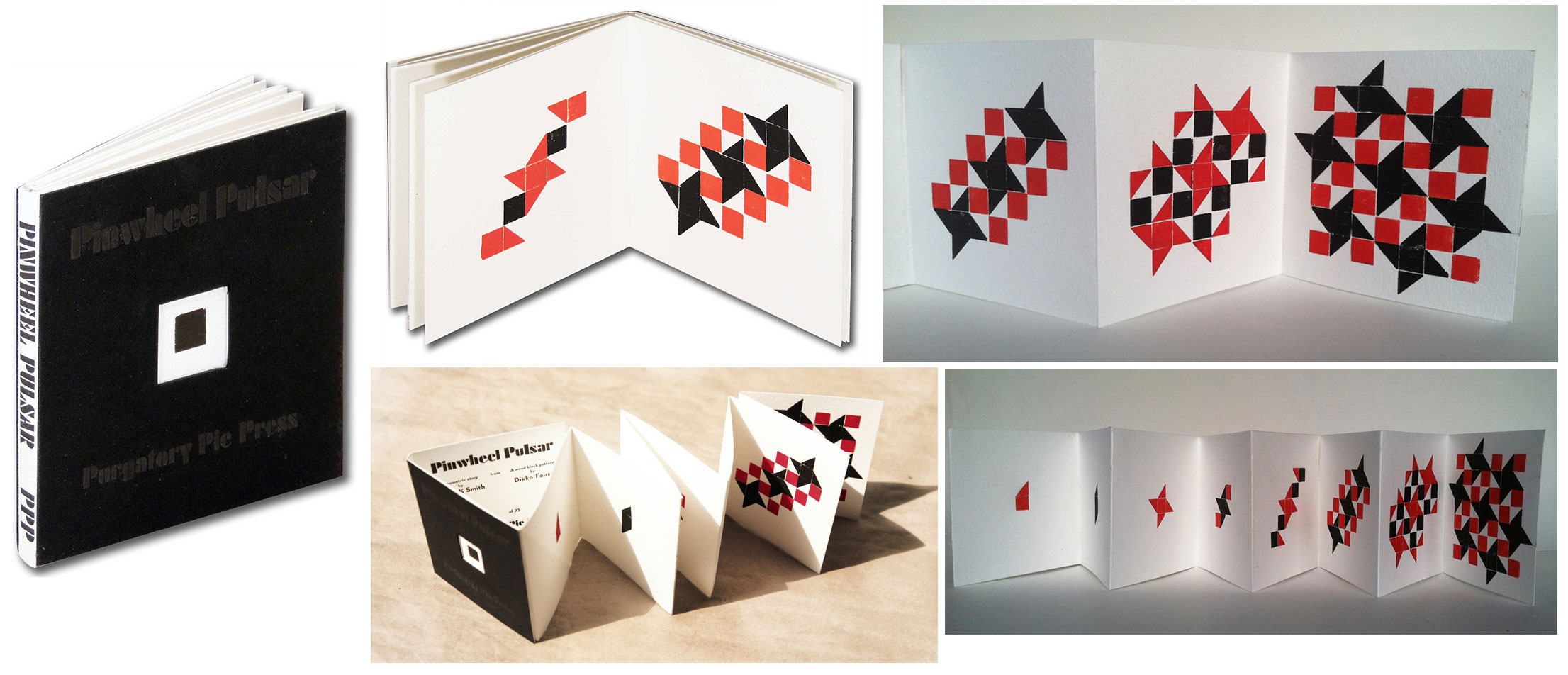
| Pinwheel Pulsar By Esther K Smith and Dikko Faust New York: Purgatory Pie Press, 2013. Edition of 75. 5" x 5" closed; 10 pages. Accordion structure extending from interior spine. Letterpress printed in red and black inks. Black paper boards with embossed titles on front cover. White spine panel with black title lettering. Square black image displays via a one inch square window in front board. Signed by printer and designer. Numbered. Esther K Smith and Dikko Faust form increasingly complex abstract images by using only red and black triangles and squares. Purgatory Pie Press: "Faust and Smith collaborate, bouncing things back and forth. Starting with production limits -- press size, paper size, number of colors, and printings -- they talk about approaches, scribble something on paper. Faust hand sets the wood and metal type and proofs the words. Smith cuts the proofs and pushes elements around on paper cut to the size of the finished piece. Faust arranges that design on the press and proofs it. They tweak spacing, try colors, and papers." $225 |
 Click image for more |
|
| EK Museum Publications: EK Smith Museum founded by Esther K Smith is a museum of found art. EK Museum and Purgatory Pie Press merged in 1980. | ||
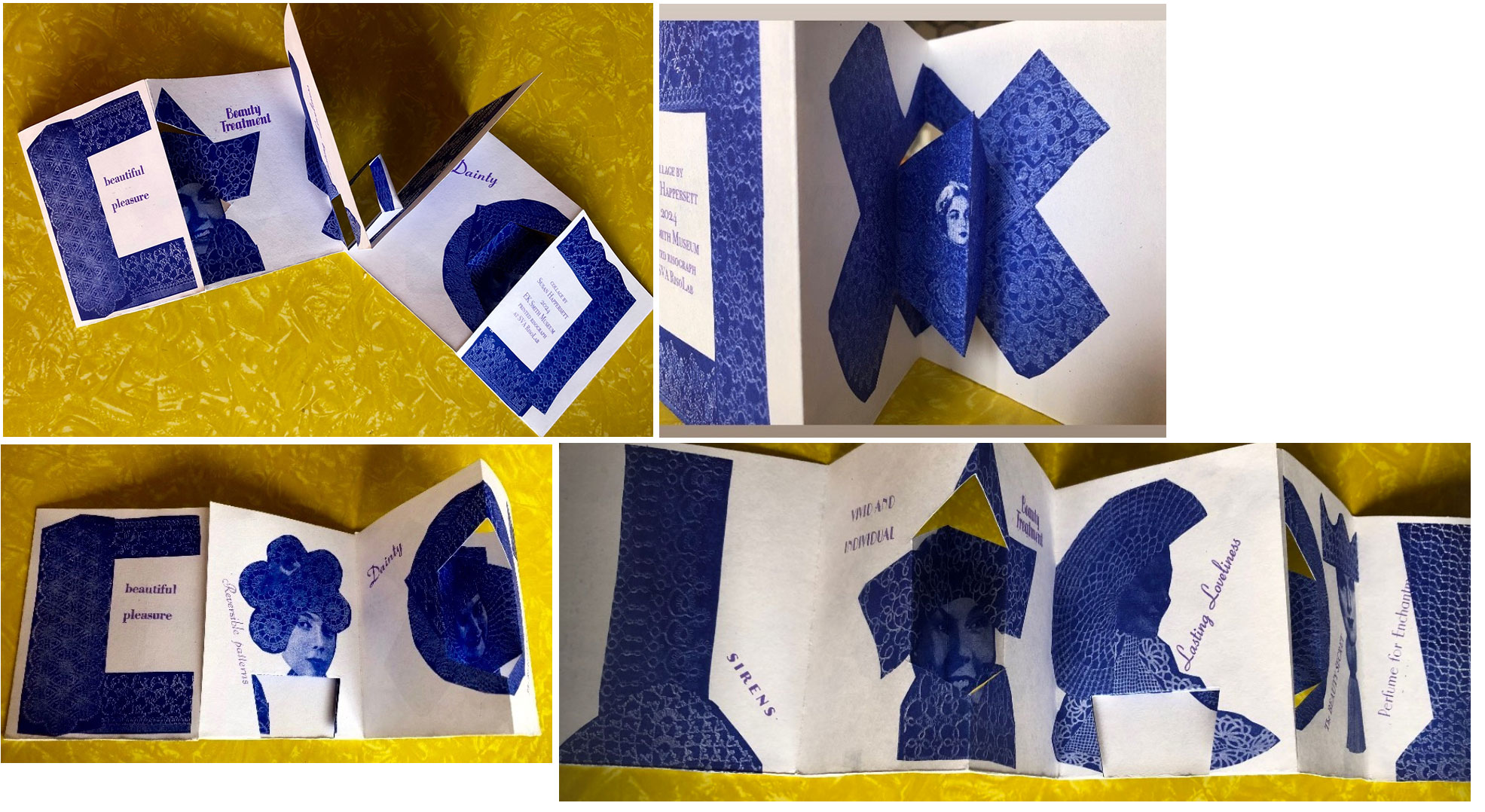
Beautiful Pleasure 4.25 x 5.5". Risography printing. Collage by the artist. One page book with pop-outs. Susan Happersett has been collaborating with Purgatory Pie Press for over twenty years. Most of their publications have been the result of Happersett’s mathematical interest such as “The Happersett Accordion”. However, she has also developed a practice of collage work, using vintage images to explore contemporary situations. With “Beautiful Pleasure” she continues exploring women’s roles and perceptions of society. The result is a kind of poetry meant to stimulate response and dialog about sexual identity and women's roles. She uses phrases from magazine articles with witty collaged images regarding women's looks - "The Beauty Secret”, “Perfume Enchantment”, “Sirens”, “Vivid and Individual” etc. |
 Click image for more |
|
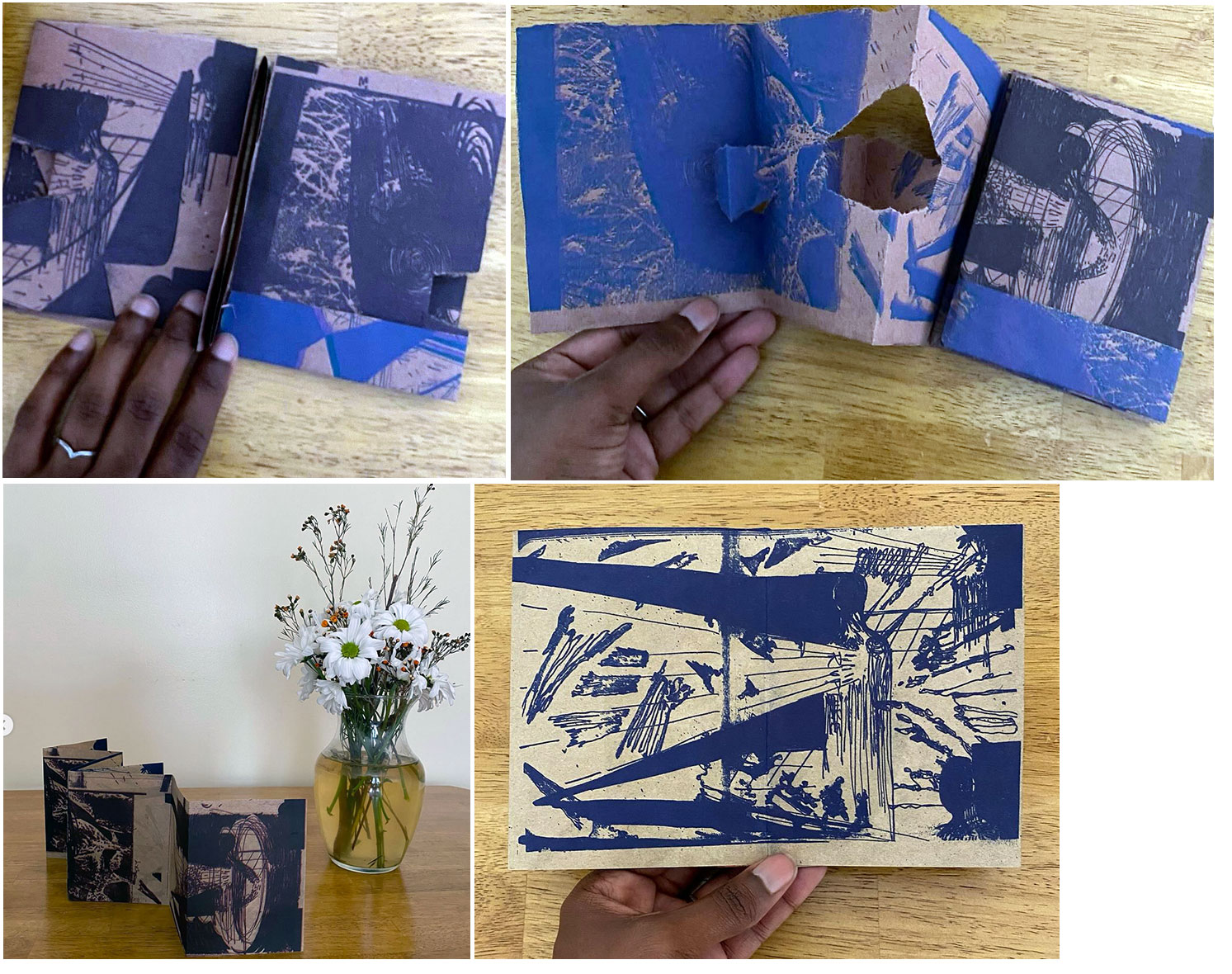
Echo's Message 3.75 x 5”. Several versions of the binding. One-page book. Accordion structure. Risography printing on several different papers. Sam Vernon, Instagram 08.27.24: "It is my pleasure to announce that Esther K Smith, author of 'How to Make Books' (Random House), and @purgatorypiepress artistic director, and I have collaborated on a very special accordion book project 'The Echo’s Message'. Printed via Risograph, this book chaotically weaves together sketchbook images I created in Berlin while processing our collective grief over one atrocity after another. The message is clear: books not bombs. Peace and light." Sam Vernon, a Black American female artist, earned her MFA in Painting/Printmaking from Yale University in 2015 and her BFA from The Cooper Union for the Advancement of Science and Art in 2009. |
 Click image for more |
|
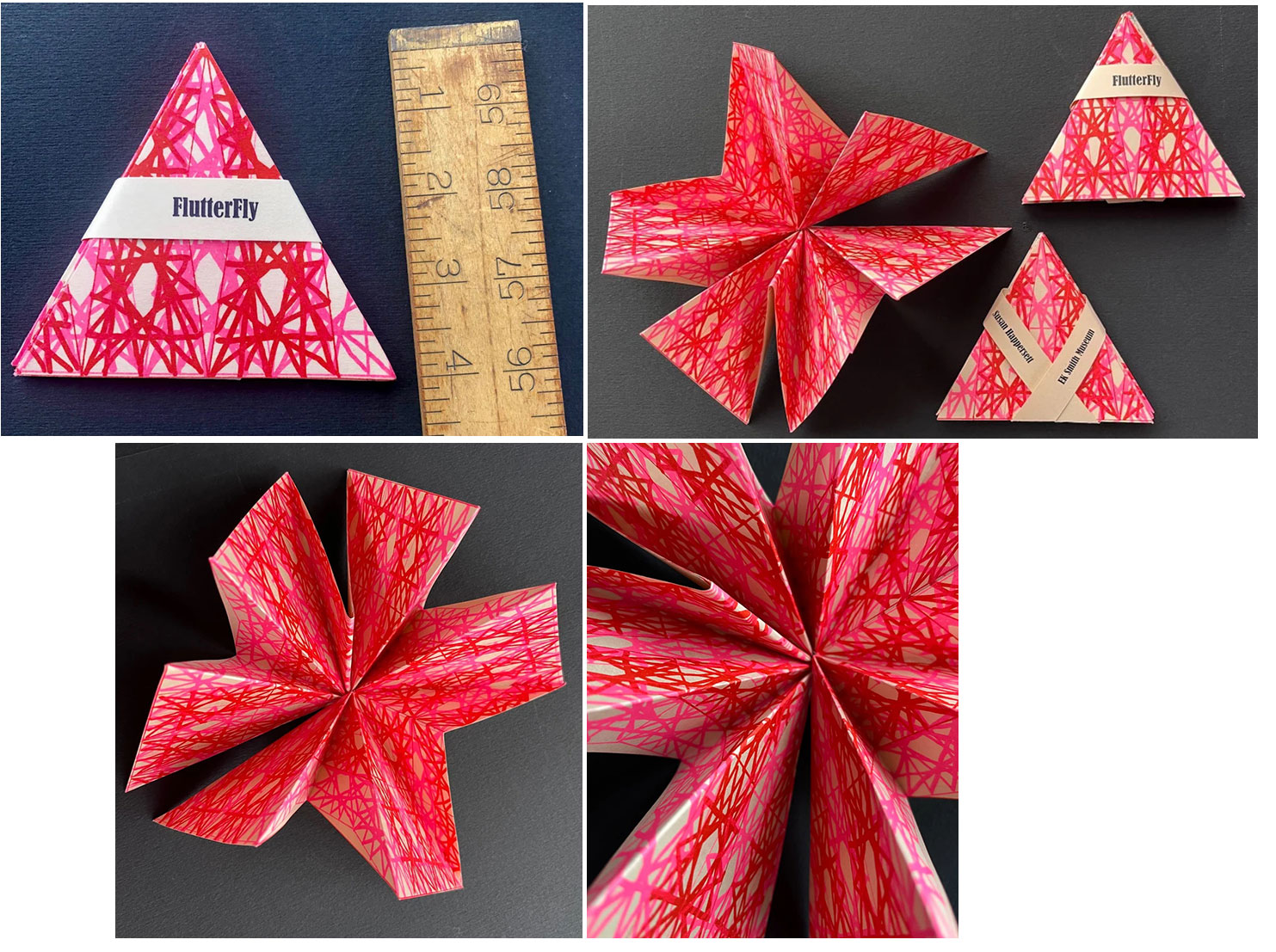
Flutterfly 4.5" x 4". Museum risograph Post Euclidean geometric sculptural artist book. PPP: “Susan Happersett hand drew her algorithmically generated mapping drawing based on trapezoids. She calls it Trapezoidal Lace. Susan's structure is a Non-Euclidean. It forms a helix built from three rectangles folded to form equilateral triangles. EK Smith Museum Risograph printed Susan's drawings and they folded the books by hand. “Please NOTE: Risograph printing is very delicate--try not to touch the printed pages, but handle this book by its edges.” |
 Click image for more |
|
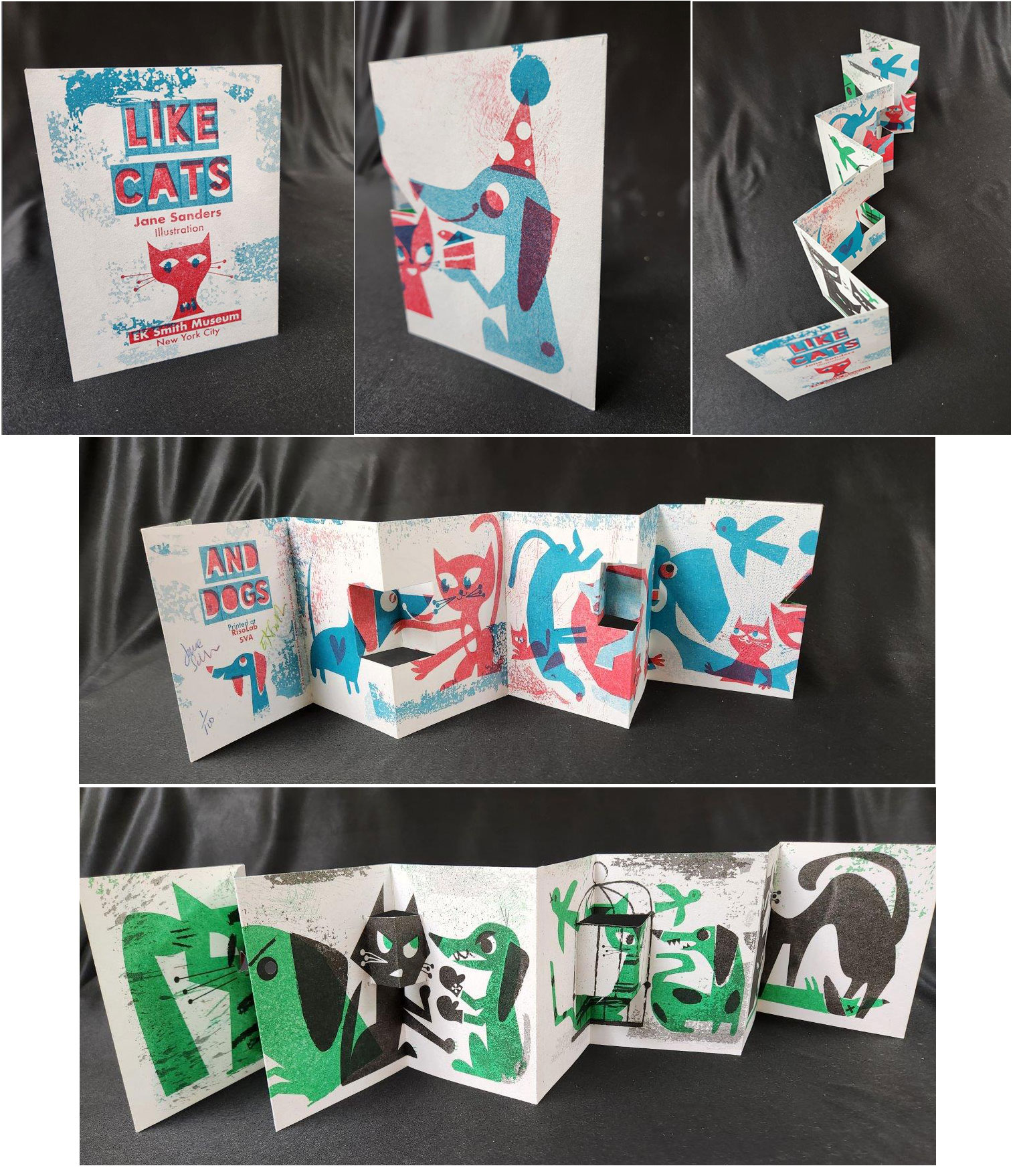
Like Cats and Dogs 4 x 5.3"; 8 panels. Double sided accordion. Risograph Signed and numbered by Sanders. Jane Sanders: "I am an illustrator/animator based in New York City. I specialize in kid-friendly illustrations for children's books, merchandise, and clothing. I work with art directors and designers to solve problems using a fun graphic illustrative style. "I am sitting here listening to political podcasts, and it dawned on me that I can incorporate my illustrations into a nod to what is going on with women’s right to choose and the remarks about Kamala being a childless, single cat lady. It sounds kind of heady, but I know it will work. Stay tuned!" |
 Click image for more |
|
| Purgatory Pie Press Out of print / SOLD titles: | ||
Do Si Do 6.5 x 6" bound do-si-do so that each book can be the accessed from the "front." Uses linoleum illustrations. Printed letterpress. Two stories by Georgia Luna Smith Faust designed into one book. In "On The A Train" the artist is gripped by a mysterious hand on the crowded train. She develops six different endings to this unsettling event. "Everything Falls into Place" is a spunky piece told by a sixteen year old New York City girl. |
  |
|
Page last update: 04.18.2025

Home | About Us | Contact Us | New Arrivals | Fine Press & Artists' Books | Broadsides |Resource Books | Order/Inquiry
Copyright © 2021 Vamp & Tramp, Booksellers, LLC. All rights reserved.