
|
Papyrus Productions
~ New York |
Share this page: |
| Papyrus Productions: "Francois Deschamps teaches photography and related media at the State University of New York in New Paltz. He is a photographer and book artist whose work involves travel and the relationship between cultures … His art is an attempt to unravel the mystery of a multicultural world of colliding realities His arsenal is pathos, humor, and the chaotic contributions from that complex and baffling world. He sometimes thinks of himself in the third person as a character in an elaborate ambiguous narrative." | |
Mali photo bookworks |
|
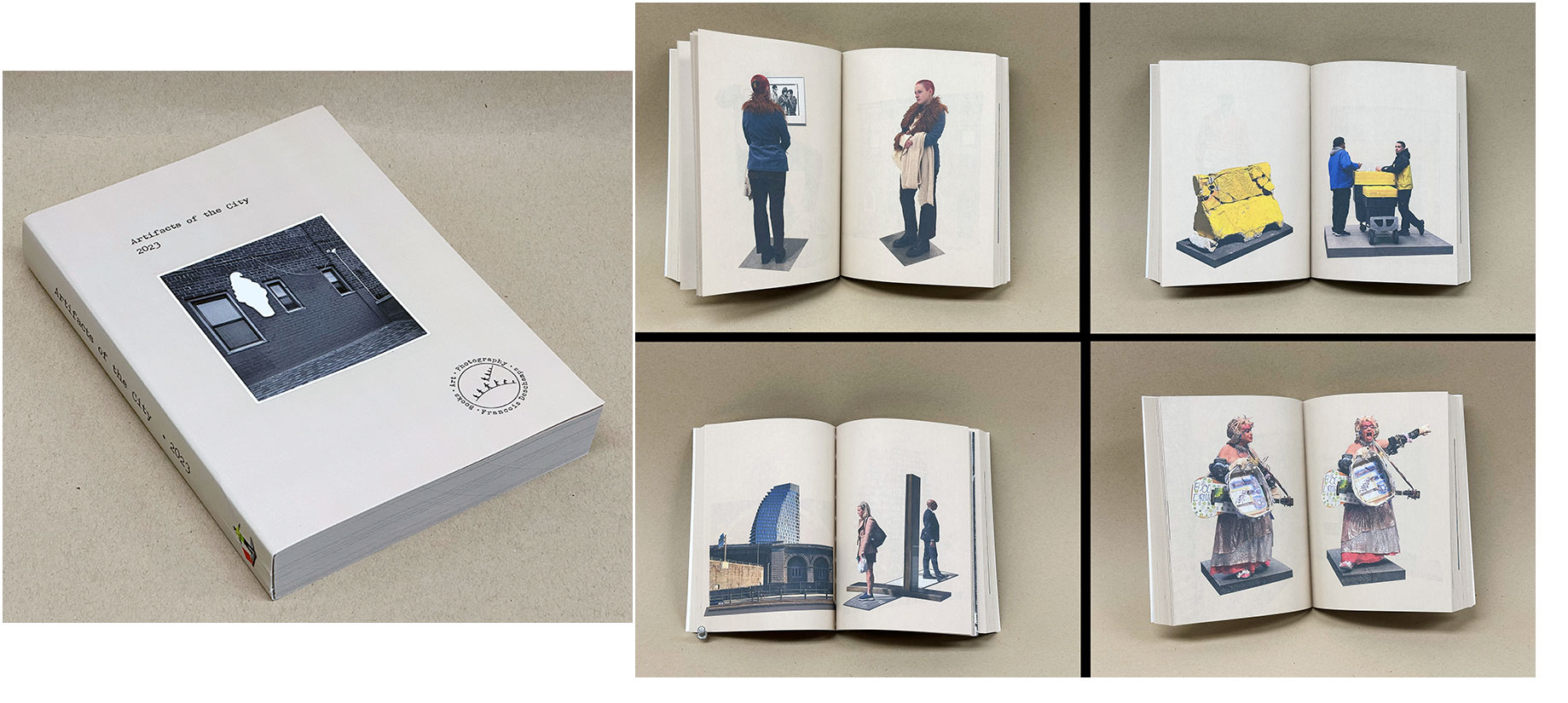
Artifacts of the City 8 x 6"; 440 pages. Soft cover. Digitally printed on plain paper. Artist Statement: “The book ‘Artifacts of the City’ is an extension of the idea of looking at a city, in this case New York City, as a set of model-like images and objects. This book, made in a three month residency in New York City in 2023, presents urban reality as a catalog of visual objects or models. These are often juxtaposed with real art work from museums raising questions concerning the nature of art and our perception of reality in public spaces. The book … digitally printed on plain paper printed a light beige color to create the illusion of a strange kind of paper.” |
 Click image for more |
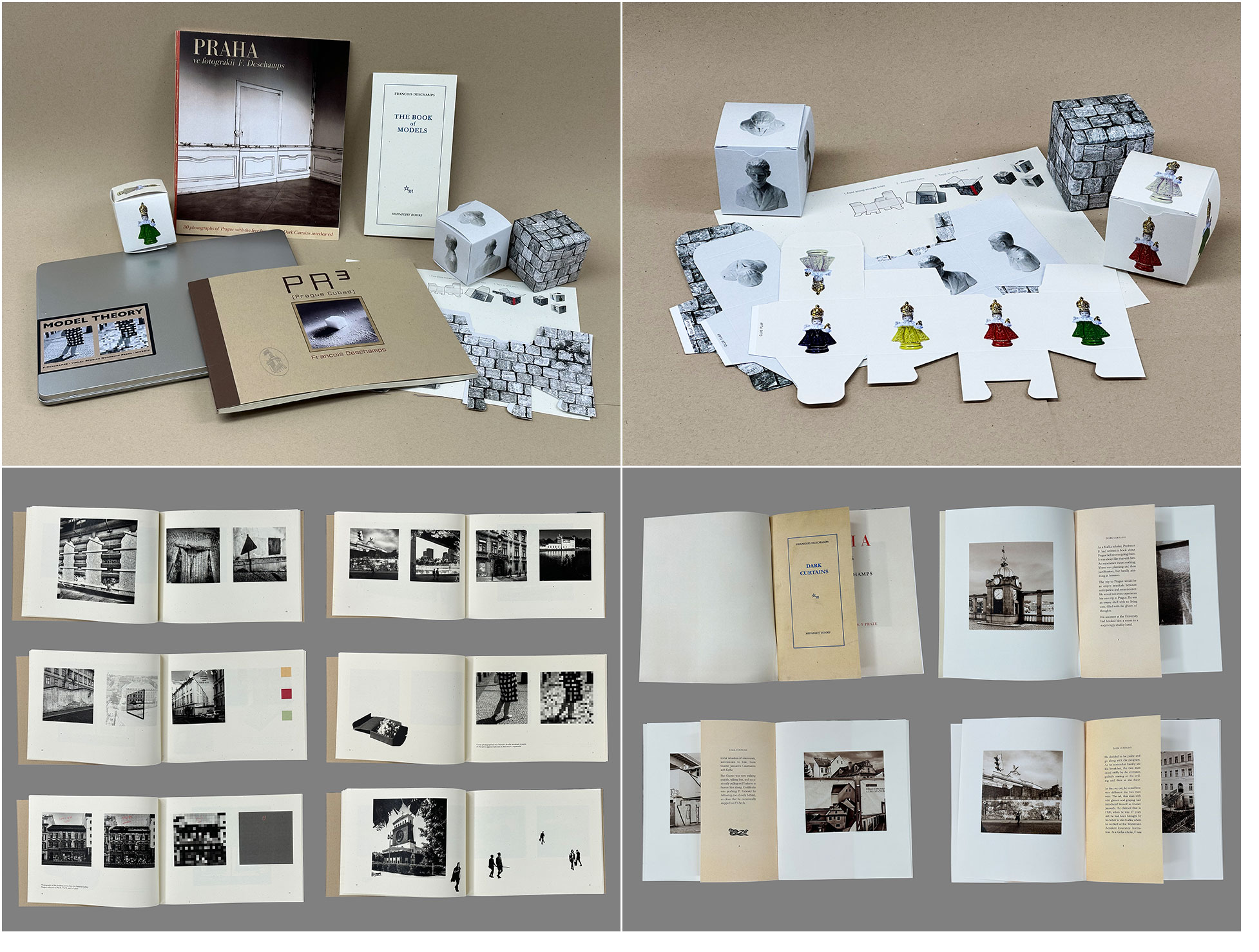
Model Theory 9 x 12” tin box containing 3 books and 3 unassembled die cut cubes. Signed by the artist. Model Theory, Artist Statement: "The book project ‘Model Theory’, 2023, is a work of visual philosophy that examines the presentation of reality as a digital model. The project was inspired by a half year Fulbright residency in Prague in 2018. As Deschamps oscillated between looking at the 3D Google earth modeling of the city and photographing the actual city, he began to see the Prague as a model of itself. “The components of the project include three books and three die cut cubes based on souvenirs of Prague, all housed in a 9x12" tin box. These disparate elements are intended to bounce off of each other to create an atmosphere imbued with content.
“ The Model Theory project explores how models, physical and conceptual organize society, culture, and behavior”. $375 |
 Click image for more |
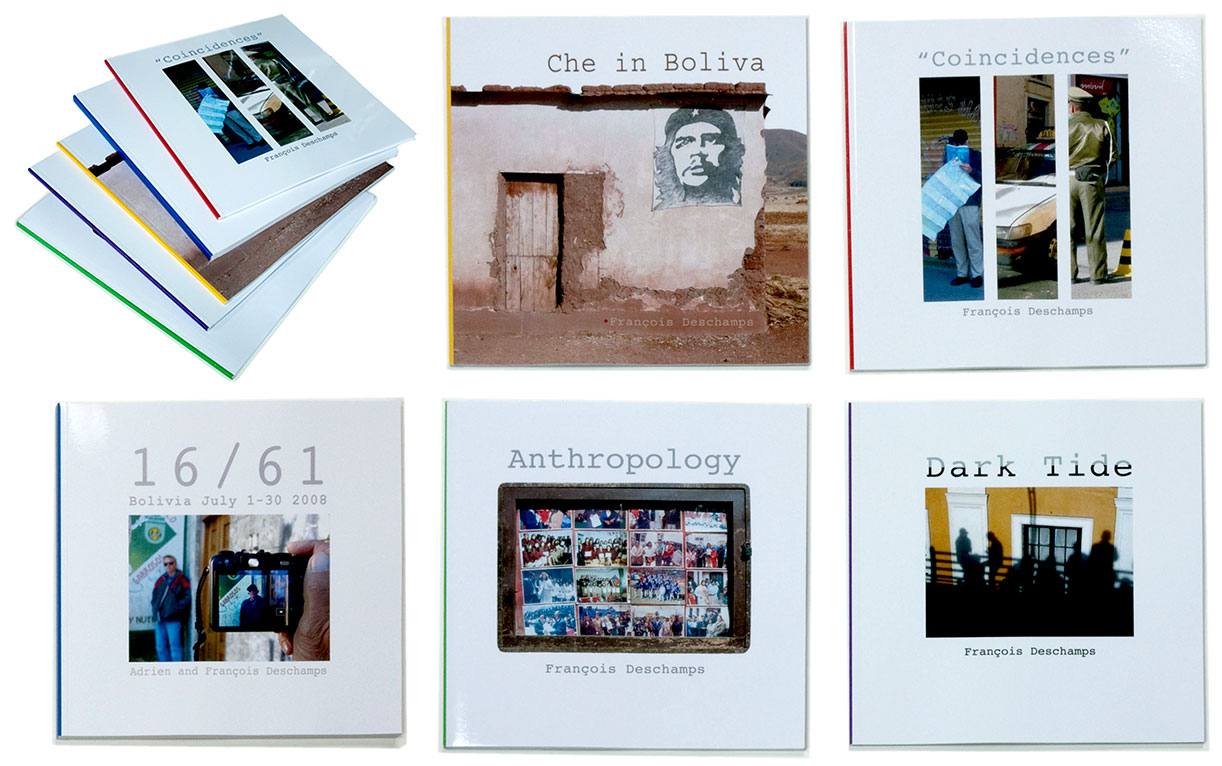
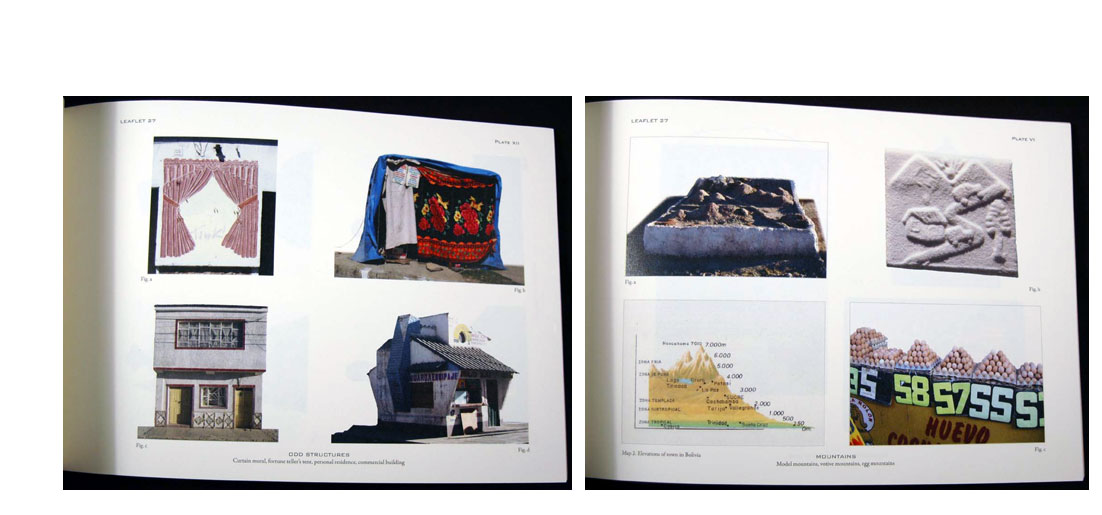
| A Casual Anthropology of Bolivia By Francois Deschamps New Paltz, New York: Papyrus Productions, 2017. Second edition of 12. 5 books, each 8.5 x 8.5": Dark Tide (50 pages); "Coincidences" (46 pages); Anthropology (62 pages); Che in Bolivia (40 pages); 16/61 (116 pages). Each perfect bound with glossy covers. In lidded box with drop side for pulling books. Colophon tipped in lid interior. Signed and numbered by the artist. Francois Deschamps: "This five volume set examines the material culture of Bolivia from five distinct points of view. The first book, 16/61, personalizes tourist culture as seen through the eyes of a father and son trip to Bolivia in 2008. The second book, Che in Bolivia, present artifacts from Che Guevara's 1967 campaign in Bolivia followed by contemporary Che imagery from streets and offices. As a revolutionary, Che was unsuccessful in Bolivia, but in memory, forty years later, he is a hero. The third book, Anthropology, isolates elements of material culture alongside a text which repetitively reads 'this is what I saw and this is what it Means.' The text of the following book, Coincidences, is taken from the country warning section on Bolivia of the U.S. State Department web site. Innocuous events, objects, and people set against the State Department's paranoid vision call into question the nature of the reality depicted. Finally in Dark Tide, shadows rising and falling on the walls of the narrow Bolivian streets are metaphors for mysterious forces that wash over the history of the land. The five volumes present various material manifestations of historical and spiritual forces that shape Bolivia with no specific agenda or politics suggested, only a sense of wonder and admiration." $675 |
 Click image for more |
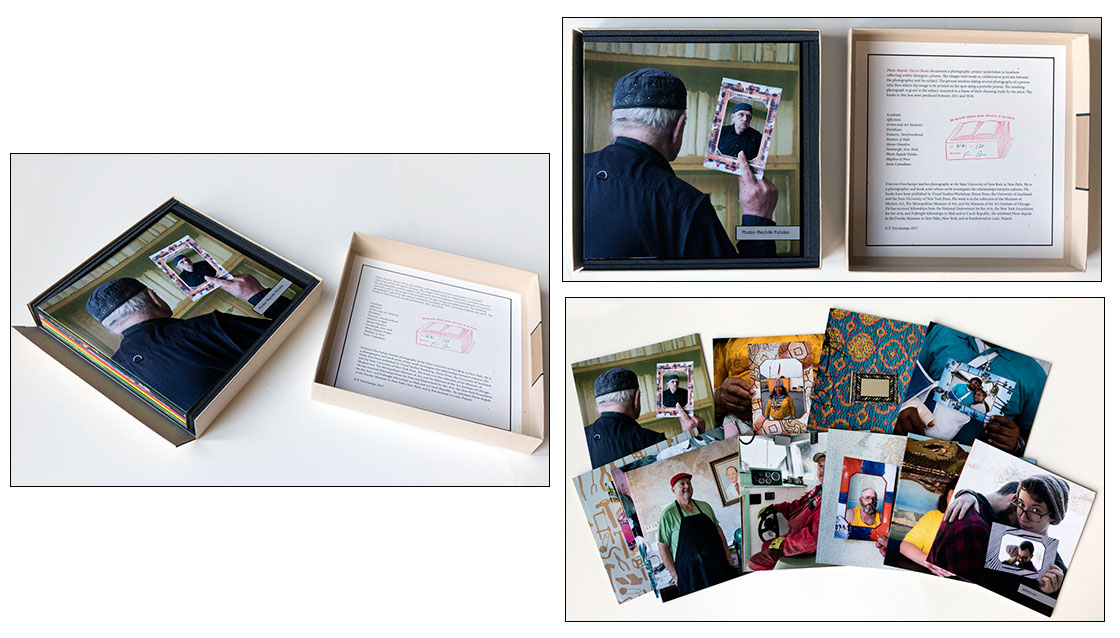
Photo-Rapide: Eleven Books 11 books, each 8 x 8", 32 pages. Each perfect bound with glossy covers. In lidded Kraft box with drop side for pulling books. Colophon tipped in lid interior. Signed and numbered by the artist. Francois Deschamps: "Photo-Rapide: Eleven Books documents a photographic project undertaken in locations reflecting widely divergent cultures. The images were made as collaborative portraits between the photographer and his subject. The process involves taking several photographs of a person who then selects the image to be printed on the spot using a portable printer. The resulting photograph is given to the subject mounted in a frame of their choosing made by the artist. The books in this box were produced between 2011 and 2016. Acadiana: "photographs made in March 2015 in the Arcadian region of Louisiana. … The Louisiana Cajuns who populate Acadiana, descendants of the 1750's Great Explusion (Le Grand Derangement) from the Canadian Maritimes, are a deeply individualistic people steeped in memories of a vague cultural past." Affections: "photographs of relationships made over a period of three years from 2012 – 2015. … Couples joined by affection, love, or habit are one of the great mysteries of life." Artists and Art Students: "photographs made in 2013-2014. These fellow artists and students never cease to amaze and inspire the photographer." Floridians: "photographs made during a 3 week trip to central west Florida in January 2014. … The population of Florida is a vibrant mix of races, cultures, and languages that give the visitor the feeling of being in another country." Francois, Newfoundland (32 pages): "photographs made in the summer of 2014 in Francois, an outport of 107 inhabitants on Newfoundland." Hunters of Mali: "photographs made in March 2011 in the Bandiagarah, Mali. … The Malian hunters are a knowledgeable confederation of shamans adept at understanding the Malian bush." Maine Islanders (32 pages): "photographs made in the summer of 2014 on the island of Vinalhaven, Maine. … These islanders and island visitors are hardy and adventurous as they inhabit a world at once isolated from and connected to American society." Newburgh, New York (32 pages): "photographs made in 2014 nearby the corner of Broadway and William Street. … The creative resilience of the people of Newburgh is deeply inspiring." Photo-Rapide Polska: "photographs made in June 2016, primarily in Lodz, Poland during Fotofestival. … Set in the historical, crumbling, and revitalized town of Lodz, Fotofestival 2016 was a spectacular event brilliantly curated by my friend, Alison Nordstrom." Shipibos of Peru (32 pages): "photographs made in January of 2015 in Contagallo, Lima and in the Amazon around Pucallpa. …. The Shipibo are a creative and proud people working to negotiate their cultural values within the demands of the 21st century." Some Canadians: "photographs made in the summer of 2014 in the Canadian Maritimes." |
|
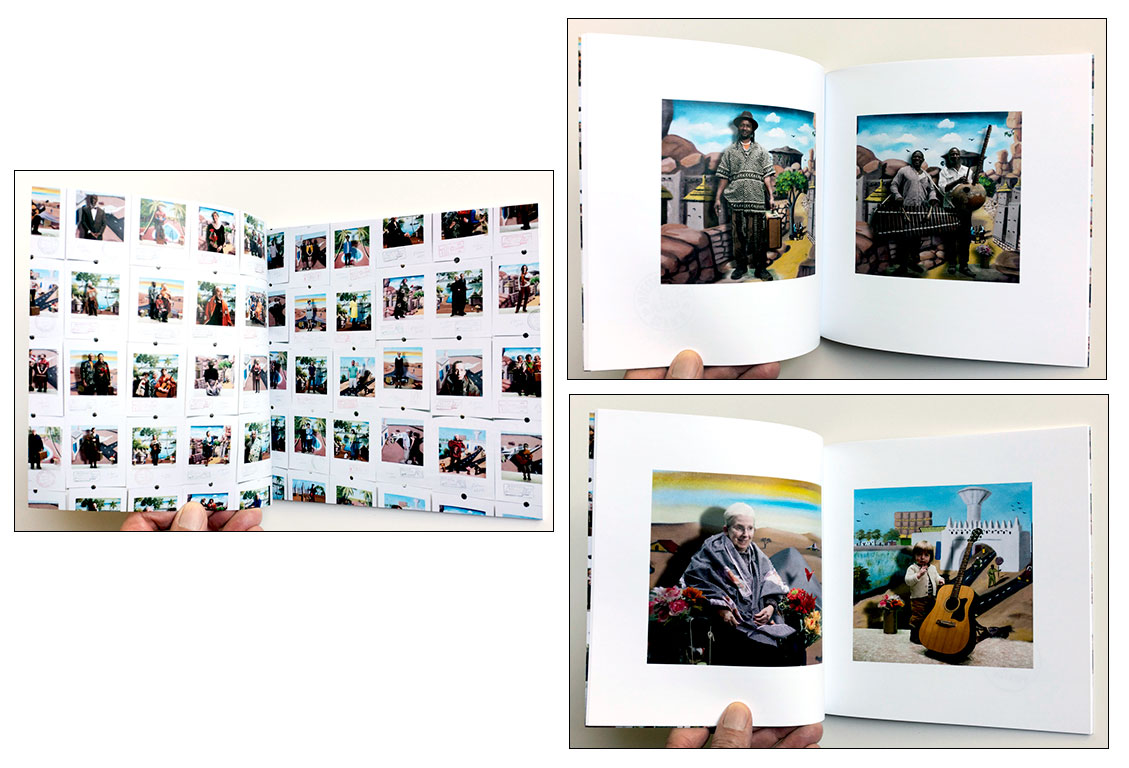
Malimerica 8 x 8"; 54 pages. Perfect bound. Glossy covers. During a Fulbright year in Mali, Deschamps traveled Mali extensively photographing people and their surroundings. The Dorsky Museum (SUNY New Paltz) has had two exhibitions of Mali work that have included Deschamps' photographs. One of these – MaliMerica — included a Malian-style photo studio where the public was invited to have a photograph taken for free. To mimic the Mali look and feel Deschamps commissioned Jo Kone to paint on canvas 7 small scale photo studio backdrops. These represented Malian scenes and were known as Studio Airport, Studio Djoliba, Studio Tomboctou, Studio Mopti, Studio Dogon, Studio Amour, or Studio Masji. Participants would choose a studio backdrop, which would later be digitally added to the photograph. The resulting images resembled traditional Malian studio portrait photography. To authenticate the prints, along with signature and a date, Deschamps stamped them with one of several rubber stamps he had designed during a year living in Mali. |
 Click image for more |
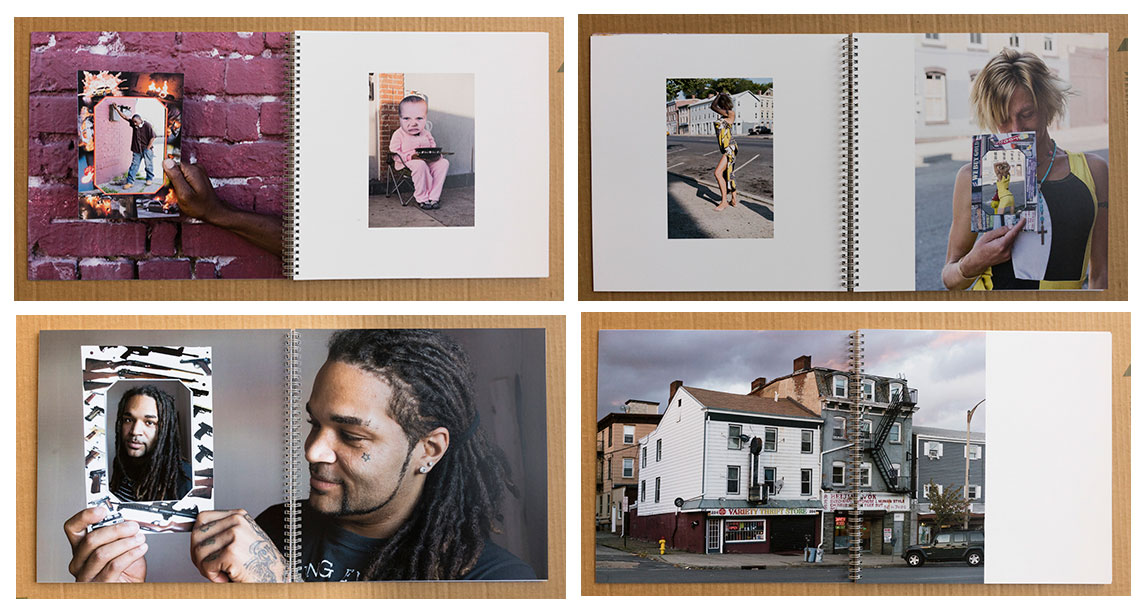
Newburgh, New York 2014-2016 12 x 12"; 92 pages. Spiral bound in color wraps. Introduction by Judith Mohns. Papyrus Productions: "Newburgh, New York 2014-2016 comprises photographs made in an inner city area an hour north of New York City. Deschamps' portraiture process is inherently collaborative as he takes several portraits of the participant who then selects the photograph to be printed immediately on a portable printer. The resulting image is given to the participant mounted in a frame chosen from a large selection made by Deschamps. This leads to deeper relationships, more picture taking, and a sharing of life experiences. The creative resilience of the people of Newburgh is deeply inspiring to the photographer." |
 Click image for more |
Drone/ 1, 2, 3 Assemblage in 12 x 9" hinged tin with three pamphlet-stitched books and remote control reproduction. Drone 1: 8.75 x 8.5"; 50 pages. Drone 2: 8.75 x 8.5"; 42 pages. Drone 3: 8.75 x 8.5"; 46 pages. Universal remote: 8.75 x 2.75"; lightweight card stock; three dimensional. Illustrated paper title tipped on lid of container. Visual Studies Workshop: "This book project comprises a series of three pamphlet-stitched books collected in a presentation hinged tin along with a three dimensional image object of a universal remote. The project deals with remote projections of power at various times in history through metaphors developed around the three principal meanings of the word 'drone'. "Drone 1 based on the drone as a male bee, creates new images of colonial history. "The books are structured so that between each full page is a half page; as one flips through the books, each image spread is modified by the half page flap to create new and sometimes disturbing juxtapositions. All photographs and drawings are by the author except those from colonial histories." (Honorable Mention in the 2011 MCBA Prize) |
|
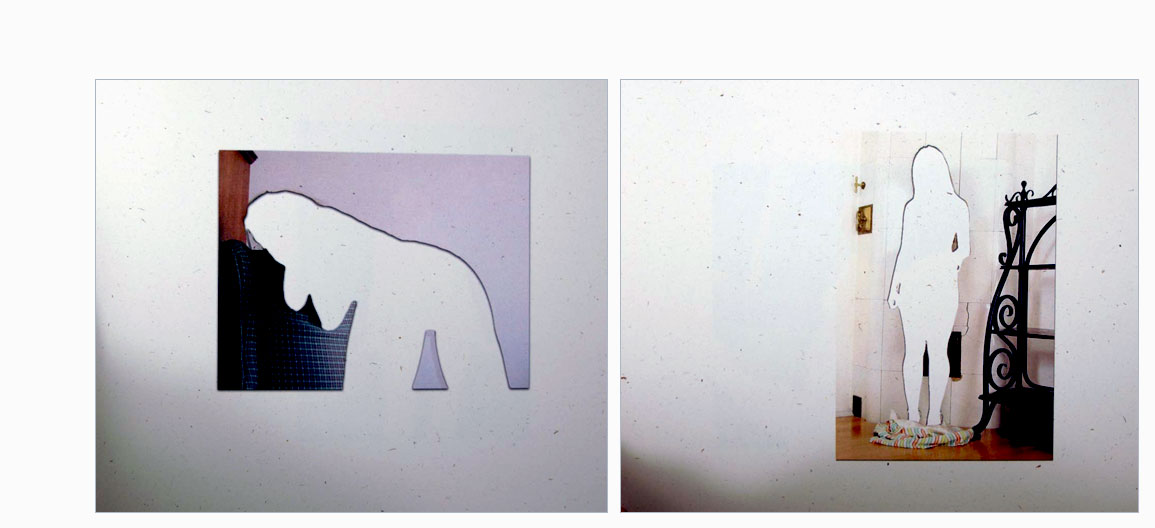
Fourteen Interiors 10.75 x 8.125"; 30 pages. Japanese stab binding. Photography. Papyrus Productions: "Represents porn sites devoid of their occupants and presumably drained of desire. Curiosity led me to investigate sites of desire. After initial shock at the full description of the most intimate secrets, only the emptiness of passion drained of love remained - the banality of fucking." The human beings in the photographs have been removed using Photoshop, leaving a hole in these fourteen interiors – and removing any hint of ardor. In the place of passion are the droll dregs of desire. |
 Click image for more |
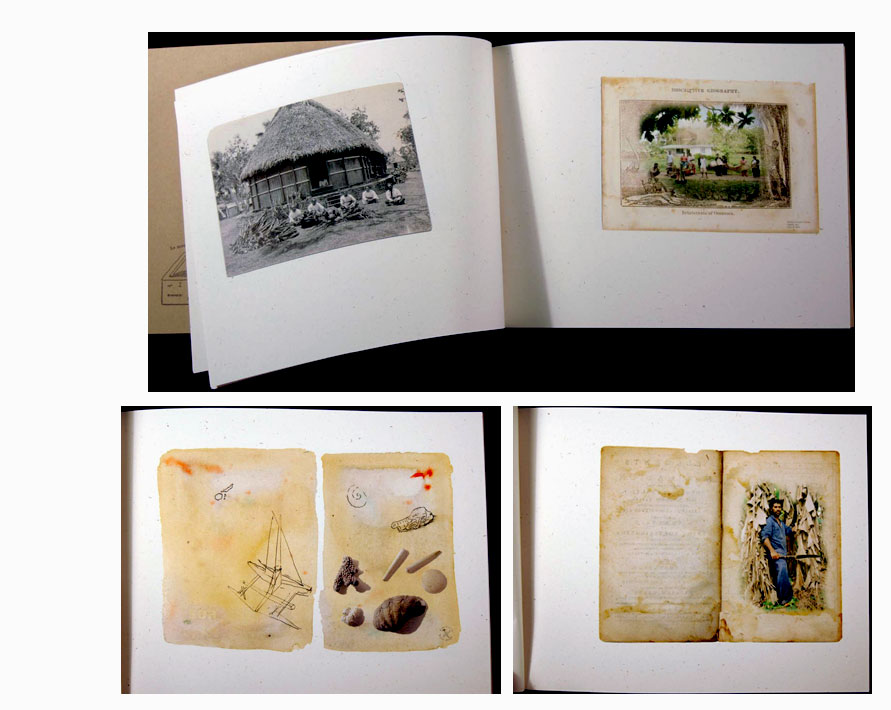
Imagination the Spy 10.75 x 8.125"; 38 pages. Japanese stab binding. Photography. Imagination the Spy compares through photographs historic and contemporary representations of Oceania. Papyrus Productions: "One hundred years ago, the anthropologist Arthur Maurice Hocart worked and photographed on Lakeba and Rotuma, two remote Fijian islands. My own travels in Fiji from 1995 - 2001 took me to the same two remote islands. This book contrasts two responses to these similar experiences. Hocart's photographs, always on the left page, are housed in the Alexander Turnbulll Library, National Library of New Zealand, Te Puna Mâtauranga o Aotearoa. My own imaginative response to these Fijian islands results from my photographs, watercolors made in 1995-2001, and from a personal idiosyncratic collection of nineteenth century travel books." |
 Click image for more |
You and Me Francois Deschamps: "This book is an elegiac mediation on a trip to Bolivia with my son in 2008." |
 Click image for more |
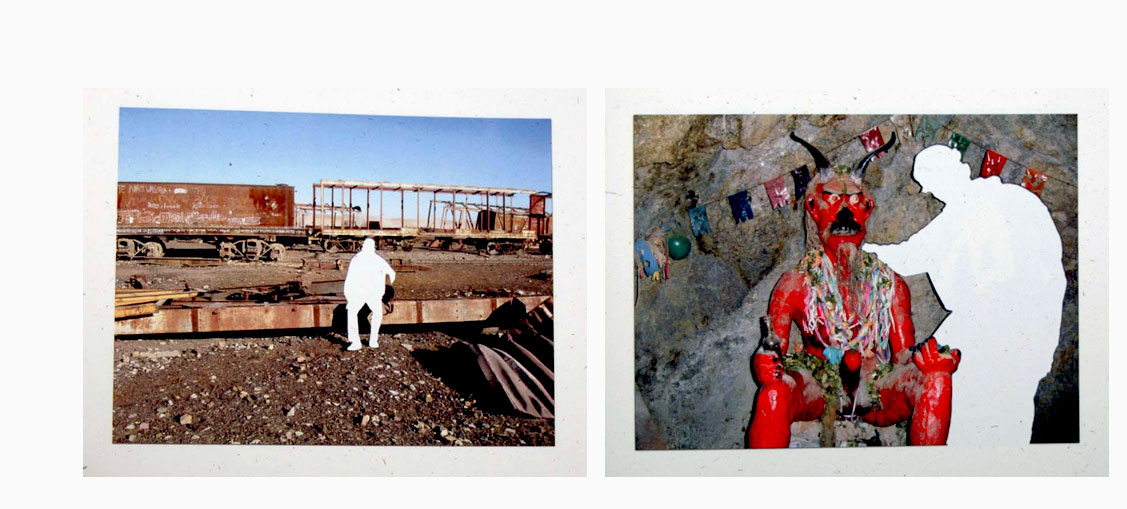
The Visual Memoire of a Casual Expedition to Bolivia: Papyrus Productions: "This book pretends to be a scholarly object by presenting a compendium of plates based on a 2008 trip to Bolivia." |
|
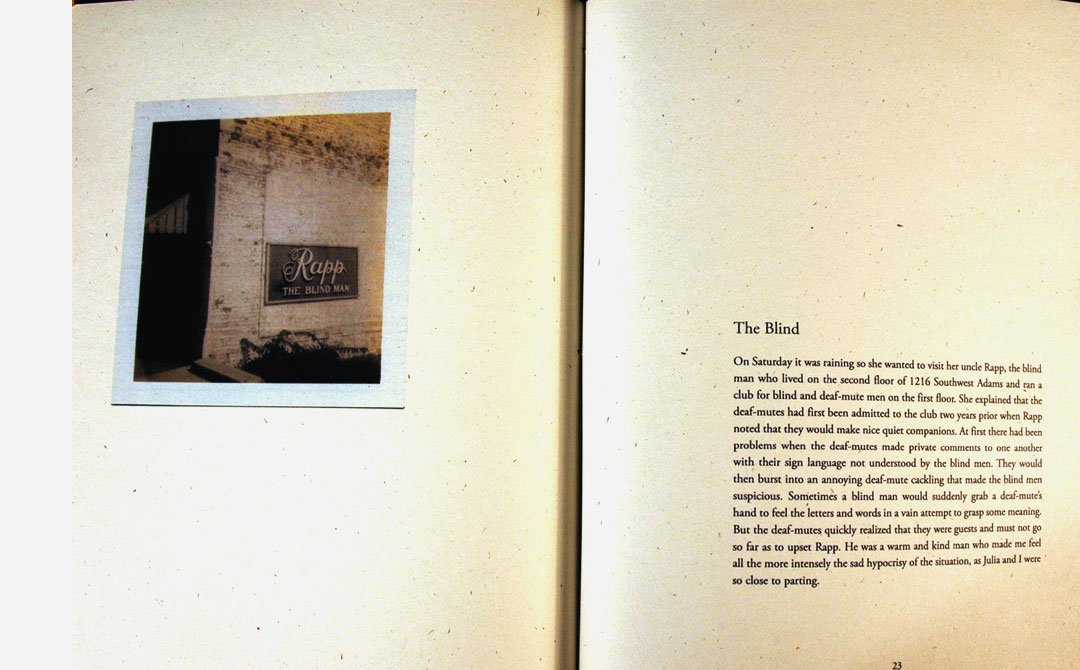
PEORIA 9.5 x 8"; 28 pages. Digitally printed on French paper. Handbound stab binding. A conventional presentation of convention, set in the heart of convention, where even the betrayals and hypocrisy seem sweetly shabby. Francois Deschamps: "At the same time as it narrates the story of an unfortunate love affair in Peoria in 1976, this book describes through Polaroid images and text the physical appearance of the city of Peoria. This comments on aspects of that city's Midwestern culture and a melancholy sense of loss."
|
 Click image for more |
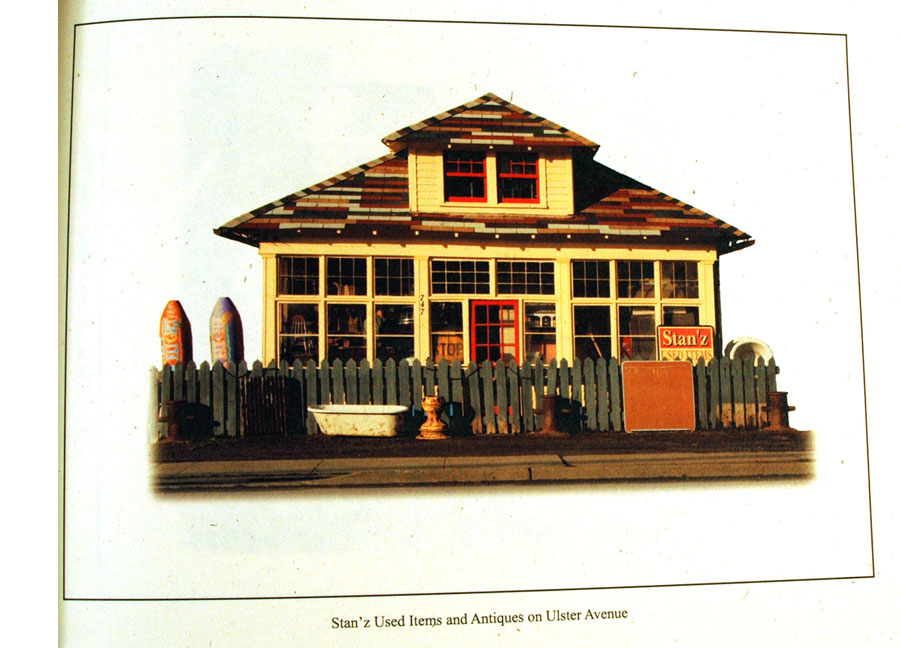
Souvenir of Kingston 7 x 10"; 58 pages. Printed on French paper. Stab binding. Although this book might seem to bow to Ed Ruscha's Twentysix Gasoline Stations, it does so only as a point of difference. The images of Kingston, disembodied from any context but this book, seem chosen and arranged as individual statements of social meaning – particularly the effect of change, changed circumstance, changed priorities, changed technology – rather than as a witty swipe at perceived pretention. Souvenir of Kingston is just that, a definition of place, and not a comment on repetition and banality. Francois Deschamps: "Presented on the occasion of the four hundredth anniversary of Hudson's sailing in 1609, this book is based on a Souvenir of Kingston published one hundred years ago. That original Souvenir featured accomplishments of civic pride and a sense of high patriotism. One hundred years later, this book reveals the buildings of Kingston, New York, as a palimpsest of historical overlays which allude to these cultural and historic changes. This project is supported in part with funds from The New York Foundation for the Arts and The New York State Council on the Arts. " Francois Deschamps, JAB 27: "Kingston is a charming slightly deteriorating river town with a varied topography, especially down by the creek that feeds into the Hudson. The approach is deadpan but the buildings themselves are amusing, isolated from their backgrounds and juxtaposed, like the Greek temples on pages 6-7. These temple houses were actually next to each other on the street, as if there had been a Greek temple competition between two families. The visual strategy of isolating the structures also turns the buildings into little models, which is the way I was seeing them. This book is an homage to the wonderful funkiness of this town." |
|
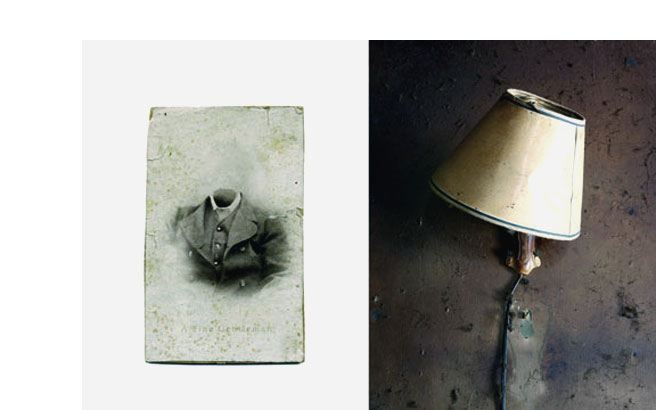
Gerontion 9.75 x 7.5"; 84 pages. Casebound. A pictorial biography, perhaps a deconstruction, of a local personality, a character whom people knew mainly from his own stories. Here it's a mix between "You are what you can make other people believe" and "You are what you leave behind in your house." This book pays dignified attention to the mystery of one human being. Francois Deschamps, Forward [sic]: "Albert 'Yellow Kid' Gerontion lived in Catskill, New York, from 1962 until his death at the age of 100 in 1998. He was a quaint, local character who claimed to have been a great flimflam artist starting in the 1920's. Few had ever been in his house until, following a neighbor's tip, police found him dead on a sofa in front of a television blaring an afternoon soap opera. The unusual contents of the house sparked interest in this man who was mysterious and unknown until the end." Gerontion, text: "A pile of newspaper clippings found in the chaos of books and papers on an upstairs bed caused many to question Gerontion's stories. It appeared that he was obsessed with the story of Joseph 'Yellow Kid' Weil. He may have used the news articles to create the story of an exciting past and to transform himself into a glamorous personality. If so, what was his true past? The artifacts in his house suggest that at least some of his claims were real. In any case, it makes an interesting chapter in the history of this small river town which time has forgotten." Francois Deschamps, JAB 27: "For this book, I took a group of photographs I had made and centered them around a real historical character Joseph 'Yellow Kid' Weil who I renamed Albert Gerontion. At the end we find out that Gerontion was using the stories about the historical 'Yellow Kid' to make himself interesting. The book uses layers of fraud to look at the slippery nature of history and narration." |
|
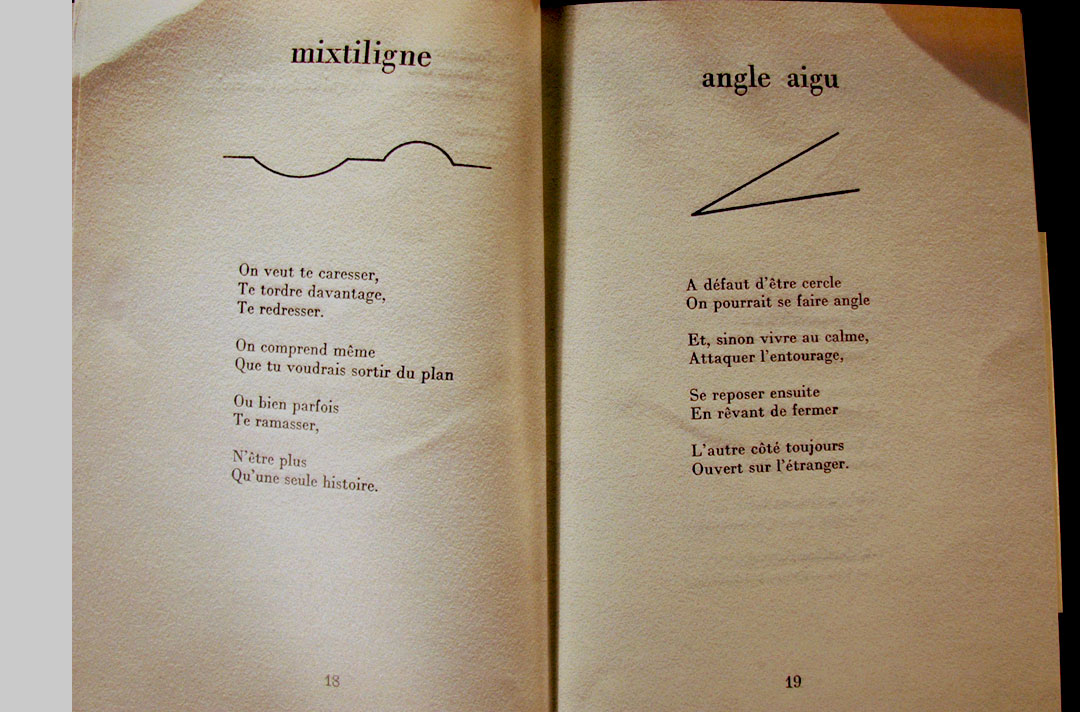
Reading Guillevic on a Sunny Day 9 x 6"; 66 pages. Text in French. Casebound with 4.5"-wide band wrapping from inside front cover to inside back cover. Papyrus Productions: "Based on a discarded copy of Euclidiennes by the French poet Guillevic, this book is about the experience of reading that original book. The spaces of the page spreads, lit by sunlight, are represented as an experience to examine and treasure — a new space for new emotions. As each page simultaneously reveals its front and back, the translucence and depth of space and time are made material." Francois Deschamps: "I was given a copy of Euclidiennes, discarded by a library, but nonetheless a thing of exquisite beauty. Reading Guillevic on a Sunny Day is my book about the experience of reading that book. The collection of poems, Euclidiennes, by the french poet Guillevic uses the figures of euclidean geometry as metaphors to comment on emotions, feelings, and relationships, thereby laying bare the Cartesian duality. In my book, the spaces of the page spreads, lit by sunlight, are represented as an experience to examine and treasure — a new space for new emotions. ... The book is dedicated to my father, a mathematician and lover of geometry. He made this drawing to illustrate a hyperbolic universe where space becomes infinitely dense as one reaches the edge, thereby paradoxically creating an infinite universe in a finite space. Can a book be a hyperbolic universe?" |
 Click image for more |
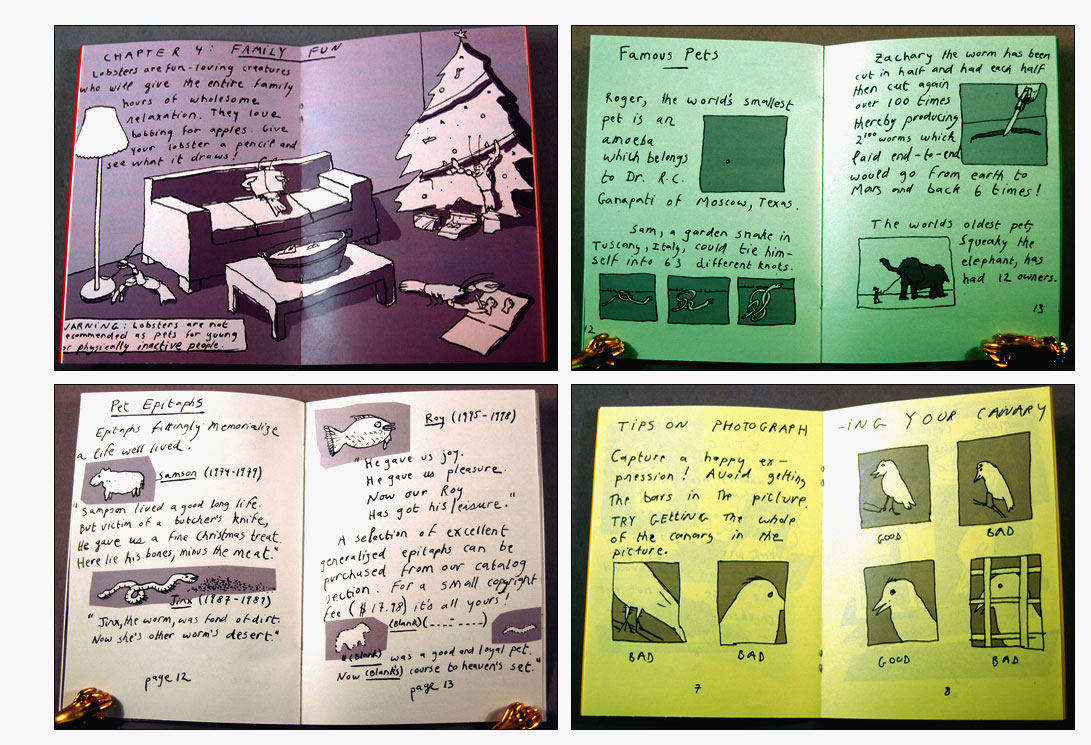
The Pet Quartet 5.5 x 4.25"; 24 pages. Four chapbook-type volumes housed in box with illustrated title paper on lid. New Shed Press: "Long awaited ... 20 years in the making ... These four exciting volumes, assembled for the first time, span Deschamps' heady rise from canary breeder to general pet philosopher and theorist." The four volumes were produced between 1986 and 2006, and are here collected in a boxed set as a Special Collector's Edition. How to Care for Your Canary, originally published in 1984, contains Deschamps' sage wisdom about owning a canary: "Do not mention famous opera singers around a canary." How to Care for Your Pet Lobster, initially produced in 1986, contains similar sage snippets: "It is good etiquette not to boil water within earshot of your pet's hearing." General Pet Theory, originally produced in 1994, offers perspective on pet ownership: "Who is Whose Pet?" Francois Deschamps, JAB 27: "On the backs of the books one can notice that the author is gradually aging, losing hair, and on the last book there is only a parrot on a skull as it is supposedly written posthumously by Deschamps' pet parrot who simply repeated the author's words in his parrot-like fashion. The canary book is fairly jolly and optimistic in tone, with important information about canary care such as feeding, naming, and canary history. The lobster book follows the same format with interesting facts about lobsters, different types of obscure lobsters and a catalog. General Pet Theory deals with pet tricks, the history of pets, and endeavors to look at existential questions such as 'can a pet be owned?' In Dead Pets the problem of death is examined. There is the clock theory (that a pet is a clock with a spring), the germ theory (that germs are everywhere), the guilt theory (that pets commit sins which cause their systems to deteriorate), and finally the economic theory (that a vast network of pet entrepreneurs cause premature obsolescence in their product). The reader can take their pick. This set of books is soft-core philosophy asking questions about life and the meaning of life in small, pleasing doses." |
|
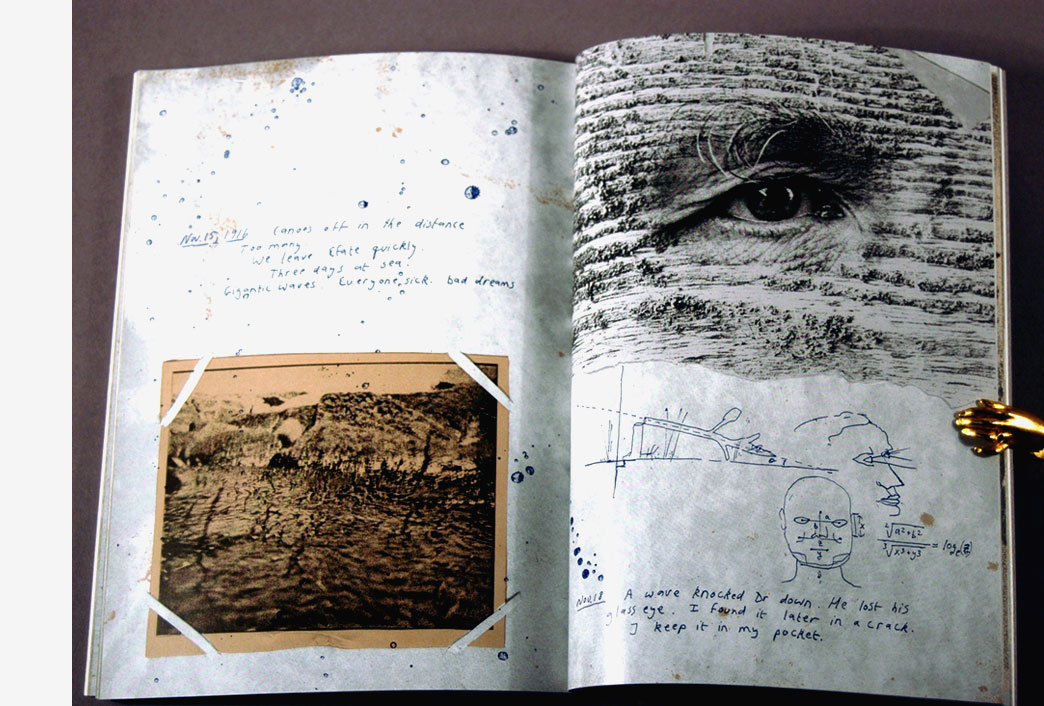
Memoire D'Un Voyage En Oceanie 6 x 8.25"; 96 pages.Gray illustrated wraps. Illustrated throughout. Offset printed in three colors on acid-free paper. With a smyth-sewn binding. Printed at the Elam Fine Arts Printing Research Unit, at the University of Auckland, New Zealand. The fictional memoirs of a voyage in Oceania that included Dr. Ernst Schlotte (scientist? owner of luxury goods store in Bremen? cannibal?) and François Deschamps (diminutive ship's photographer) and the monograph's putative author. Introduction by Dr Hinemoa Heke-Gibbons, afterword by Joan Turner, R.N. Francois Deschamps: "This monograph is the study of a fictitious voyage of the ship Curriodity in the South Seas ca. 1920. It features a facsimile version of the journal left by one member of the expedition." Francois Deschamps, JAB 27: "I created a fictitious memoir that would have been written in 1914 by a South Seas expedition photographer who was a dwarf and produced a journal documenting the (evil_ Doctor Schlotte's quest for a cannibal feast. In a sense it is very similar to Sombras Rojas, both using the device of a book within a book, as well as a lonely, misunderstood, and disabled narrator to tell a story about political ideas. This is the story of a man, Francois Deschamps, born a midget in Sydney in 1883. He was selected to be the expedition photographer because he fit in the tiny darkroom on the ship. He did not even use an enlarger; he put negatives on a darkened window with a lens in front to make exposures. Later he was marooned on an island and he made a crude camera so that he could continue to make photographs. Underlying all this is the simultaneous progress of World War I in Europe. The violence that we ascribe to the natives of the Pacific, such as cannibalism, is contrasted with the massive impersonal violence on the battlefields of World War I where millions perished. This book is not an apology for cannibalism, but asks questions about the nature and uses of violence." |
|
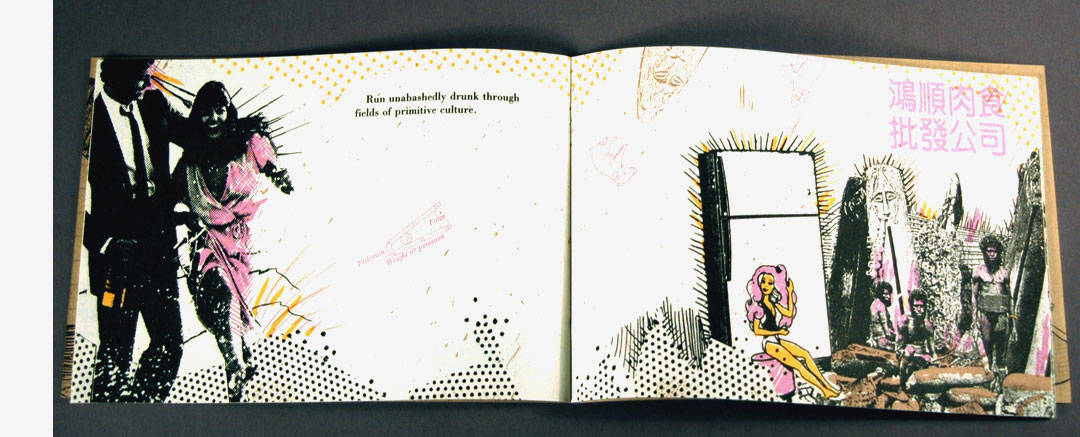
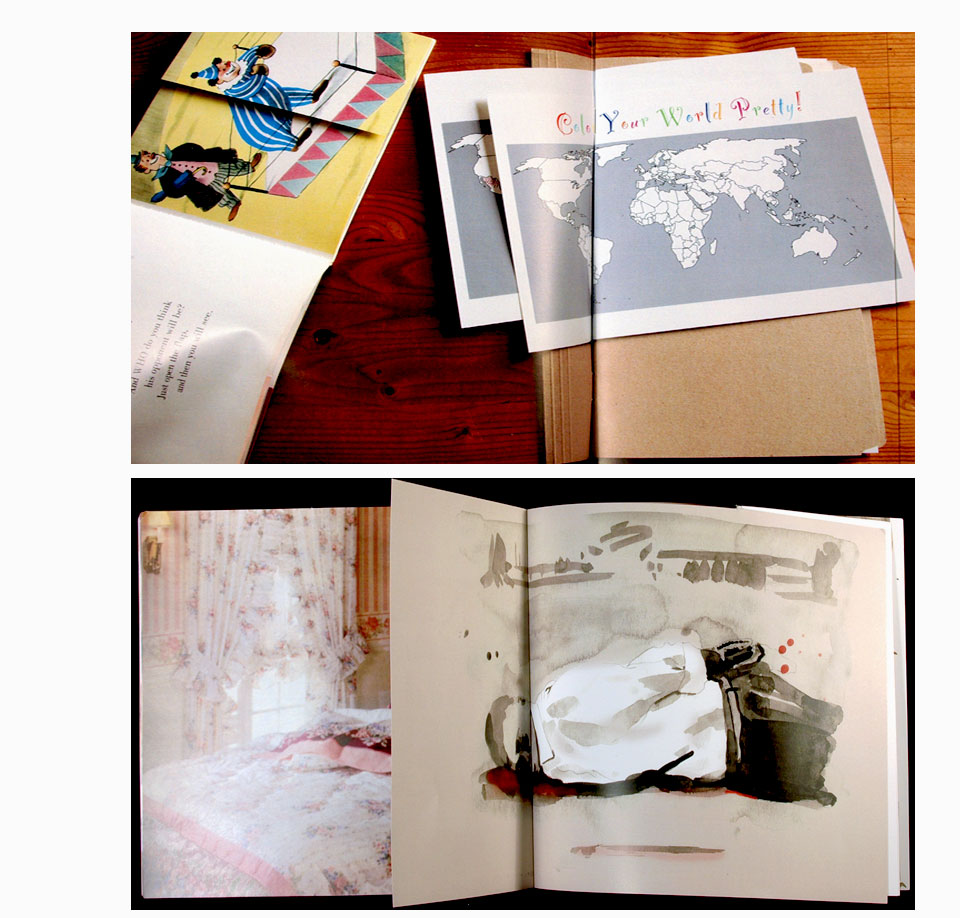
A Guide to Antipodea 5.75 x 9"; 32 pages. Offset printed in 7 colors on French text and cover. Printed at the Borowsky Center for Publication Arts at The University of the Arts (Philadelphia). "Tired of the persistent pull of Gravity? Float off to Antipodea — home of beautiful natives, fine foods, long beaches and, best of all, a weak gravitational field!" "Return with a small, native child for entertainment in your suburban home. Send it to an American school and see what happens! It's harmless and fun?" Francois Deschamps: "This guide to a fictitious 'primitive' land questions issues of cultural identity and in particular, the relationship between oppressor and oppressed cultures." Francois Deschamps, JAB 27: "Antipodea is a place where there is only a very gentle pull of gravity, which makes it an attractive tourist destination. It is fun to go there and enjoy a vacation floating around. ... This place is basically a western playground. The book comments on how we use those places and how we ultimately destroy them. ... At the end it is even suggested that one can return home with a small native child for one's entertainment." |
 Click image for more |
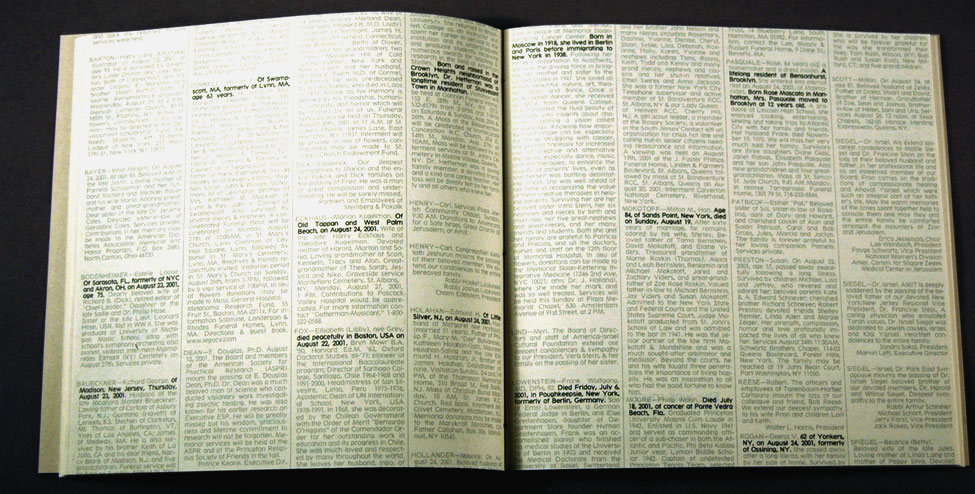
Remembrance 6.5 x 6.5"; 72 pages. Offset printed on French Dur-O-Tone Newsprint text and cover (100% recycled and acid-free). Pamphlet sewn. Judith Mohns: "This book uses the August 26, 2001 obituary page from The New York Times to create new readings of the existing text by isolating different words and lines. The visible and underlying structures of obituaries, families, society, and the qualities of life and death itself are explored revealing both the cold commonalities and the very personal specifics of the lives of the deceased." You'll never read the obituary page quite the same way again.
|
 Click image for more |
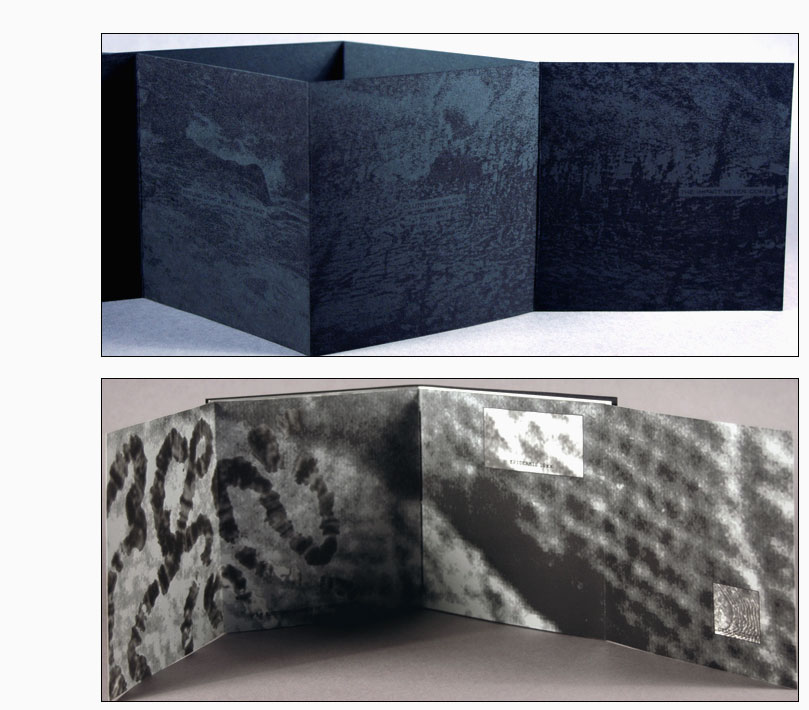
Quartet Each book 4.75 x 4.75". Four books laid in paper wrap enclosure with cutout for title. Housed in sturdy black archival box (5 x 5") with title on lid. Offset printed at the Elam Fine Arts Printing Research Unit at The University of Auckland, New Zealand. Judith Mohns: "Like variations on a theme, Quartet is a set of four books, each printed on different papers and independently structured. Using transparency, gate-folds, die-cuts, two-color printing and paper manipulation, these books explore a personal journey of identity and conflict." Each book, with form and content reflecting the slant, poses a form of the existential dilemma: What makes me me? Destiny, genes, conditioning, choice? |
 Click image for more |
| Bookworks resulting from Deschamps' stay in Mali. He arrived August of 2010 in Bamako, the capital. During an eleven-month-long Fulbright fellowship to teach at the Conservatoire des Arts et Métiers, he traveled around Bamako and other parts of the country with his digital camera. | |
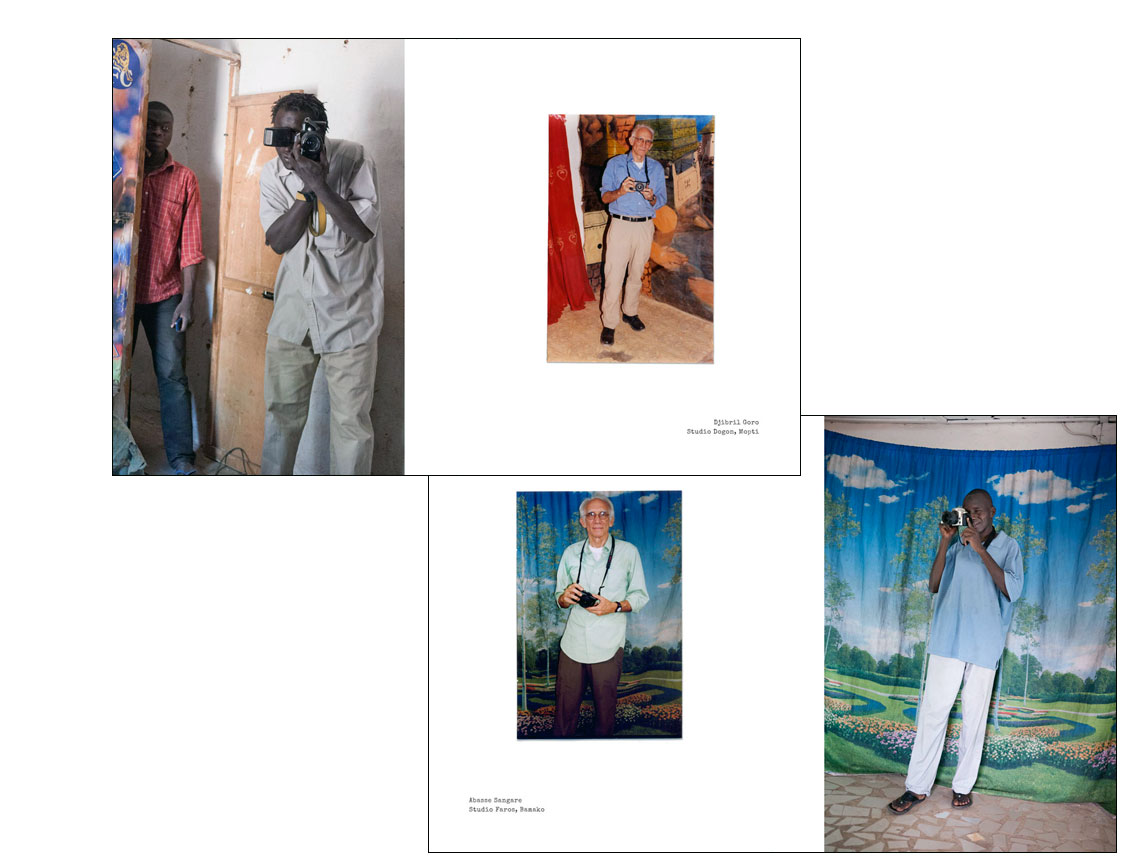
| Mali Photo ByFrancois Deschamps New Paltz, New York: Papyrus Productions, 2013. Edition unstated. 8.25 x 10.75"; 64 pages. Perfect bound. Glossy covers. Photographs of Francois Deschamps taken by Malian photographers. Each photograph of Deschamps is accompanied with a photograph of the photographer and his studio. Humane exchange and human relationships are a two-way street, or lane, or cart path. This give-and-give interaction is on display in this remarkable set of photographs. $55 |
 Click image for more |
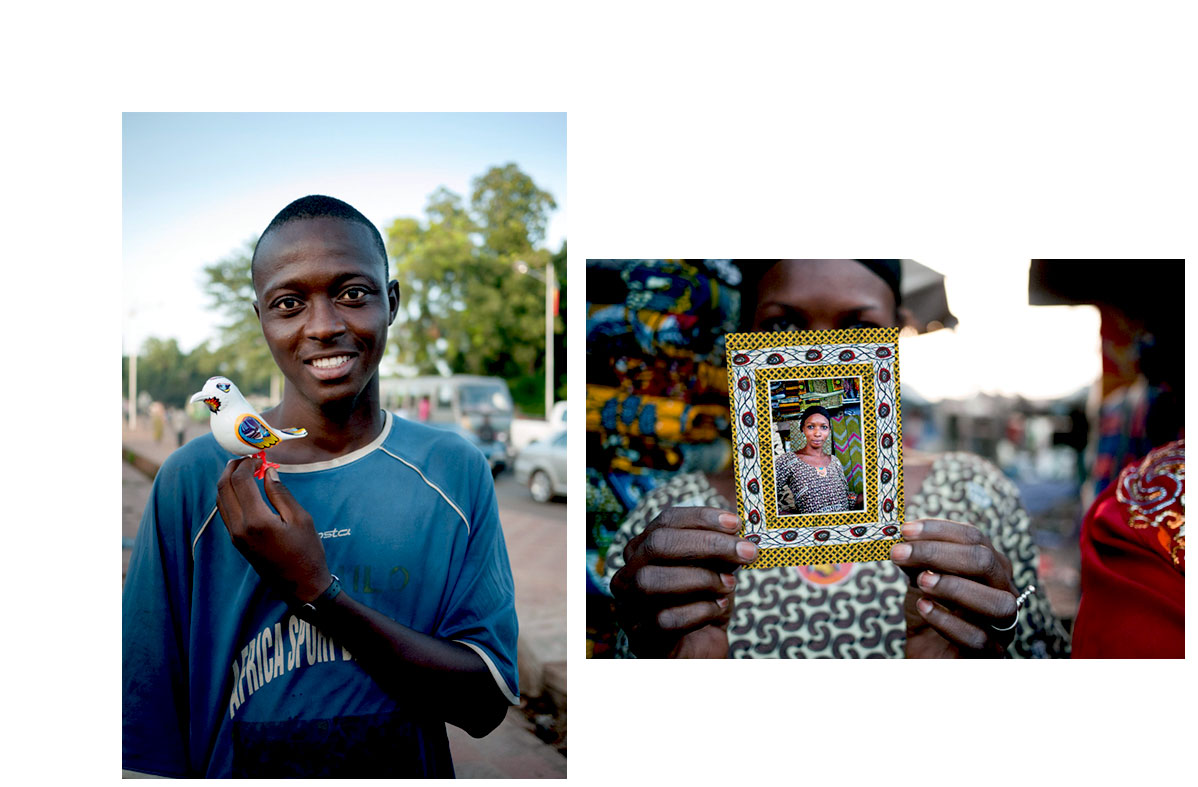
Photo-Rapide 8.75 x 10.75"; 116 pages. Perfect bound. Colophon: "Published on occasion of the exhibition Photo-Rapide: Francois Deschamps. Curated by Daniel Leers; on display from January 23-April14, 2013 in the Alice and Horace Chandler Gallery of the Samuel Dorsky Museum of Art at the State University of New York at New Paltz." Claire Lambe, "Malian Portrait Photography" and "Photo-Rapide": Francois Deschamps at the Samuel Dorsky Museum of Art: "Deschamps riffs off the tradition of the photo studio in ways that are particularly interesting. While in Bamako, he created a studio complete with a hand-painted sign and rubber stamps, but he also went out into the community to find subjects for his project. The title Photo-Rapide comes from the fact that he carried with him a digital printer not much bigger than an iPhone so that, when he found a subject, he could immediately give them a copy of the photograph. He noted that many people, possibly sensitive to exploitation by tourists, were wary of having their photograph taken, so he was very careful to ensure that this was a quid-pro-quo. However, Deschamps didn’t just give them a print, he also carried with him cardboard frames he had made on which were printed a variety of designs and patterns all connected to Mali. The designs include traditional fabric designs, nuts and bolts, herds of goats, fish, vegetables, and images of local currency. One design is a repeat of photographs from the ubiquitous Bamako motor-cycle traffic jam. "Deschamps would offer the subject a choice of frame in much the same way a studio photographer would offer a choice of backdrops. Then he would take a photo of the subject holding the newly framed photograph. This second photograph, in addition to its own intrinsic value, must have acted as an aide-mémoiré for the specific frame the subject had chosen when the photographer came to creating his own copy for the project." Francois Deschamps, Reflections on Photo-Rapide: "In the course of the project, I gave over 500 photographs to people whom I thought of as my clients and collaborators. I picked subjects I liked or respected or who seemed to hold a strong narrative in their lives. Then the process would often get out of my hands as there would be a long line of people waiting to be photographed at which point, I would photograph anyone until I ran out of printing paper or energy. In the picture taking, I would vary the poses - close up, half-body, full body - and the backgrounds. ... "In the final images, I would get excited by the collision of the cultural elements which occurred especially in the re-photography of the framed image. In those images there are at least three levels of choice. First the original portrait picked by the client on the camera back, then the frame chosen by the client, and finally my choice of how to photograph the resulting image in context. ... "Photo-Rapide seeks to honor my subjects and create an image which ultimately reflects positively on Malian culture." $70 |
|
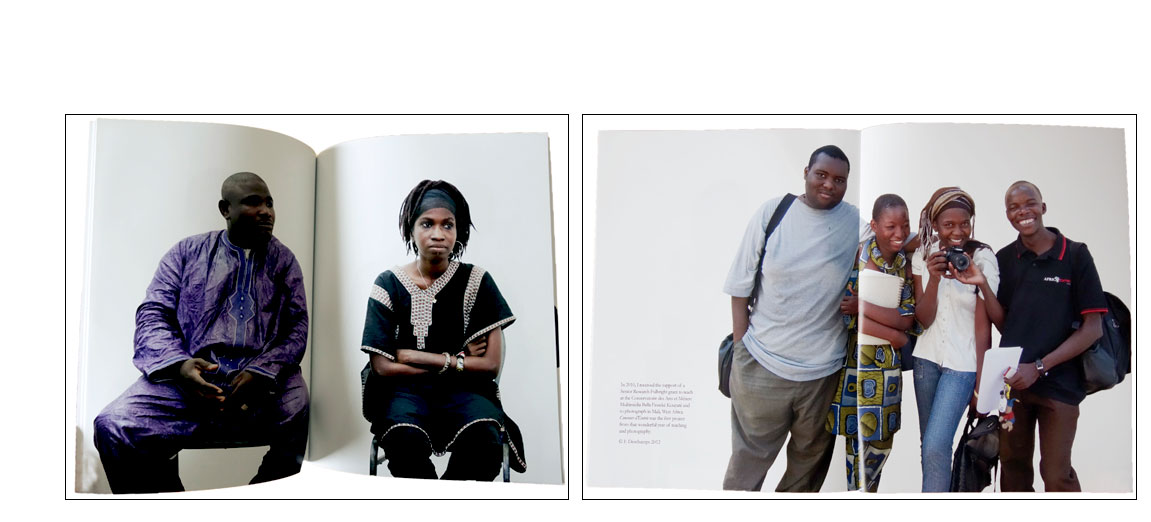
Concours d'Entrée
"To get a sense of the candidate determination and strength under fire, the questions were intentionally tough. The faculty on the panel were often challenging and argumentative." |
 Click image for more |
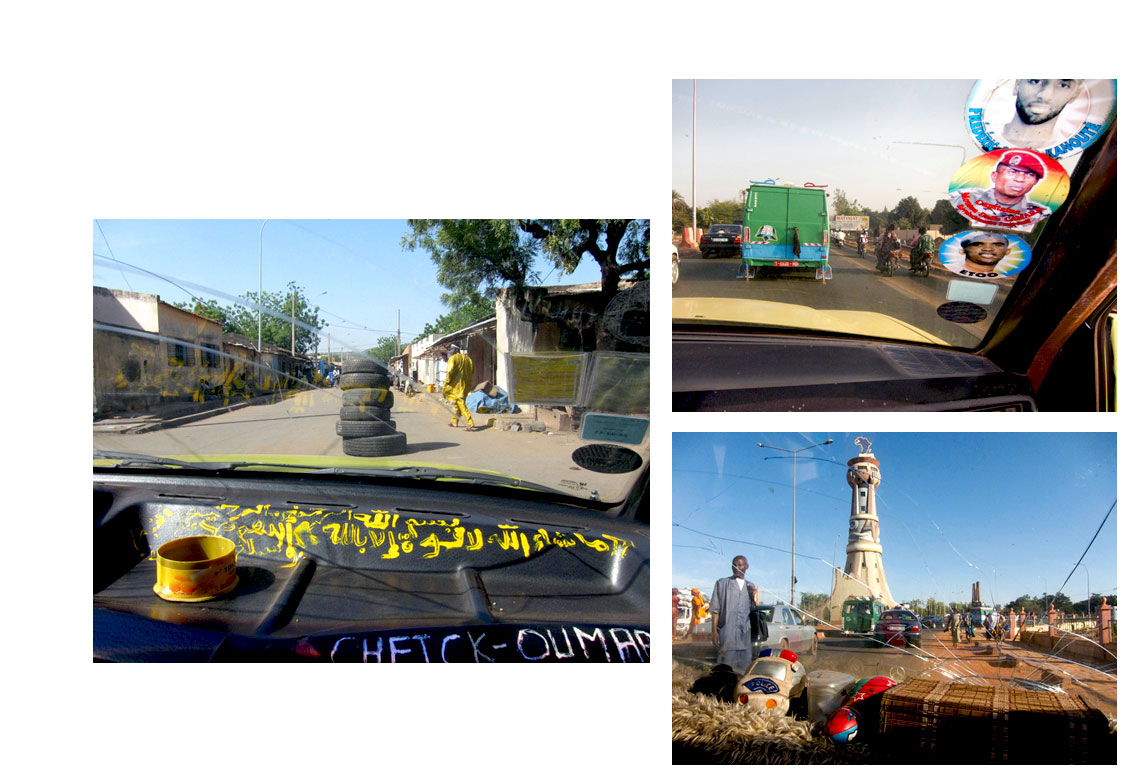
Taxi Bamako $55 |
 Click image for more |
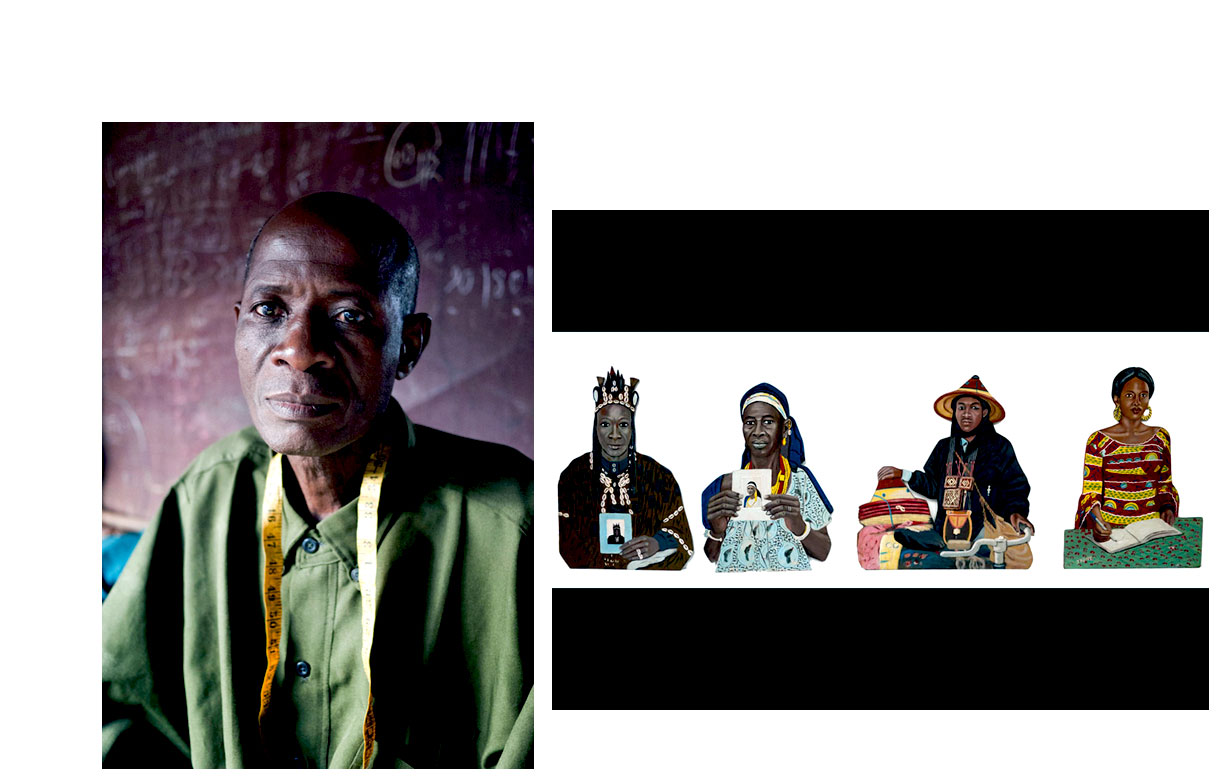
| Les Voyages au Mali 2010-11 A Book of Books Comprising Several Simple Stories ByFrancois Deschamps New Paltz, New York: Francois Deschamps, 2013. Edition not stated. 8.25 x 10.75"; 98 pages. Perfect bound. Glossy covers. Eight chapters documenting Deschamps' time in Mali photographing and teaching. The first chapter is a brief summary of the artist's Photo-Rapide project where he offers to give his subject a photographic portrait printed on the spot with a small digital printer. The other seven chapters are specific to subjects: the children of Mali, the Painter, the stamp maker, the photographer and brick maker, the streets of Bamako, the gift books, and the tailor - all documenting the people and life of Mali. $70 |
 Click image for more |
| Papyrus Productions Out of Print Title: |
|
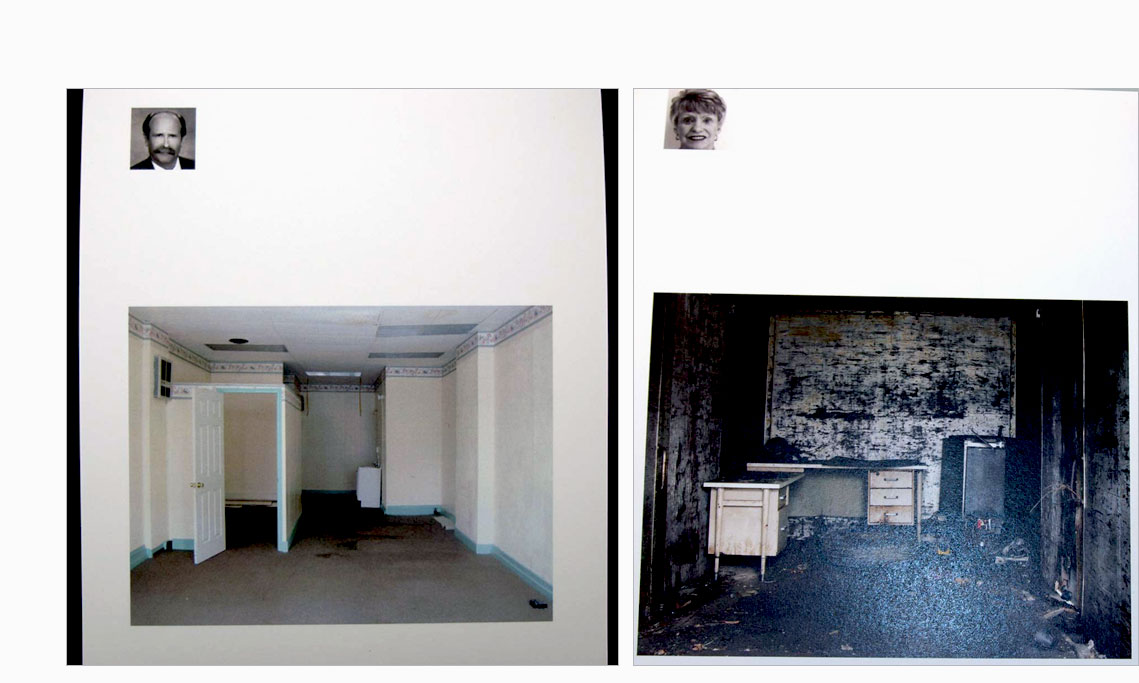
Available 8.125 x 12"; 24 leaves. Post binding. Photography. Available juxtaposes forlorn real estate sites and the agents assigned to sell them. It's a comparison made with Deschamps' characteristic sense of the ludicrous. Papyrus Productions: "Available presents images of real estate opportunities punctuated by pictures of realtors from listing websites. The photographs of spaces are all taken through the windows of storefronts. The discrepancy between the melancholy yet curiously beautiful places for sale or lease and the peppy agents reflects the gap between dereliction and prosperity apparent in many aspects of American culture in the year 2010." |
 Click image for more |
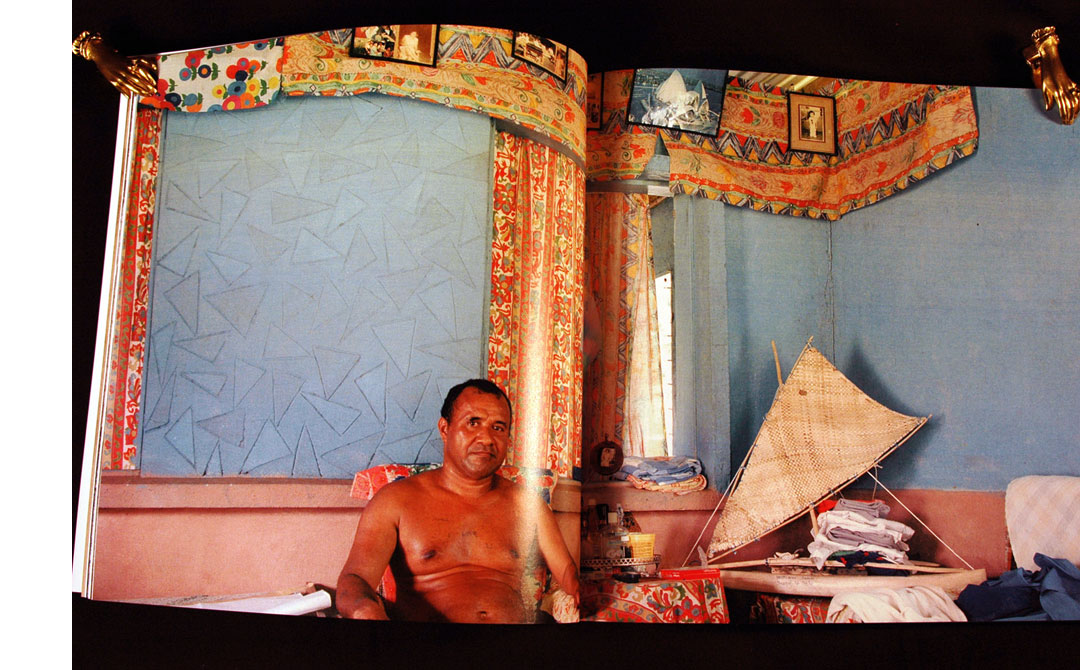
(No Words) 8.5 x 8.5"; 94 pages. Casebound. In pictorial wraps. There are a few words, but the core of (No Words) is a pictorial presentation that calls into question the romantic view most Westerners hold of Oceana, the South Seas, and adventures in paradise. Francois Deschamps: "Juxtaposing historical images and photographs taken in the Pacific from 1994-2001, this book deconstructs the imagery of this highly mythologized region of the world. The sequencing of the images is organized by thematic issues such as death, interracial relations, education, Oceanic waters, and changes in historical representation. An index of the images at the end gives extremely precise information on sources." Francois Deschamps, JAB 27: "I called it (No Words) because I wanted the juxtapositions of historical photographs with new photographs that I had taken to speak for themselves. On page 34-35 there is a short visual history of the Fijian war canoe: this goes from an 1884 account in a missionary journal, to a photograph by the Burton Brothers, to that same photograph translated into an 1880 textbook, and finally a photograph of a model of a war canoe for tourists. This book is about history, change, and the myths we create to understand new experiences." |
 Click image for more |
Page last update: 02.06.2024

Home | About Us | Contact Us | New Arrivals | Fine Press & Artists' Books | Broadsides |Resource Books | Order/Inquiry
Copyright © 2021 Vamp & Tramp, Booksellers, LLC. All rights reserved.