
|
Flying
Fish Press ~ Wisconsin |
Share this page: |
|
 |
Julie Chen: “My approach to the artist’s book involves intensive explorations of both form and content. My work is heavily rooted in the ideas of the book as a physical object and a time-based medium. I view reading as an intimate act in which the reader must be in close physical proximity to the book, can control the pace of reading through the self-directed turning of pages, or equivalent action, and must interact with the book through the manipulation of the book’s physical structure. I strive to present the reader/viewer with an object that challenges preconceived ideas of what a book is, while at the same time providing a deeply engaging and meaningful experience through the presentation of my own text and imagery in a purposefully structured format. Often the reader must engage in unexpected physical actions such as the unfolding or sliding of pages, the turning of a wheel, or the tilting of a box in order to fully read/view a piece.” SFCB Shelter in Studio: Julie Chen / Flying Fish Press https://vimeo.com/489921085 |
|
| "Please note these pieces are made to order and may not be available for immediate delivery. Presently turn-around time could be 3 - 9 months." | ||
| Collaboration projects Julie Chen feature on Craft in America |
||
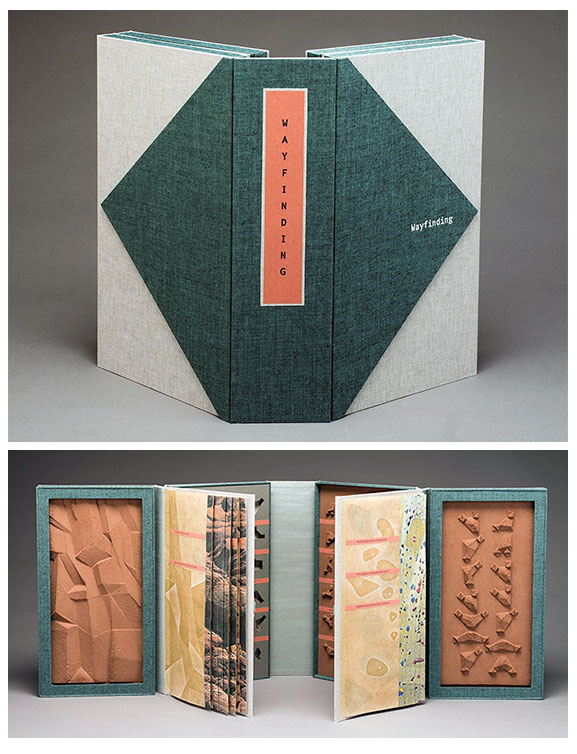
Wayfinding 9 x 16 x 4.5" closed, opening to a full width of 42". Letterpress printed using pressure printing and photopolymer plates on handmade paper from the Morgan Paper Conservatory and Hahnemuhle Bugra paper. Consists of four box trays that are connected by a series of panels. The top layer contains two trays containing cast paper sheets and two booklets assembled in dragon scale binding format. Numbered. Written, illustrated and designed by Julie Chen. Julie Chen: "'Wayfinding' examines the relationship between physical and mental learning through the context of navigation through time and space. The piece focuses the reader’s experience on the physicality of the book as object through the inclusion of three- dimensional cast paper sheets and pages of handmade paper that rattle when turned. A 3-dimensional alphabet abstracted from diagrams of flag semaphore addresses the activities of signaling and translation and how information is taken in by all the senses and not just through the eyes. "'Wayfinding' was inspired by a series of conversations between Julie Chen and her daughter Eleanor Chen-Ranstrom about pattern texture, perception and learning. This book consists of a series of four box trays that are connected by a series of panels. The top layer contains two trays containing cast paper sheets and two booklets assembled in dragon scale binding format. The first booklet focuses on the perspective of a physical learner and the second booklet is written from the perspective of a mental learner. When the book is opened to the second layer of trays and panels, the translation of an alphabet from gesture to symbol to three-dimensional abstract shapes is revealed, giving the reader the tools needed to decipher some of the abstract elements found throughout the book." |
||
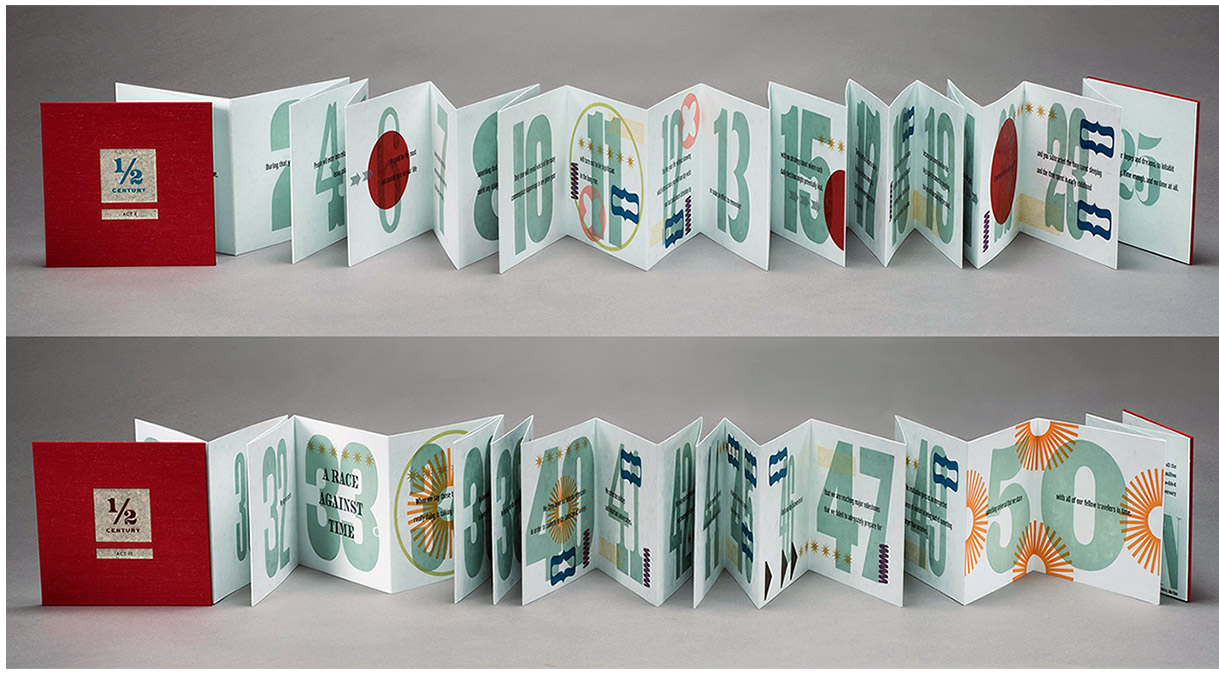
Half Century 6 x 6" closed, extends to 174"; 56 pages. Double-sided accordion. Numbers printed at the Hamilton Wood Type Museum. Smaller type printed from photopolymer plates using typefaces from the P22 Type Foundry' s Hamilton Wood Type Collection. Bound in cloth-covered boards. Signed and numbered by the artist. Laid in matching cloth-covered clamshell box with magnet closure. Written, illustrated, and designed by the artist. Colophon: "Half-Century is dedicated to Sandra Kroupa, Book Arts & Rare Books Curator, on the occasion of the 50th anniversary of her career at University of Washington Libraries, Seattle, WA." Julie Chen: "The text of Half-Century considers the complexity of our relationship to time in our daily lives. We think we understand how time works, but our public beliefs about time may not sync up with our private beliefs about time. Our conception of time changes over the course of a lifetime but we often only realize this at milestones and/or traumatic moments in our lives. Imagery includes a variety of large wood type numbers that were printed at the Hamilton Wood Type Museum in Two Rivers, WI, along with an abstract visual timeline illustrating a pattern of significant life events over a 50-year period." Kathryn Leonard, Conservation Librarian at the University of Washington, provided information for the abstract visual timeline that is embedded in the book. |
|
|
| Collaboration projects with other artists | ||
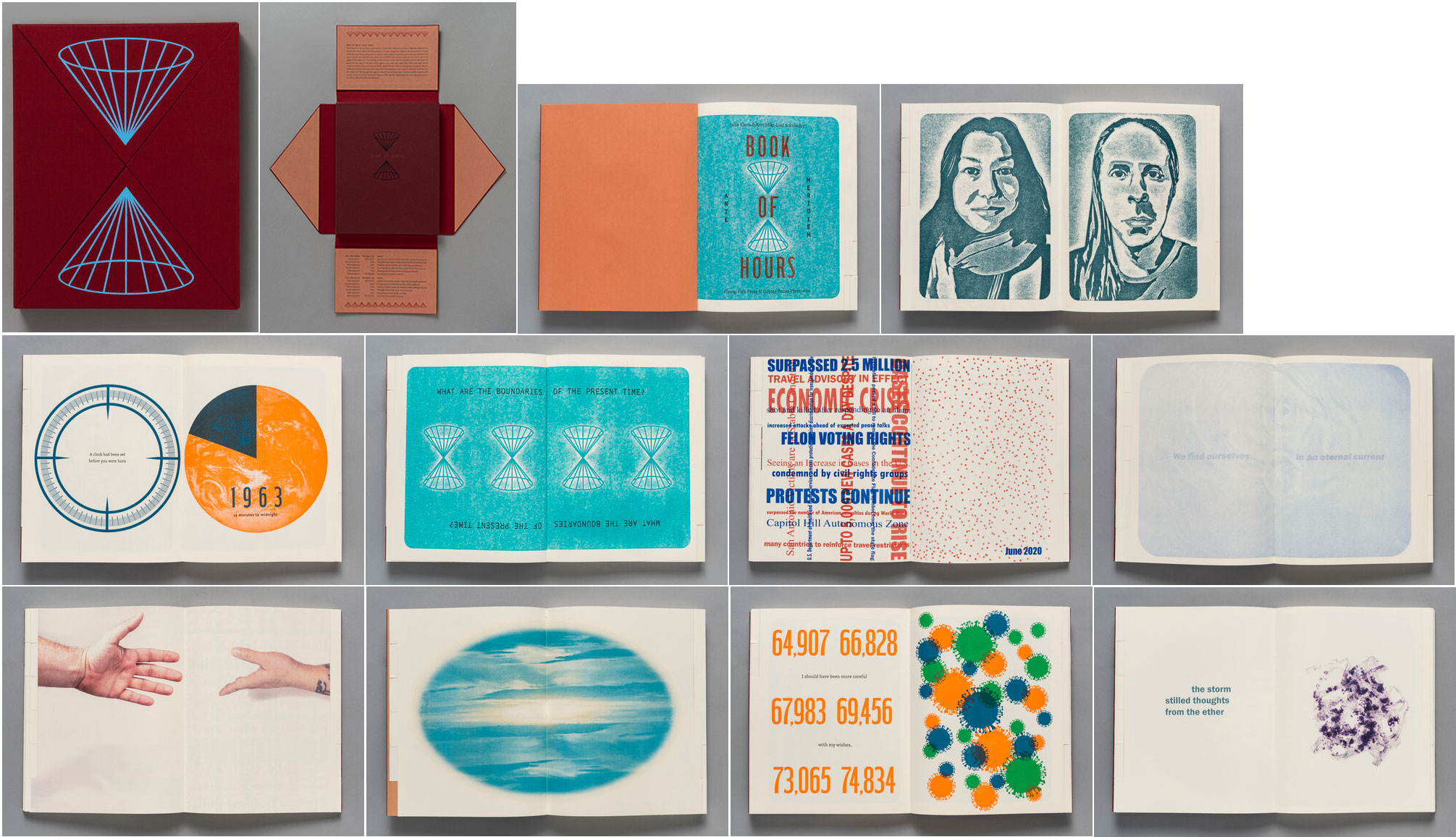
Book of Hours 8.5 x 11 x 1 7/8 inches book in 8 5/8 x 11 7/8 x 2 inches four flap box enclosure. Blow book structure. Print methods: letterpress, digital, and Risograph. Papers: Mohawk Superfine, Mohawk Keaykolour, and Hahnemühle Bugra. Binding completed at Flying Fish Press and Coyote Bones Press. Box designed and fabricated by Keri Miki-Lani Schroeder. Signed and numbered by the artists. Coyote Bones Press: "'Book of Hours' was designed and created by Julie Chen & Keri Miki-Lani Schroeder. This long-distance collaboration, between California and Texas, took place during the 2020-21 pandemic. The format of 'Book of Hours' is known as a blow book, a historical structure originally designed as a magic trick which allows the presenter to show completely different visual sequences of pages within the same book. “'Book of Hours' contains 12 distinct sequences. The first and last sequences on each side of the book were designed by the two artists collaboratively, and the other eight sequences were designed individually by each artist. These different narratives exist concurrently within the same space and time of this book but are activated sequentially by the reader. The cone motif used throughout this book was inspired by the concept of the light cone which in general and special relativity denotes a single point in space and time." |
||
| Flying Fish Press Out of Print and SOLD titles: | ||
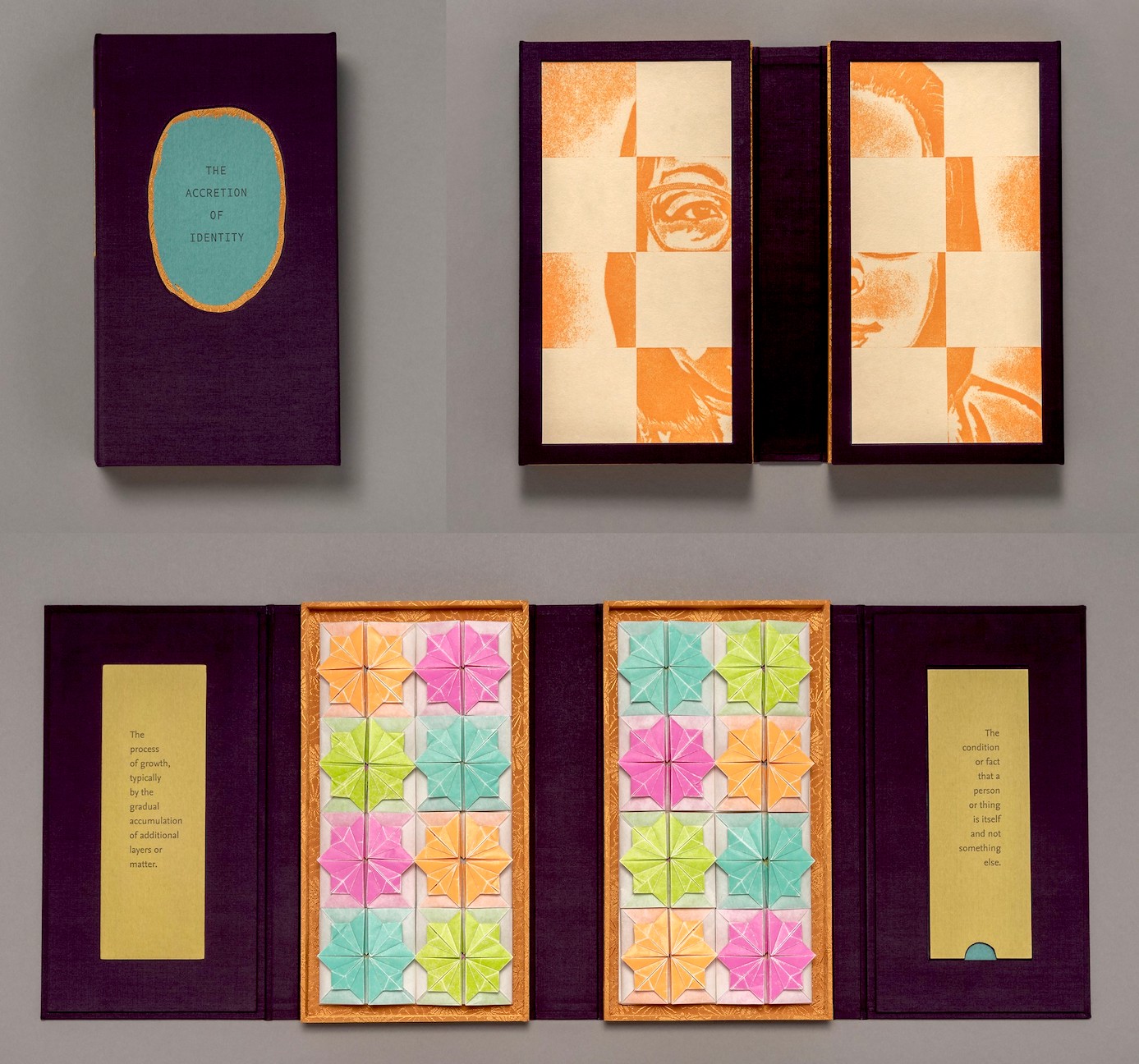
The Accretion of Identity 5.375 x 9.625 x 1.625” closed, opening to a full width of 24.5”. Letterpress printed from photopolymer and pressure plates on handmade abaca and Japanese papers. Chinese thread book (zhen xian bao) structure. Constructed with four levels of folded boxes housed in a box with a magnetic closure. Julie Chen: “’The Accretion of Identity’ explores various ways in which individual identity is developed. We might assume that identity is largely self-determined, but many factors, some easily discernible and others hidden from view, go into the process of defining who we are. The persona we embrace as our own is not solely made up of conscious choices but is instead a constant process of adaptation to our surroundings. For people of color there is an added layer of external expectations and assumptions that must be confronted. Family, community, and everyday interactions with strangers all influence our continually evolving sense of self in both overt and subtle ways. “I took my own identity for granted as a somewhat finished process until the pandemic changed almost everything about everyday life. In this new environment, could I continue to be the exact same person that I was before? Pandemic times forced me to consider my sense of self with fresh eyes and to notice how tightly the past and the present are inextricably intertwined." |
||
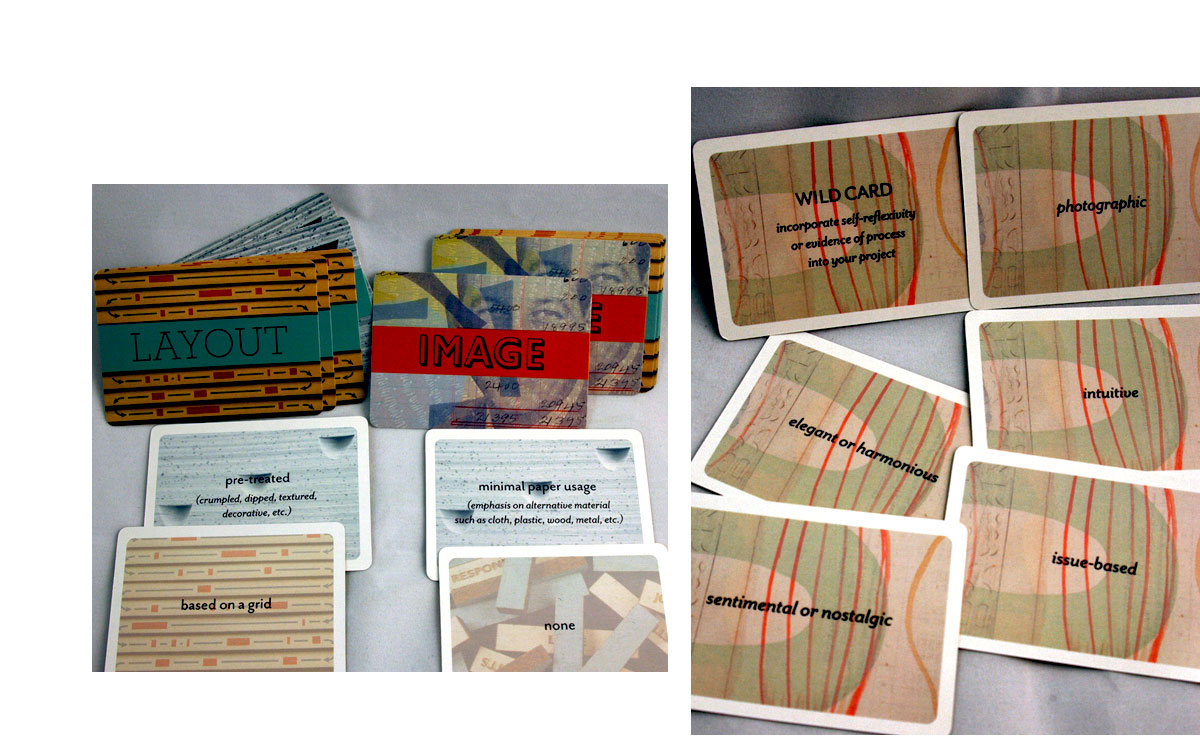
Artist's Book Ideation Cards 3.75 x 5.5 x 1"; 108 cards. Two decks of cards in lidded acrylic box. Barbara Tetenbaum: "The Artist's Book Ideation Cards was designed as an aid to the book artist, to jump start a new project or inform one in progress. There are two decks in the set: Category Cards containing approximately 8 cards in each of the 7 categories (text - image - structure - paper - layout - technique - color) and 54 Adjective Cards of which 3 are wild cards. Choosing a card randomly from each of the seven categories and five cards from the adjectives offers an unexpected recipe for a project." Julie Chen: "The first deck of cards has different categories related to the basic parts of a book: text, image, structure, color, and layout. A second deck contains adjectives to be used for added influence." |
|
|
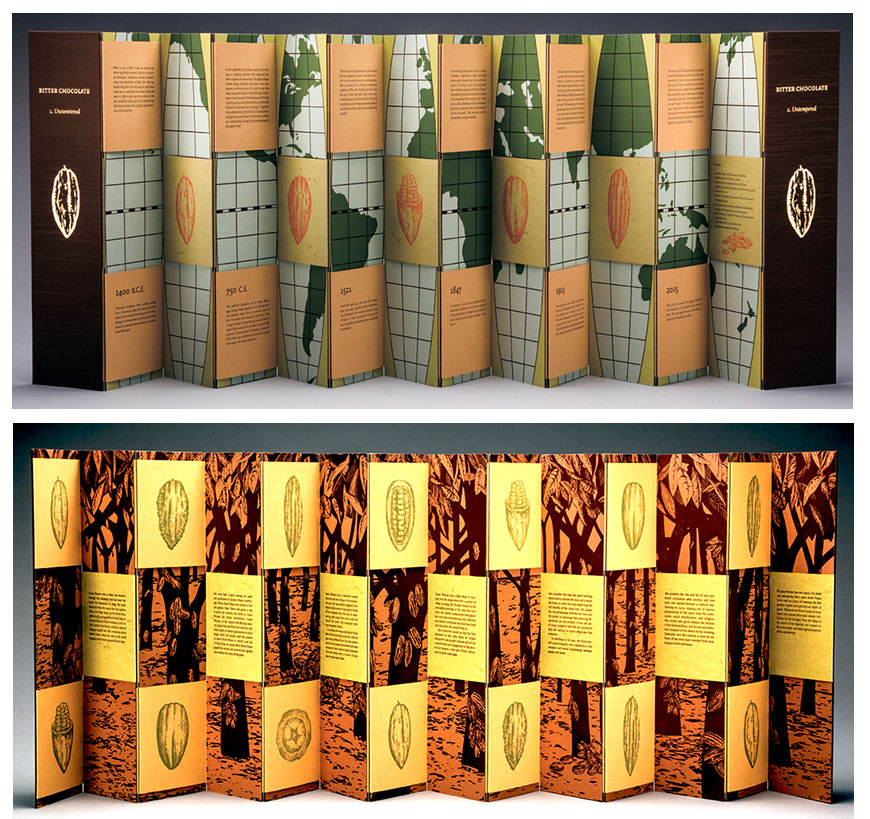
| Bitter Chocolate By Julie Chen Berkeley, California: Flying Fish Press, 2016. Edition of 50. 3.5 x 14.75 x 1.875" closed, extends to 25.75”. Letterpress from photopolymer plates on a variety of handmade and commercial papers. Jacob's ladder construction. Illustrations by Keri Miki-Lani Schroeder and Julie Chen. Text by Julie Chen. Presented in a portfolio case with magnetic closure. Signed and numbered by the artist. Julie Chen: “Bitter Chocolate is an exploration of chocolate through the lenses of fact, fiction and culture. The book weaves together a fictional mythological narrative with historical facts and the artist’s own personal experiences to create a portrait of chocolate that is both lyrical and unsettling. The Jacob’s ladder structure allows for four distinct presentations of content. The book is first unfolded into accordion format, presenting the reader with visual and written content on each side. Then the page panels can be flipped over within the hinge straps that connect them revealing the second half of the content. The full meaning and impact of the story is only revealed when all four parts of the content are discovered and read.” Just Look exhibition catalog: "A Latin American oral folktale about Ixcacao, the Mayan goddess of chocolate, was the springboard for Julie Chen's wholly new version of the myth. Titled 'Bitter Chocolate', it features an Ixcacao-like character named Cacao Woman. "In the original narrative, Ixcacao is revered for abundantly providing for the people and showing compassion and wisdom in seeing to their needs. Then it happens that a ruling class of kings and noblemen comes to power. Science and the arts flourish but, sadly, the peasants suffer. "Ixcacao is forced to marry the God of Commerce who turns her cocoa beans into currency. Because of its new monetary value, chocolate is forbidden to the common people. Later, the goddess of chocolate manages to bring joy back to the people. But the plan, though at first successful, backfires; war and disease pervade the land. "Chen augments and varies the legend, adding many nuances to the character of Cacao Woman. She is powerful and yet self-effacing. Although she cherishes the cacao trees in the rainforest, she also worries about their future. Uncertain about the complex and changing relationship between the people and chocolate, Cacao Woman even questions her own culpability in the evolution of that relationship. Chen writes, 'If Cacao Woman has one regret it is about not intervening when cacao beans began to be used as a form of currency, for this practice turned each pod into an object of greed. Tribute in the form of sacks of cacao beans was exacted from each weaker civilization by the stronger, from the Maya to the Aztecs to the Spanish, and onward to the unfortunate and unjust global practices of the 21st century.'" (Out of Print) |
|
|
Cat's Cradle Text: self-generated |
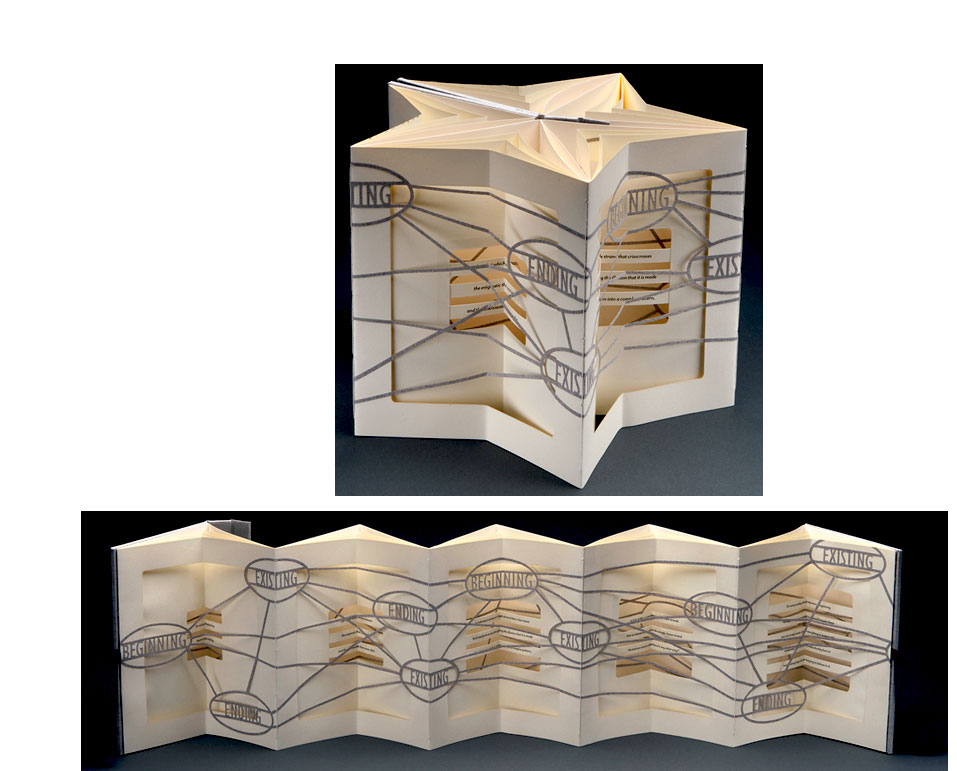 Click image for more |
|
| Chrysalis By Julie Chen Berkeley, California: Flying Fish Press, 2014. Edition of 50. Box size: 6.75 x 11.75 x 6.625". Cloth-covered. Removable lid with colophon tipped to interior. Door front with see through panel and paper title. Book object sits on padded cloth base. Text panel with ribbon pull in base. Book object size: 7 x 11 x 7" closed; 11.5 x 18" opened. Letterpress printed on handmade paper using photopolymer plates. Signed and numbered by the artist. Flying Fish Press: "Chrysalis is an interpretation of the complex and transformative nature of the process of grief. The piece consists of a sculptural book object housed in a box. The book object is held together by a series of magnets and can be opened by the viewer until all the panels lie in a flat plane, revealing an inner book with circular pages that can be held in the hand and read." Colophon: "The shape of the outer structure is a version of an oloid, a geometric shape discovered by sculptor and mathematician Paul Schate in 1929. An oloid is defined by the space created by two linked circles that intersect on perpendicular planes. It is the relationship of the circles that creates the shape." (SOLD/Out of Print) |
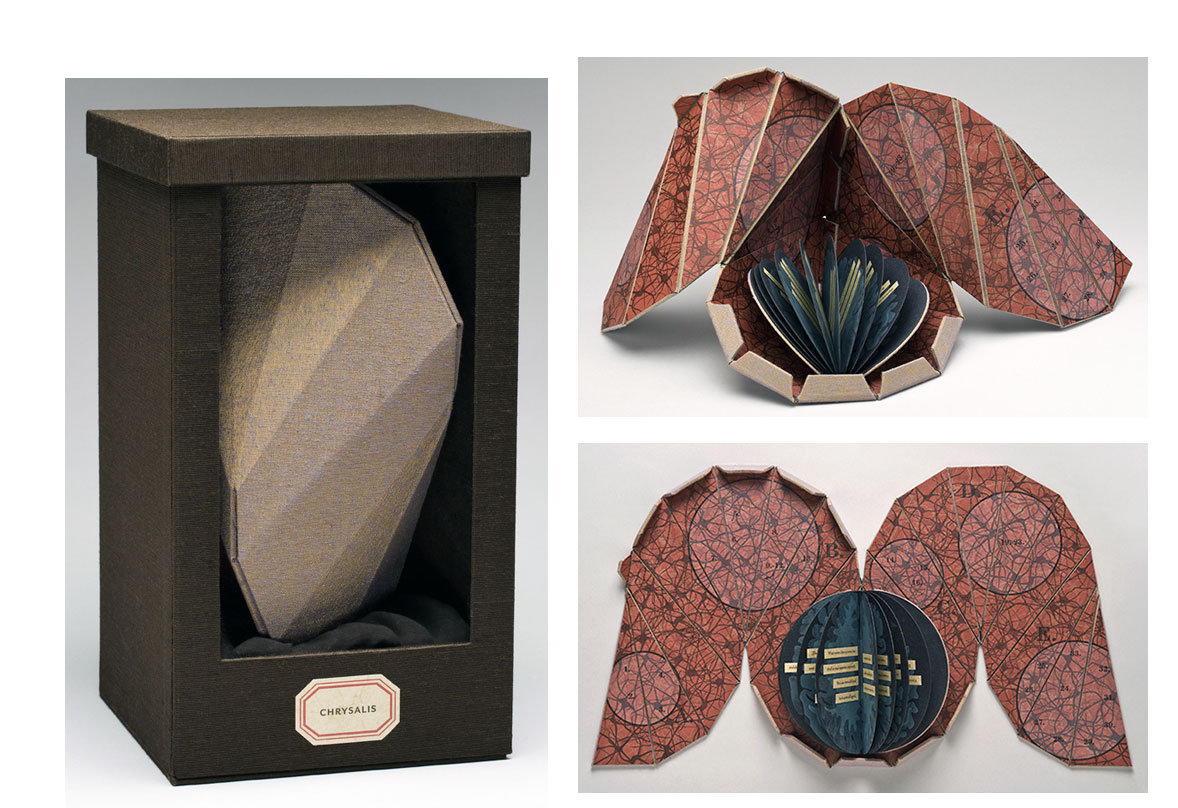 Click image for more |
|
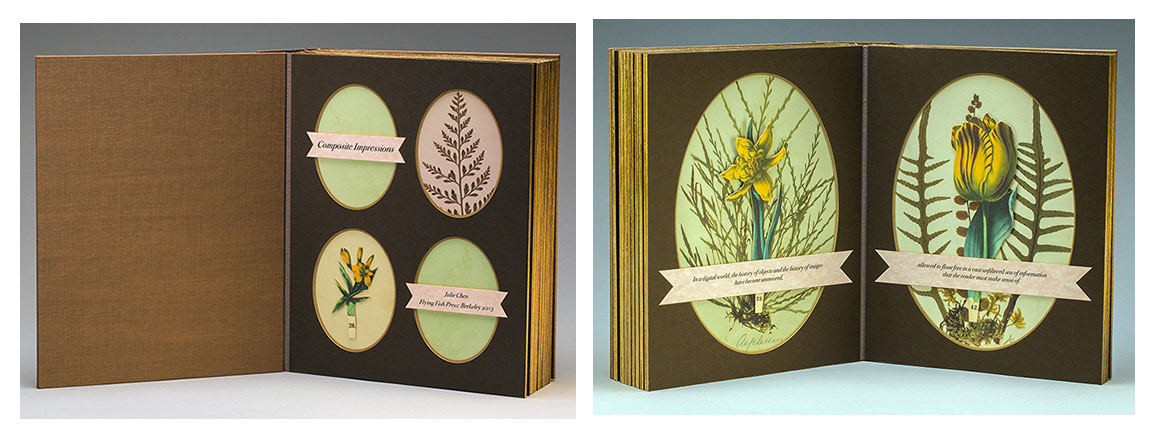
| Composite Impressions By Julie Chen Berkeley, California: Flying Fish Press, 2014. Edition of 50. 7.75" x 9.75" x 2.5"; 22 unnumbered pages. Digitally printed text and images. Oval cut outs in brown book board frame flora cutouts. Text across images printed on strips v-cut like decorative ribbons. Materials: paper, book board, bookcloth, acrylic paint. Written and designed by Julie Chen. Fern images photographed from an album of pressed ferns collected by Miss Mills, circa 1880, in the Sir George Grey Special Collections, Auckland Libraries, Auckland, New Zealand. Flowers reproduced from Das Reich der Blumenkonigin, circa 1880, in the Special Collections at the University of Washington libraries, Seattle, Washington. Bound in cloth boards with gilt edges and titles on front board. Signed and numbered by the artist. Flying Fish Press: "Composite Impressions examines the meaning of images and objects in relation to the activity of reading in today's digital age. The book presents images of natural objects and replicas of paper objects, both originating in the 1880s, combined with text that is self-referential in nature. Composite Impressions poses questions about the meaning of the reading experience, and asks the reader to assess his or her own reading process as it is occurring, both through interaction with the text and through interaction with the physical format of the book itself." (SOLD/Out of Print) |
||
Correspondence Course 6.5 x 9". Canson Vidalon, Coventry Rag, and Elephant Hide papers. Typefaces: Gill Sans Condensed & Kaufmann. Card images screen printed by Thomas Wojak. Letterpress printed. In paper-covered slipcase. A feast of text and image, visual and language puns, using cards slipped into pocket pages so that they can be swapped back and forth. Set up in sections as a textbook with divider pages & tabs. Contents: Foreword; Philosophy; World Studies; Household Arts: Transportation; Health Care: Life Science; Social Studies; Afterwords. |
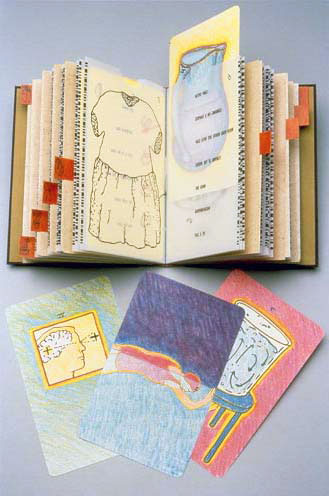 Click image to enlarge |
|
Family Tree Created using Artist Book Ideation Cards for an Ideation show at the Abecedarian Gallery in the fall of 2013. Technique: unfamiliar Julie Chen: "I struggled with this draw at first mainly because of the 'no text' prompt that I originally got. In the end, I decide to exercise my option to throw one card back, and drew a new card from the text category. My original plan was to create a deck of cards, but as my ideas for the project progressed, I became more and more interested in the idea of random access of content that was afforded by creating something that was unbound. This eventually led me to the idea of creating a set of blocks so that each individual block in the set would have six possible sides of content that could be mixed and matched with the six possible sides of all the other blocks. The theme for the piece was based on work that I was already involved with on the theme of family history and personal identity. As is often the case with my process, my structure ideas turned out to inform my content ideas in unexpected, but meaningful ways." |
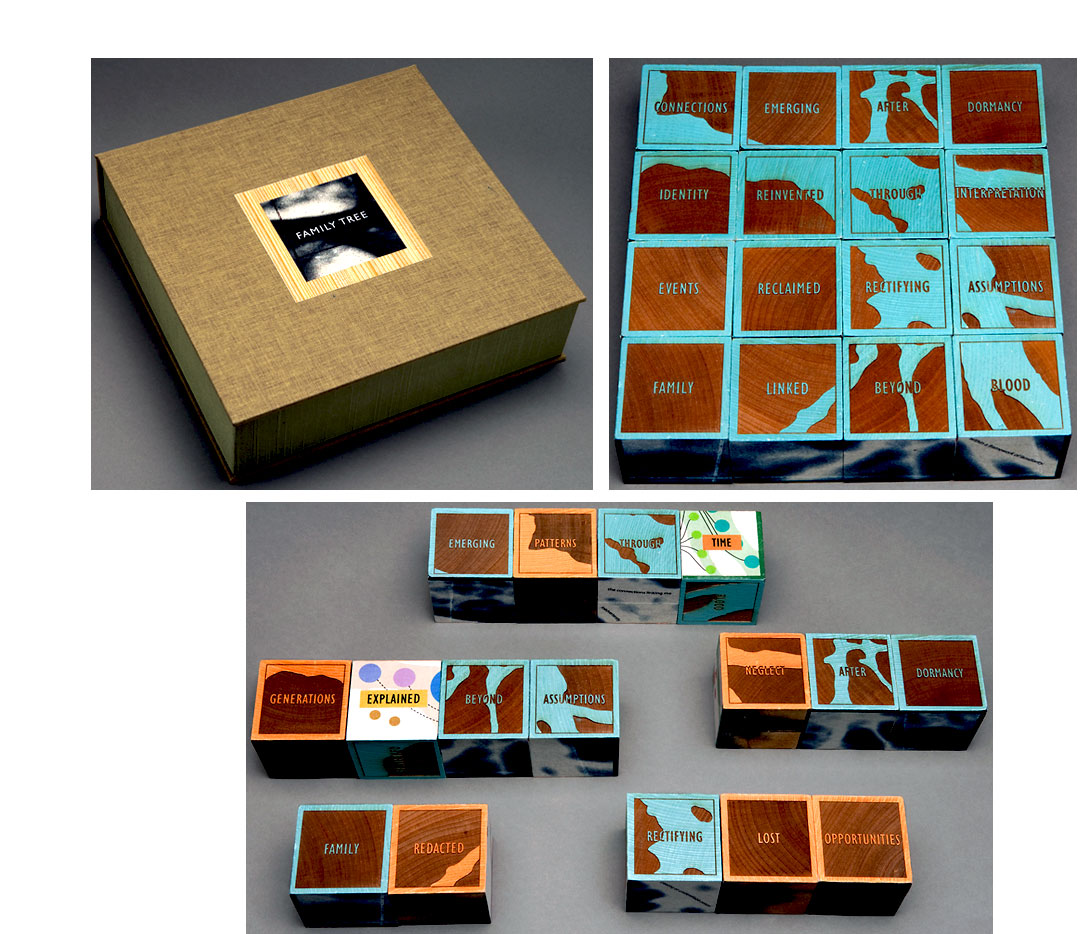 Click image for more |
|
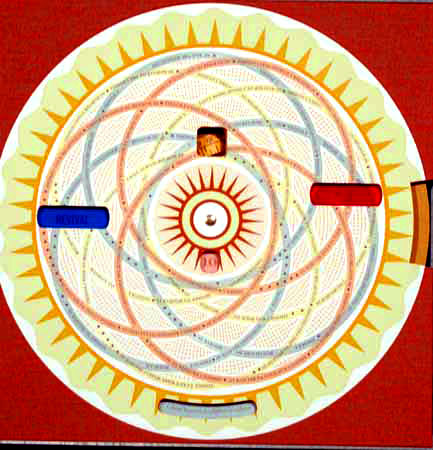
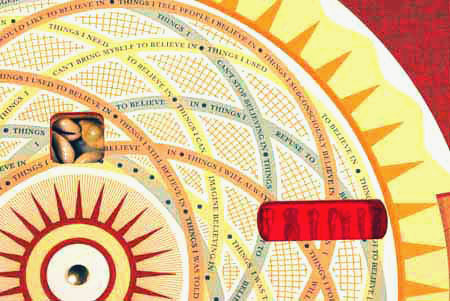
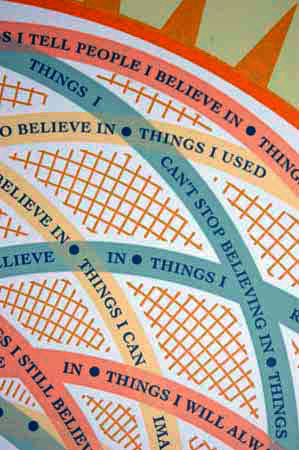
Full Circle Rotating wheel in a 15" x 15" x 3" silk-covered box. Full Circle — like so many of Julie Chen's bookworks — offers the sensation of being caught up in something at once momentous and personal. Another elegantly clothed, unmistakable Chenbox opens to reveal a marvel of execution and effect. Once again, Julie Chen takes physicality, an essential part of all books, and makes it a vital element of expression. A spinning wheel — that the reader controls and rotates — suggests a clock, or progressive stations along some journey. The contents of the book are viewed by turning a wheel and pausing whenever text and image are centered in 4 windows. At 3 intervals a drawer lines up with the opening in the front of the box. Pulling a tab reveals a tongue-like 3-dimensional diagram of the mind and heart in relation to each other. The subject? The clue is on the face of the top of the box: an array of intersecting circles hold phrases like "Things I was told to believe in," "Things I would like to believe in," "Things I used to believe in." Full Circle is about belief, or more pointedly, about cycles of belief. As the wheel moves from stage 1 to stage 12 (12 stations?), the windows offer four different ways we can chart belief: a single word, objects, the image of a body part, a sentence. At station 1 are the single word INQUIRY, some tear-shaped egg-like objects, the image of a closed mouth, and the sentence "I look for you but you will not speak to me." At each stage the windows have new content. At each stop connections between the windows are left up to the reader. And, as the stages progress, so is the developing story. Full Circle demonstrates that the cycle of belief is the same for all, but different in the particulars. Over and over, Chen's works have a foundation of social connection. Early in her career, the connection was in collaboration with others; lately, her works have insisted on reader/viewer participation, directly as in Personal Paradigms or now indirectly as in Full Circle. Is it about how belief intersects with human relationships? Is it looking at religious belief? When queried, Julie Chen wrote, "the text if purposefully ambiguous about whether the main reference is religion or relationship. It's not exactly about either, but more about the daily cycles of belief that we go through all the time without even realizing it, but that make life bearable. Things such as believing that we will never get seriously ill or lose our jobs—can't happen to me, right? We don't actually have any control of these things, and have to rely on faith to not be swallowed up by anxiety all the time. The objects in the window aren't meant to have deep meaning in relationship to the text. Rather, they are like talismen, reminders or lucky charms — place markers for belief. I chose them because I liked the intuitive connections which are not easily explainable. I like the idea that viewers are searching for their own ideas of what the objects might mean." The experience of Full Circle is the practical gloss on the bleak view — I can't go on, I go on — Beckett presented to the world 50 years ago in Waiting for Godot. Full Circle acknowledges the presence of ambiguity in our lives, but, most wonderfully, demonstrates that ambiguity and delight can co-exist. Julie Chen's bookworks have always been lucid without being transparent, accessible without being simplistic. Her recent works, most pointedly True to Life and now Full Circle, offer evidence that memory is fluid and that getting though the day (and the night) calls for belief and the suspension of belief in an ongoing cycle. |
|
|
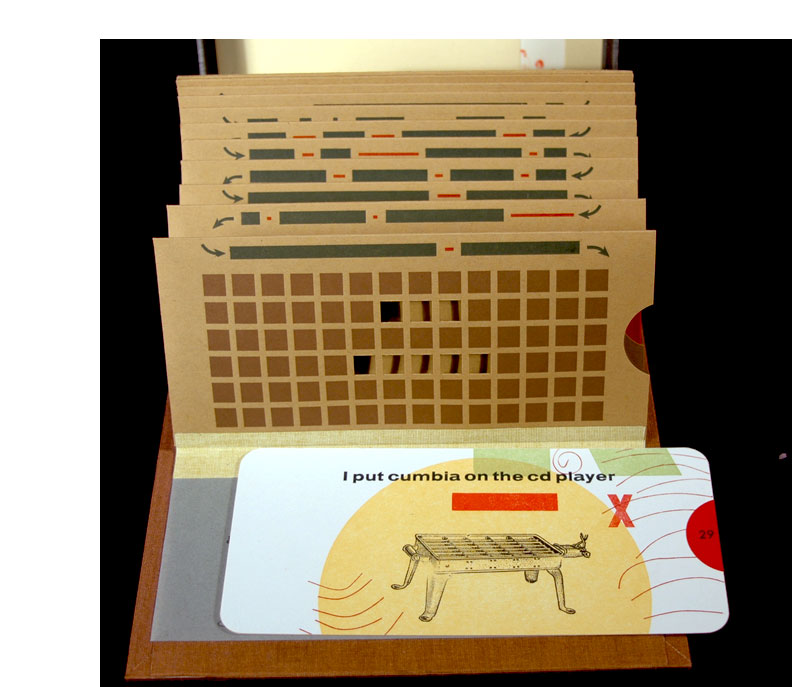
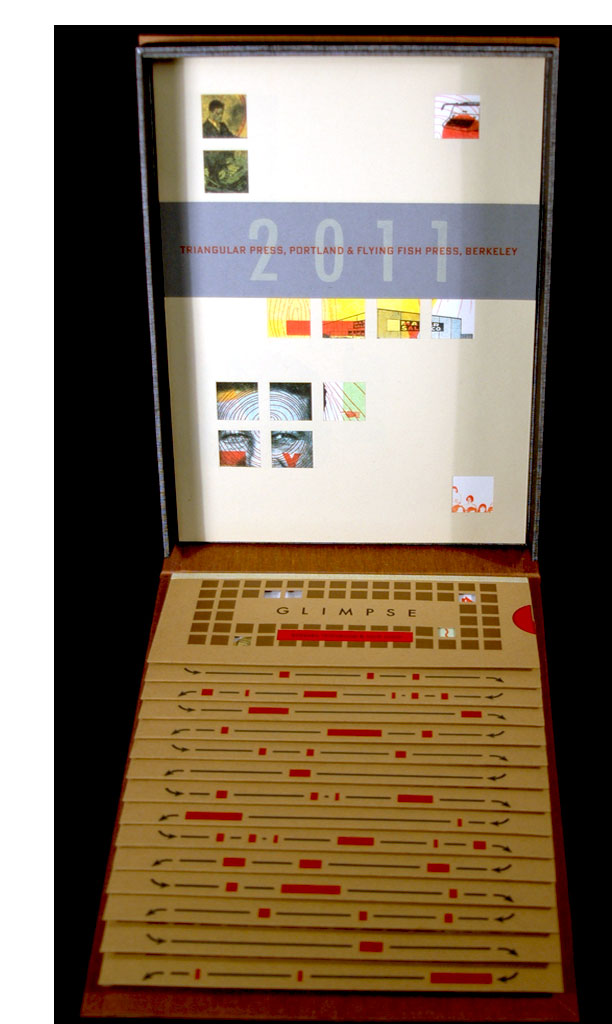
| Glimpse By Julie Chen and Barb Tetenbaum Berkeley, California / Portland, Oregon: Triangular Press / Flying Fish Press, 2011. Edition of 100. 8.125 x 11.25 x 1.25"; 15 sleeves, 15 cards. Printed letterpress from handset type, wire, antique news cuts, dingbats, and photopolymer plates. Pages formed by envelope sleeves open ended on right. Each sleeve with miniature square window cutouts, and no sleeve with the same cutout pattern. In the form of a tablet with overlapping staggered 7.5 x 3.5" pages. Sleeve enclosure is attached to box of cloth-covered boards with title tipped on front. Signed by both artists. Triangular Press / Flying Fish Press: "Working together again after almost a decade (Ode to a Grand Staircase, 2001), Glimpse is a new collaboration between Barb Tetenbaum and Julie Chen inspired by a conversation about how a person translates their life experience into a narrative form: prominent events may stand out as the nameable moments, yet it is the space between these events that life, in fact, is lived. "The mid-century photo album structure contains text written by Chen, examining this question. Her text is printed on both surfaces of each of the 15 hinged sleeves. Windows in the sleeves reveal small glimpses of the pull-out cards, each written and printed by Tetenbaum and containing dates and events of the non-important moments of her life. These texts are supported by diagrams, grids, and mundane imagery." Working together again after almost a decade (Ode to a Grand Staircase, 2001), two divas of the book arts world present a life lesson elegantly – as expected – and precisely – which is not quite a red herring, but at least pinkish. Glimpse contrasts the series of discrete events we use to define ourselves and the unexamined "spaces between events … when much of life is actually lived." The suggestion is that we should pay more attention to those in between times ("waiting for something else" times, perhaps, in John Lennon's terms). If we want certainty, as the precision of the books surface design seems to suggest is possible, we'll be disappointed, as the subtext – both in design and text – suggests. The glimpses provided by the book – through the windows in each sleeve – don't offer much with which to construct a human being, or even suggest at the woman/women behind them. If you pull out the cards, note the precise date and time, take in the fragmentary description of an event, make yourself aware of the stylized antique news cuts laden with stereotypes and implied significance – what do you have? What remains is the sense of something significant in the artifact and its implied significance. Perhaps the lesson is that we shouldn't be suborned by the obvious; it's always too scant, too easily misconstrued by our own desire for self-myth. It's part and parcel of Yeats' observation: We still can't tell the dancer from the dance, the water from the wave. We are. And some can make art. It's a glimpse of what we should cherish. (SOLD/Out of Print) |
|
|
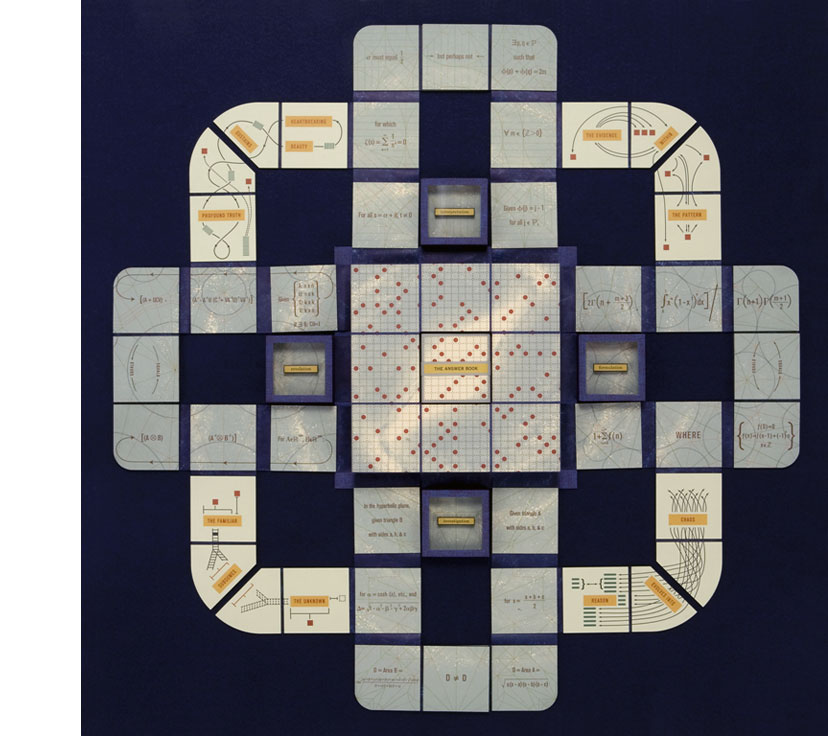
A Guide to Higher Learning 11.25 x 11.75 x 3.75" cloth covered clam shell box. Letterpress printed from photopolymer plates. Interior lid contain instructions on how to unfold the book. Bottom tray has instructions on how to refold the book. Includes 34 x 34" folded felt cloth for displaying and reading the book. Cloth folds into the center of the structure. Book consists of a central box surrounded by rows of square pages on all four sides. To read the book the whole assembly must be lifted from the tray and placed on the center of the cloth. Each square page is numbered clockwise. The reader thus begins with page 1 on the right and continues around the structure clockwise through page 12. Accompanying the structure is a 3 x 3" book, "The Answer Book." It is laid in the center of the book assemblage. Julie Chen, in "The Answer Book": "A Guide to Higher Learning includes many elements that are highly technical in both language and concept which often go far beyond my own level of knowledge. I would like to thank the following people for their contributions to this project. Henri Ducharme and Laura Norin supplied all the mathematical formulas and equations that appear in the book and spent much time and effort trying to explain to me what they mean. The intricate patterns of lines that appear with the equations are origami crease patterns by Robert J. Lang and are used with his kind permission. "The mathematical statements are from the four branches of mathematics: abstract algebra, analysis, geometry, and number theory. The abstract algebra and analysis loops demonstrate the central concept of unity in mathematics. Each of the four equations has a version of '1' as its solution. The geometry loop evokes the surprise of newer geometries incompatible with Euclid's mathematics: once thought to be true absolutely is now true only conditionally. The vastness of mathematics yet unknown is hinted at by the conjectures in the number theory loop. Mathematics have been trying to prove or disprove these conjectures for centuries, but still do not know if either is true. "The origami crease patterns of Robert J. Lang that appear in the four quadrants of the book are shown here in miniature with descriptions and opus numbers of the amazingly detailed forms that can be made, each from a single piece of folded paper, by following the diagrams. "At the center of this book is the beginning of an Ulam spiral, which illustrates the discovery that if the counting numbers are arranged on a spiral grid, the prime numbers - shown as red dots - form surprising and unexpected patterns." (Finalist in the 2011 MCBA Prize) |
||
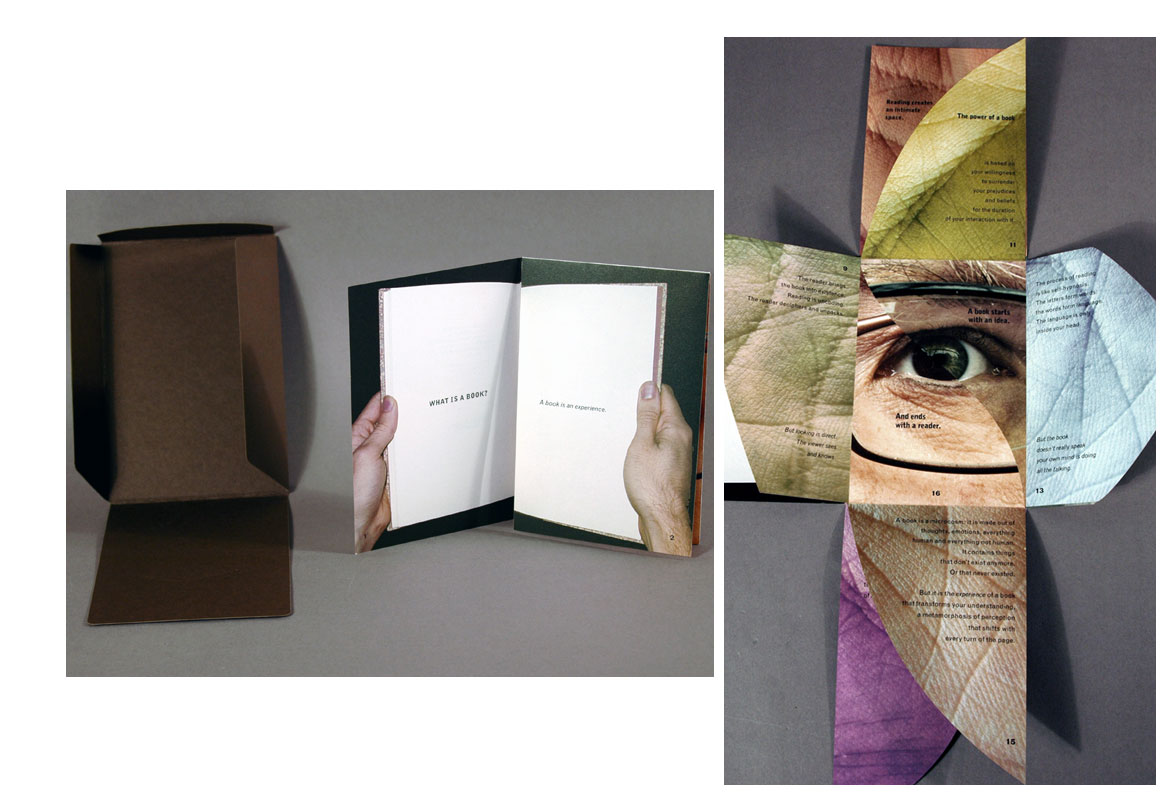
| How Books Work By Julie Chen and Clifton Meador Berkeley, California / Chicago: Julie Chen and Clifton Meador, 2011. 4 x 6"; 16 pages. Offset lithography using non-process colors. Interleave structure. Laid in letterfold paper wrapper with slip-in closure. Written, designed, and produced by Chen and Meador at Flying Fish Press in Berkeley, California and the Center for Book and Paper at Columbia College in Chicago. In an age of electronic media and virtual simulacra "What is a book?" is a common question. This is the question that Chen and Meador, two veteran practitioners near the top of any serious list of contemporary book artists, address in "How Books Work." This elegantly simple book marries structure and content in the best tradition of artists' books. It begins: "What is a book? A book is an experience." And ends: "A book starts with an idea. And ends with a reader." (Out of Print) |
 Click image for more |
|
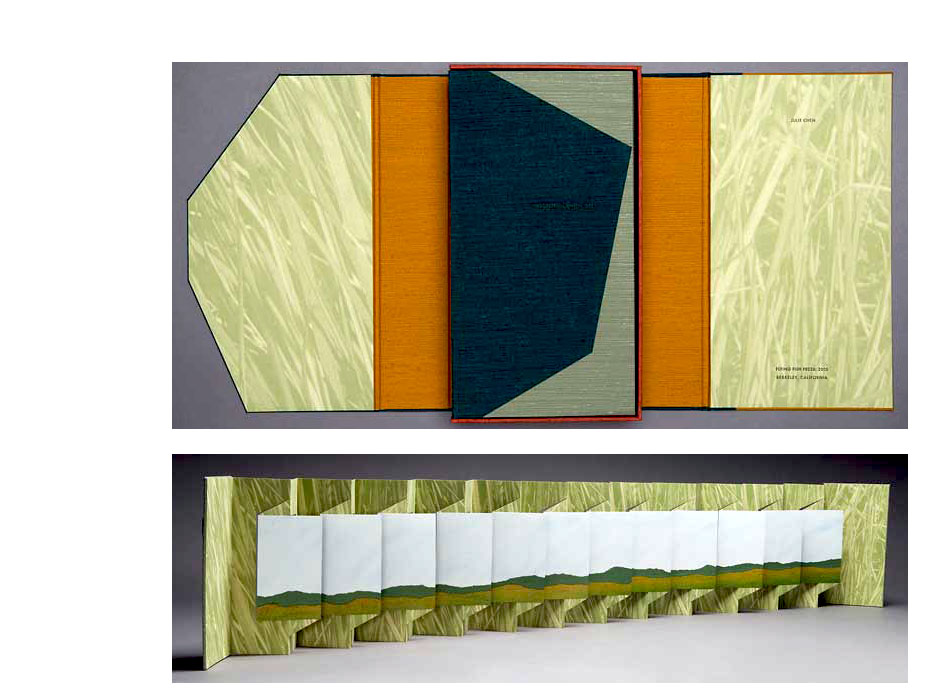
| Invented Landscape By Julie Chen Berkeley, California: Flying Fish Press, 2010. Edition of 50. 5 x 9.75" closed, extends to 66"; 24 pages. A combination of letterpress printing and monoprinting. Accordion structure with a variation on a structure originally designed by Hedi Kyle. Housed in 5.5 x 9.75 x 2.75" two flap portfolio cloth-covered box. Magnet closure. Flying Fish Press: "Invented Landscape is an exploration about the perception of the world beyond a person’s immediate physical experience. The idea that we know and understand the larger world through print and digital media may be more of an illusion than we realize. ... This book presents the reader with a contemplative and intimate reading experience as well as a very wide three-dimensional sculptural object." Julie Chen, colophon: "The initial idea for this book came out of my participation in The Fourth International Biennial for the Artists' Book hosted by The Bibliotheca Alexandrina in Alexandria, Egypt, in the spring of 2010. The assigned theme of nomadism led me to do much research and reflecting about the steady decline of the grasslands of Central Asia and Mongolia, and the disappearance of nomadic pastoralism in those parts of the world. In 2010, Mongolia experienced one of the harshest winters in a decade causing catastrophic losses of herds that may force many nomadic families to abandon their traditional way of life." (Out of Print) |
 Click image for more |
|
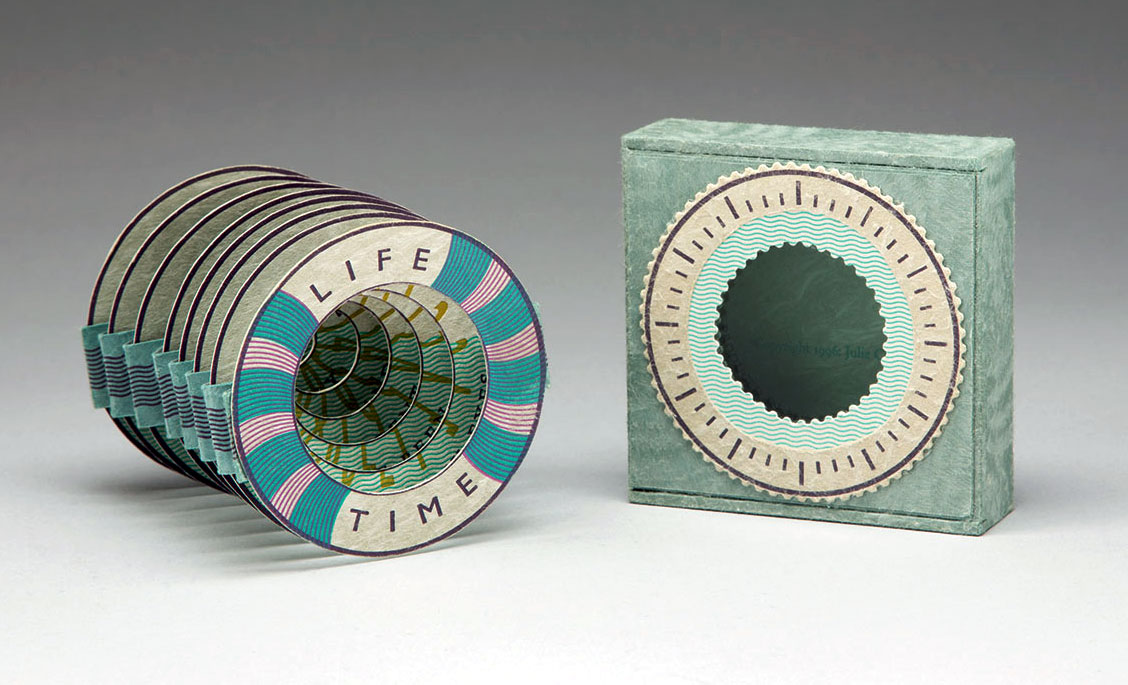
Life Time 2.75 x 2.75” closed, 2.75x 7” extended. Miniature, Tunnel book structure. Letterpress printed from photopolymer plates. Printed on a series of 8 concentric paper discs attached by paper hinges in accordion fold format. Issued in a decorated paper box (80 x 80 x 23 mm.) with hinged glass window lid. Colophon pasted inside bottom of box. Signed and numbered by the artist. Text printed on a series of eight concentric discs attached by paper hinges in an accordion-fold format designed to be read through a center hole when the construction is fully extended. Once the book is expanded, it must be swiveled in a circular motion in order to access all the text. |
 Click image to enlarge |
|
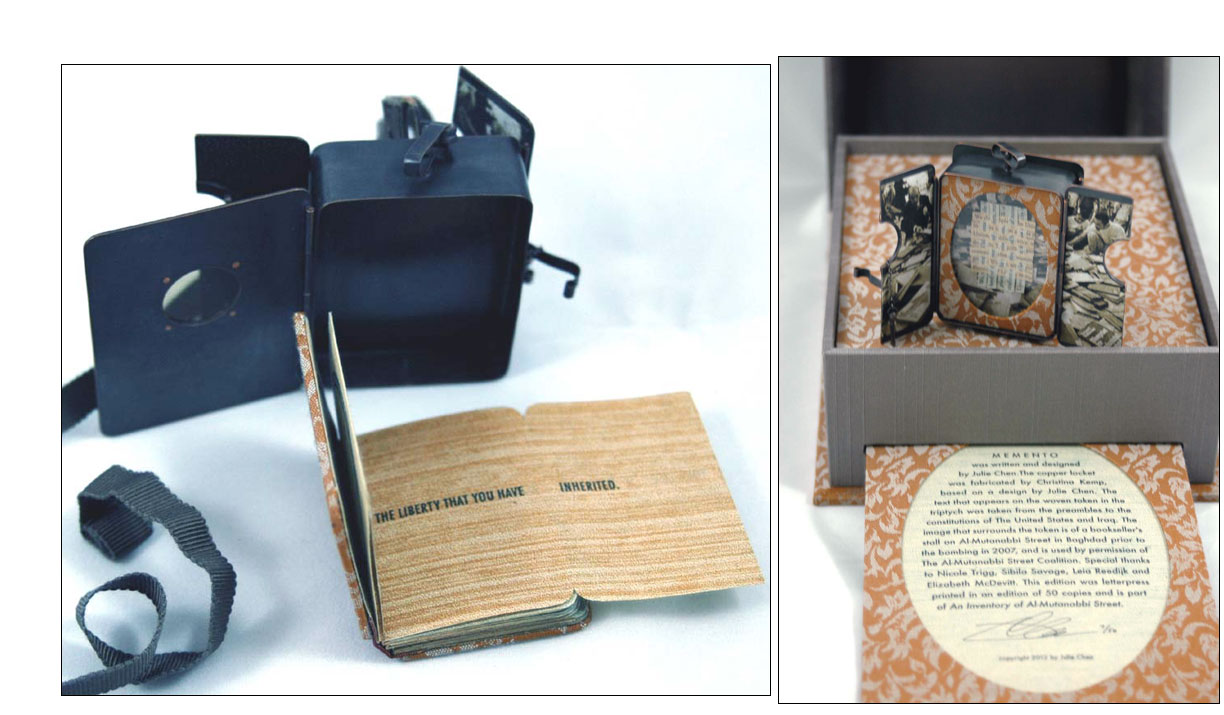
Memento A custom-made copper case/locket (1.8125 x 2.375 x 0.75") by Christina Kemp houses on one side a miniature book (1.5 x 2.125 x 0.375", 56 pages) letterpress printed on Kitakata and opens on the other side to reveal a triptych. The case/locket and a web strip (for wearing the locket) are housed in cavities in a padded clamshell box (5.625 x 6.75 x 2.875") with title on the cover. The colophon slips into a groove in the box's base. Materials: copper box: bookcloth; binder's board; satin; plexiglass. Julie Chen: "Memento is about the fragility of the book and the power of reading. It includes a miniature book that is housed in a metal locket that allows the reader to wear the book close to the body. The simple act of carrying a book on one's person has diverse implications depending on circumstance and place. The locket also houses a triptych that contains a woven token commemorating Al-Mutanabbi Street in Iraq. The texts on the woven strips are taken from the preambles to the constitutions of the United States and Iraq. The image surrounding the token is of a booksellers stall on Al-Mutanabbi Street prior to the bombing in 2007. While the commemorative aspect of this piece is clear, the content of Memento addresses philosophical questions about the nature of reading and information transfer in our own lives as well as within the context of western culture in general. This edition is part of An Inventory of Al-Mutanabbi Street." Calling for attention to things dear, fragile, and gone, Memento has definite parallels to Victorian mourning jewelry. This is Julie Chen's first miniature since the paper confections of Bon Bon Mots, but here the sense of seriousness has been raised several levels. Replete with the touches Chen is deservedly noted for – sensitive text, impeccable craft, design ingenuity – Memento takes its place with Chen's more somber works like Panorama and The Veil. |
 Click image for more |
|
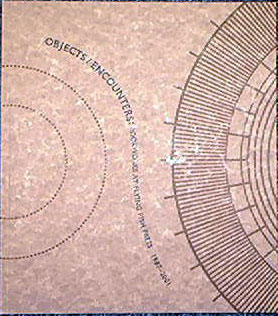
Objects / Encounters: 8 x 9"; 48 pages. Catalog design by Julie Chen. Photography by Sibila Savage. Bound by Cardoza James Bindery. Printed by Coast Litho. Letterpress covers designed and printed by Julie Chen. Descriptive essays of Julie Chen's work by Connell Gallagher and Cynthia Imperatore. Features seventeen color images of her books, plus two black-and-white views of the Flying Fish Press studios. Includes a checklist of books.
|
 |
|
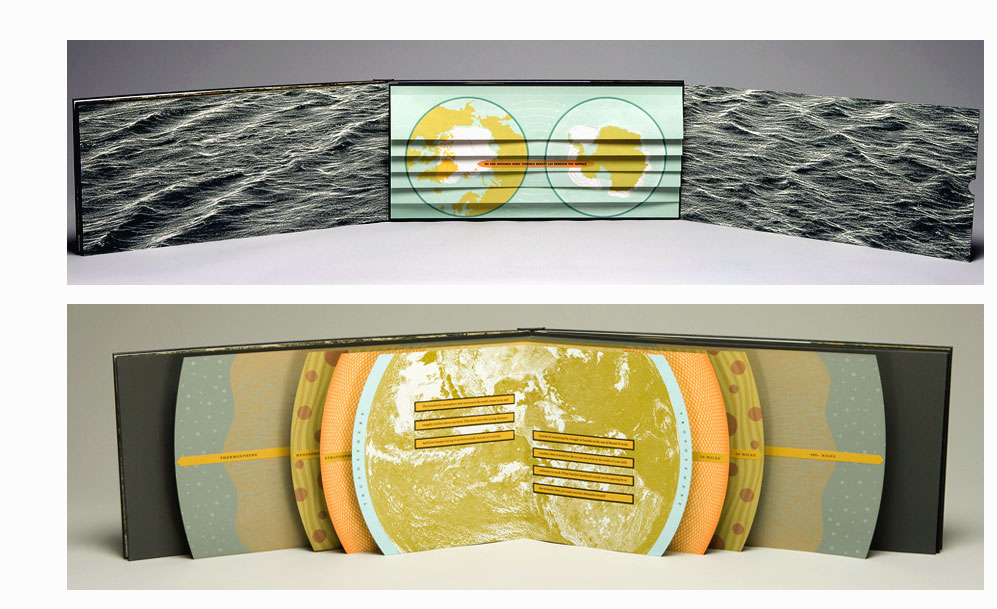
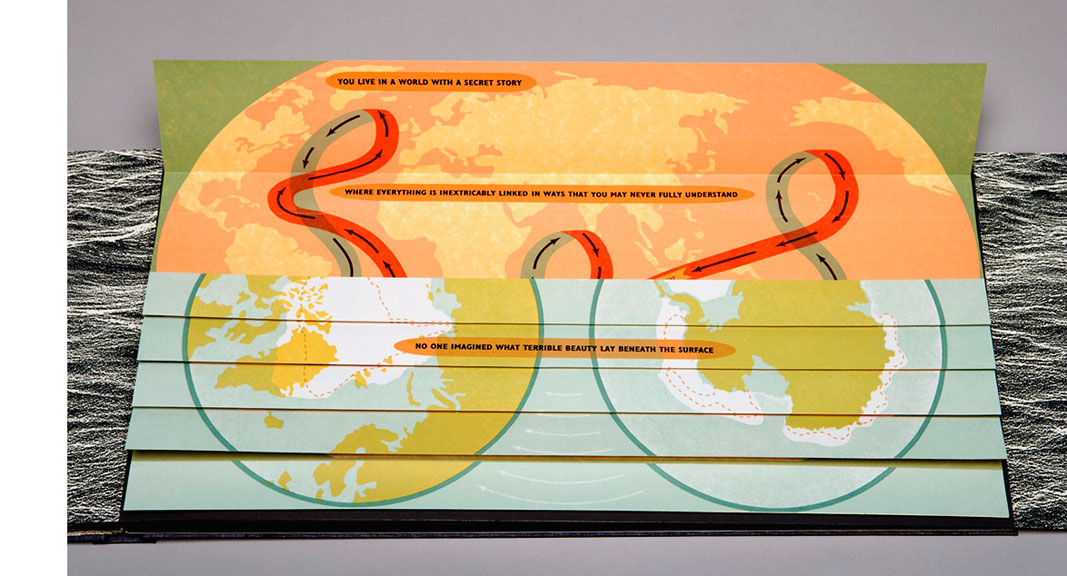
Panorama 10 x 21 x 2"; 12 pages. Three foldout pages and two double-page engineered structures. Cloth-covered boards with paper titles on front board. Housed in matching cloth covered box with magnet closure. Colophon: "Letterpress printed from wood blocks and photopolymer plates by Julie Chen and Alan Hillesheim, and assembled in the studios of Flying Fish Press by Julie Chen, Erin Latimer, and Kimi Taira. Special thanks to Erin Latimer for her stalwart support in the studio through the year-long process of birthing this book." Panorama is a warning, a challenge, a clarion call to action. It begins with “You do not want to believe that time is running out” and ends with “What matters now is whether you will think beyond your own survival / And respond to the challenges that await you.” Its five spreads present in a visual, tactile, and focused way the situation: You are here and now, and you are in denial; the earth’s environment is delicate and endangered; “everything is inextricably linked” and “your failure to change is having serious repercussions”; species are disappearing at an alarming rate; “your habitat is in peril.” What will you do? As always with Julie Chen’s work, it begins with an elegant box, suggesting that what is inside can be contained. But once the pages begin opening, Panorama expands in two and then three dimensions. The problem is bigger, more complex, and more entwined than we might think. And as always the craft and formal invention are lusciously overwhelming and yet on point. Three sections of the book demand physical interaction with a lift tab structure; two sections turn into grand — in both senses — sculptures (to call them pop-ups would be an injustice). You might not want to hear what Panorama says; you might not believe what it purports; but if this doesn’t elicit at least an inward gasp, it may be too late for you anyway. |
|
|
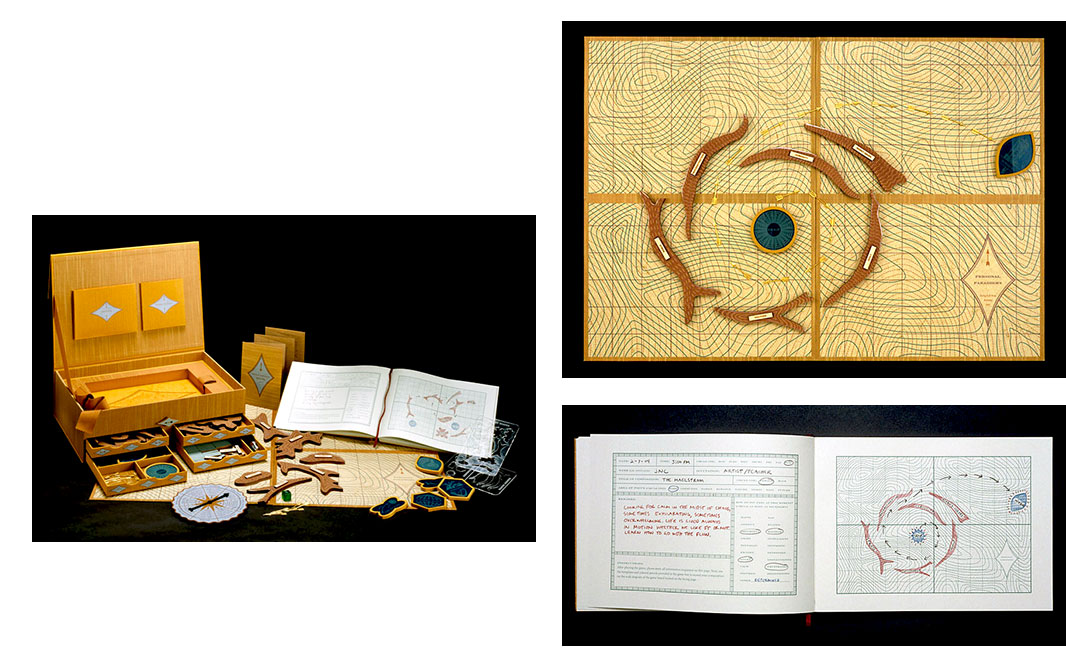
Personal Paradigms Game components housed in 15.5 x 11.25 x 4.75" cloth-covered box. Includes a letterpress printed game board and a multitude of laser-cut game pieces. Game board opens to 21 x 30". Flying Fish Press: "This new bookwork by Julie Chen is by far the most ambitious and extravagant piece ever to be produced at Flying Fish Press. Personal Paradigms presents a truly interactive experience for the reader in the form of a game that is played and the results then recorded in a collaborative ledger book. The object of the game focuses on the player's own life experience and perceptions at the moment that the game is being played." |
 Click image for more |
|
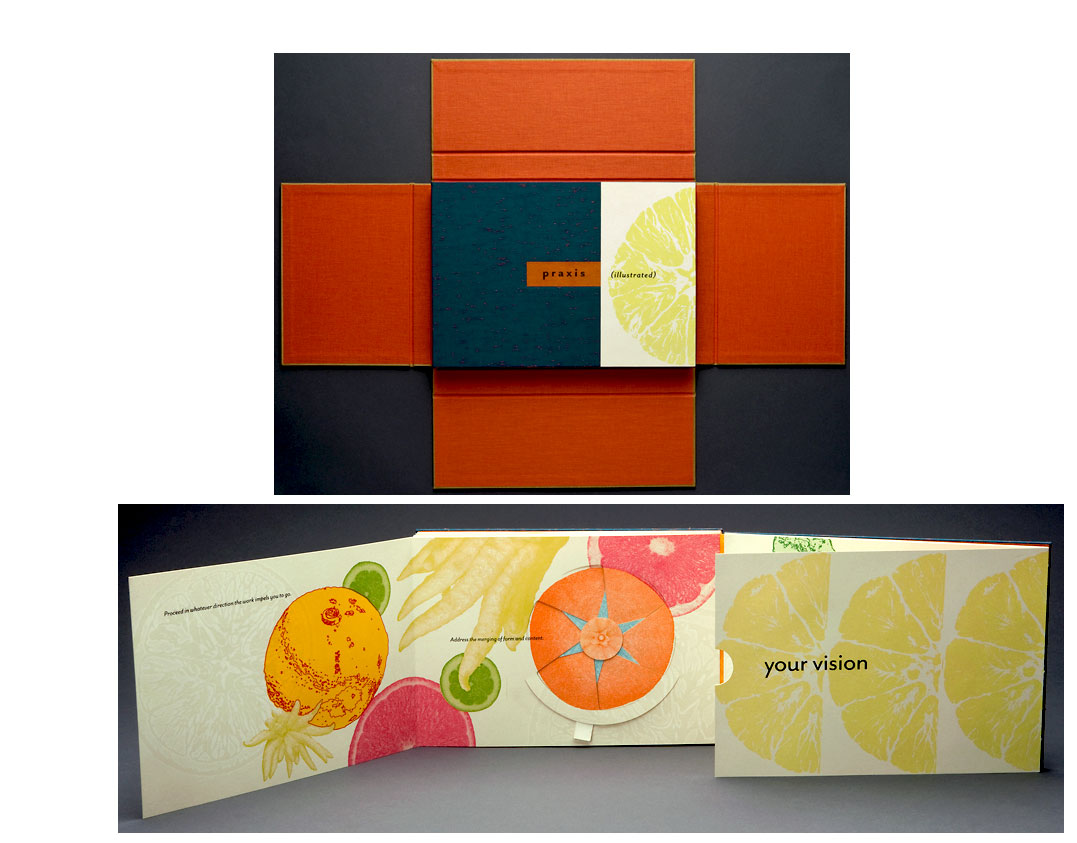
| Praxis (illustrated) By Julie Chen [Sarasota, Florida]: Julie Chen and Ringling College of Art and Design Letterpress & Book Arts Center, 2013. Edition of 45, 3 artist's proofs, 1 presentation proof, and 2 archive impressions. 10 x 7"; 7 leaves with 4 fold out pages. Movables. Letterpress printed. Housed in a four-sided portfolio case with magnetic closures. Signed and numbered by the artist. Printed at Ringling College of Art & Design. Bound at Flying Fish studios. Colophon: "Written and designed by Julie Chen, and letterpress printed by Jill Lerner with assistance from Michael Bailey, Allie Doersch, Dylan Johnston, Mariana Shiva, and Blair Seward. Many people contributed to the making of the imagery including Katy Brandes, Patricia Thompson, Sandra Lefever, and Susan Trovas" Produced as a part of the Ringling College visiting artist subscription series. Flying Fish Press: "The book examines ideas about the creative process and includes several movable mechanisms. It is beautifully letterpress printed and comes housed in a four-sided portfolio case with magnetic closures." (Out of Print) |
 Click image for more |
|
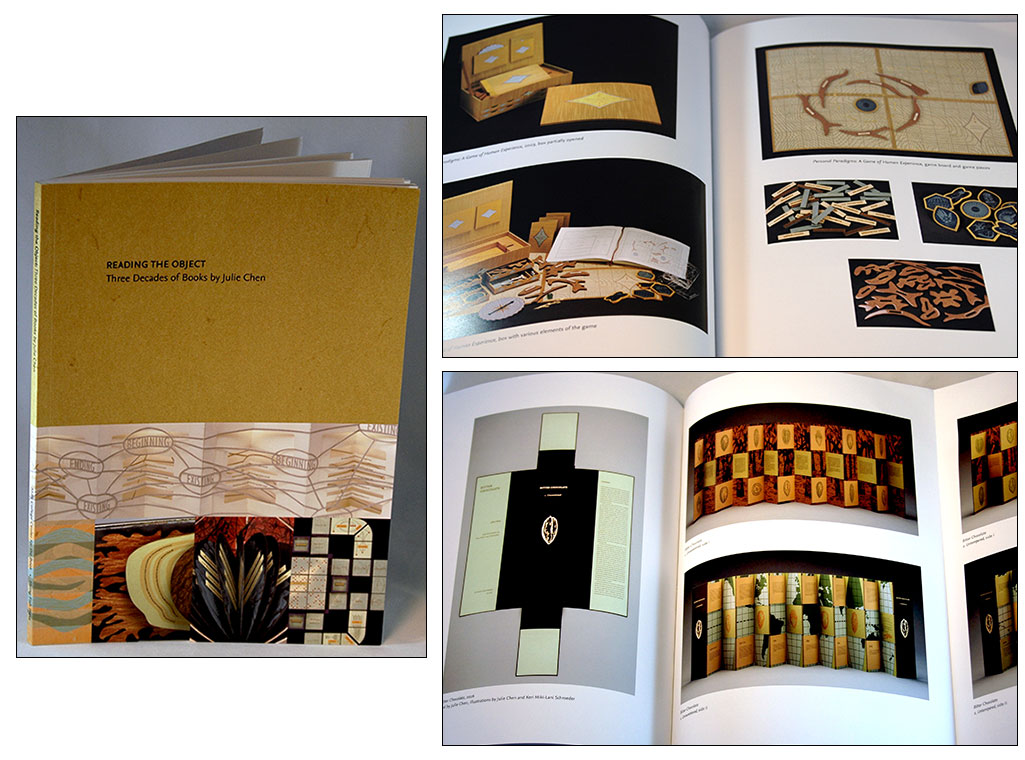
| Reading the Object: Three Decades of Books by Julie Chen | ||
| Oakland, California: Mills College Center for the Book and Flying Fish Press, 2016. 9x 12"; 108 pages. Printed offset. Designed by Julie Chen. Catalogue raisonné of Julie Chen and Flying Fish Press. With essays by Kathleen Walkup and Sandra Kroupa, and commentary by Julie Chen. (SOLD) |
 Click image for more |
|
| Ste. Ostrich Set: Ste. Ostrich in Manhattan and A Recuerdo for Ste. Ostrich | ||
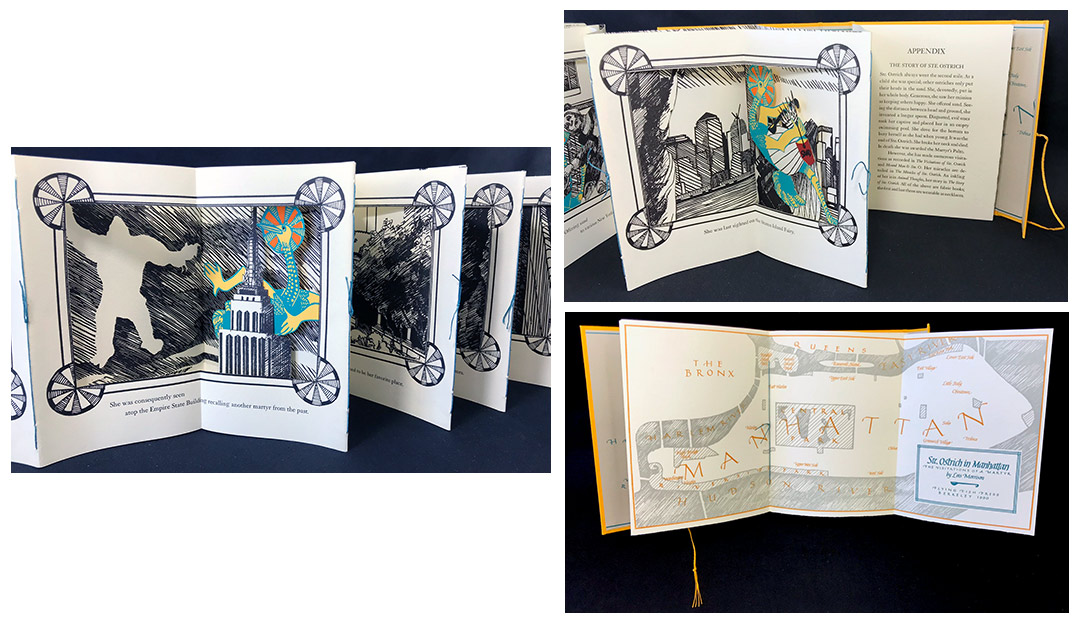
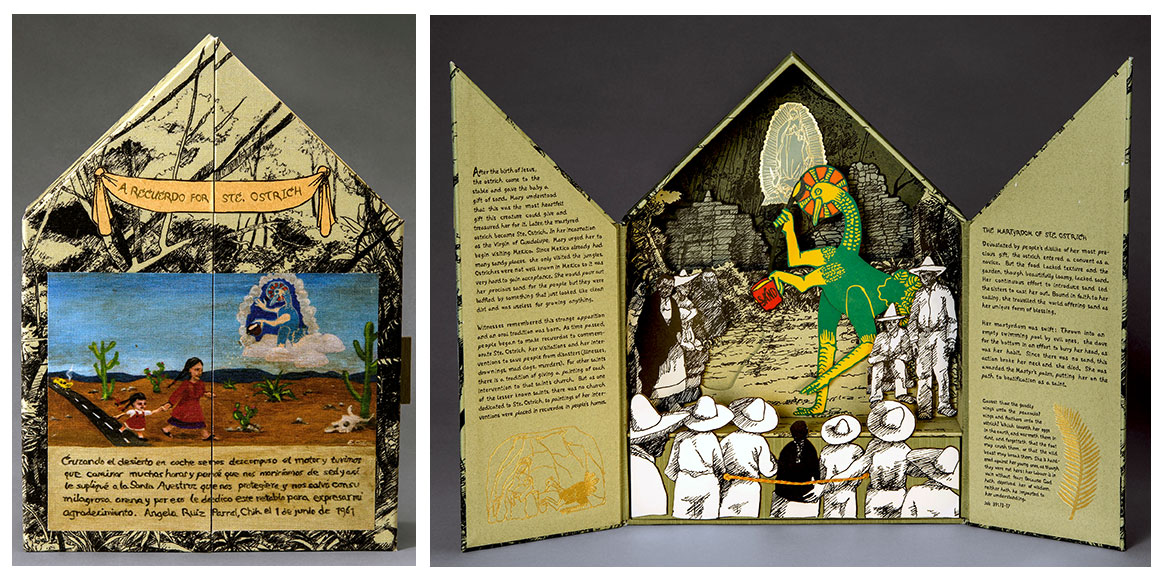
By Julie Chen and Lois Morrison Book artists Julie Chen and Lois Morrison have been friends for 40 years and have worked together on three artists' book collaborations including Ste. Ostrich in Manhattan: The Visitations of a Martyr and this most recent work - A Recuredo for Ste. Ostrich. Ste. Ostrich in Manhattan 6.25 x 8 x 1.25" closed, extends to 84". Carousel book with wraparound case. Letterpress printed from handset metal type. Magnesium and linoleum block prints. Sewn in blue-green thread at the fore edges. Housed a brigh-yellow, cloth-covered folder.Text and images by Lois Morrison. Book design by Julie Chen. Califia Books: "Follow the ornithic saint as she calls at notable NYC sights. This sometimes off-the-wall and always entertaining story is brought to life with Morrison's illustrations and engaging page construction. Each spread of the accordion book is layered with four printed sheets that are "short-sheeted" at the front, to create a series of dioramas." A Recuerdo for Ste. Ostrich 9.25 x 12 x 3" house-shaped structure. Pullout drawer with artifacts and colophon. Written and illustrated by Lois Morrison. Ex-voto painting created by Elizabeth Collins. Printed letterpress on a variety of papers including paper made at Papeterie Saint-Armand. Book and artifacts made and assembled at Flying Fish Press. Text in English and Spanish. Numbered. A recuerdo is a memento, here a votive offering to a saint or divinity given in gratitude or devotion. In Mexico there is a long tradition of these offerings, giving thanks for a miracle or favor. This house-shaped votive recounts several stories about Ste. Ostrich. The outside tells and shows the intercession of the Sainte when a breakdown strands a mother and daughter in the desert. Inside are a series of connected stories recounting the ostrich's saga - her unappreciated gift of sand, unappreciated first at the birth of the baby Jesus, then by the sisters in a convent, then by the people of the Mexico. All this leads to her martyrdom and subsequent beatification. As in all of Morrison's religious work, this one has an element of quirkiness and dark humor. Though this seems to be looking through the glass darkly - only gift the ostrich has is rejected by all, the ostrich breaks her neck trying to bury her head at the bottom of a swimming pool -- ultimately the positive wins out. Even the seemingly most unworthy, even the lowly ostrich who "God hath deprived … of wisdom …[and] understanding" (Job 39: 13-17) is valuable and able to perform miracles. (SOLD/Out of Print) |
|
|
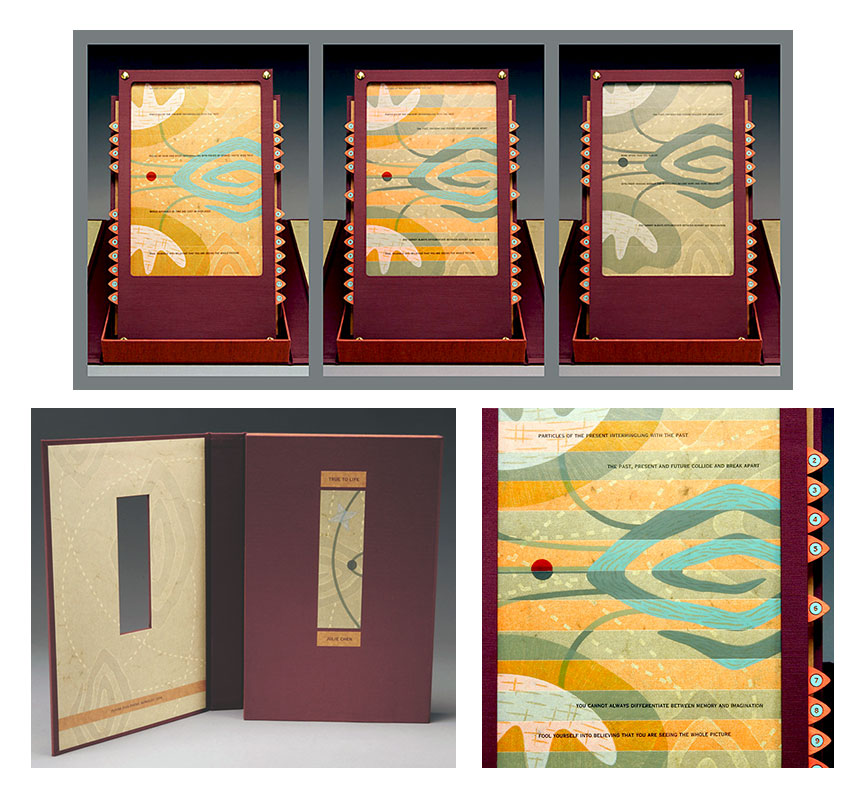
True to Life 9.75 x 15" case with tray for book and prop to showcase book. The hinged floor lifts to support the book in an upright position at an angle. Letterpress printed using a combination of pressure plates, woodblocks, and photopolymer plates. The image that appears on each page is one section of a long, continuous visual timeline that can never be viewed all at once. The page shows through a plexiglass window. There are twelve views of the "page" that are accessed by pushing upward on wooden handles. Sections of the next page will slowly slide into view over the previous page. A visual and textual exploration of the vicissitudes of living. It shows life as a continuous process of change as truth, perceptions, memory and re-interpretation liquidly mix to form this sea of life. |
 Click image for more |
|
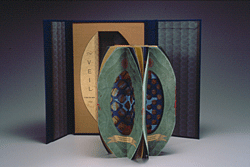
The Veil 4.25 x 10.5" closed. Opens to a full width of 27 inches when opened for display. The book has magnets imbedded in the covers which allow it to be displayed in a circular, sculptural format. Presented in a sumptuous box with magnetic closure. "The Veil" presents personal reflections inspired by the current political situation in the Middle East and the world. In carousel book format with shaped and intricately cut pages, the story unfolds in a richly beautiful, but strangely disquieting setting. With text and illustration by Julie Chen. |
 |
|
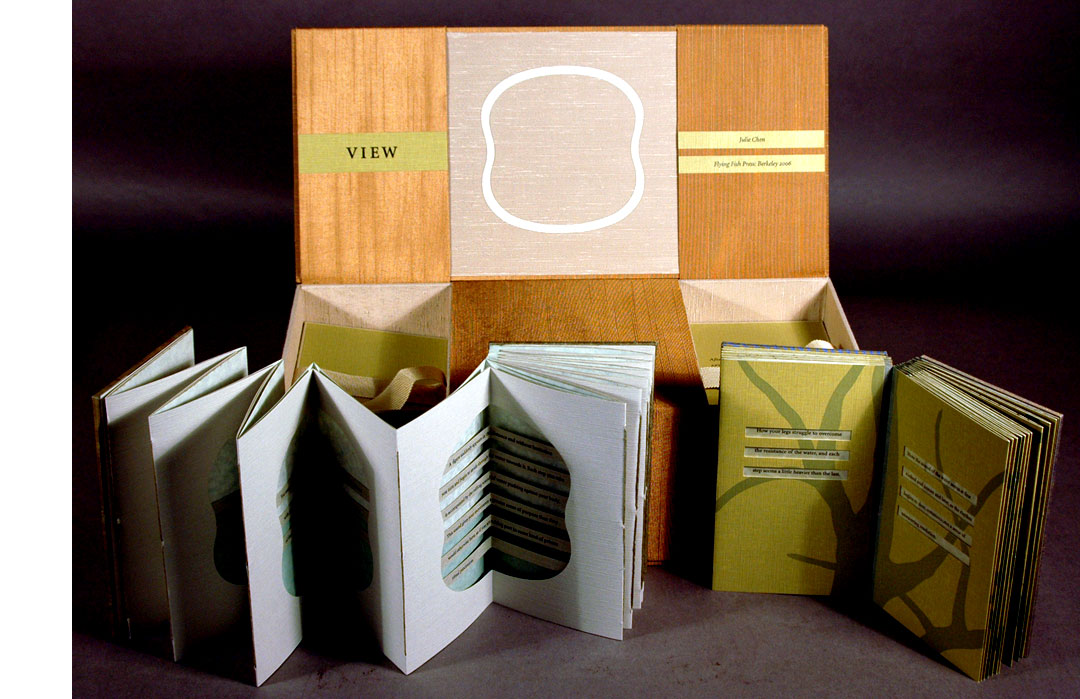
View 6.25 x 13.625 x 4.625" cream and brown cloth box. A magic wallet structure: two books recount and process a dream and a shadow box offers the dreamscape. Written, illustrated, and designed by Julie Chen. Letterpress printed using a combination of photopolymer plates, wood blocks, and pressure plates, and assembled at the studios of Flying Fish Press. Julie Chen: "Based on a personal experience of loss, View is a bookwork that deals directly with ideas of coming to terms with mortality. The piece includes two books that are housed in a compartmented box. After the books have been read, the box can be tilted forward to reveal a mesmerizing view of a miniature world." "We dream the answers before we ask the questions." (SOLD/Out of Print) |
 Click image for more |
|
Page last update: 10.10.2024

Home | About Us | Contact Us | New Arrivals | Fine Press & Artists' Books | Broadsides |Resource Books | Order/Inquiry
Copyright © 2021 Vamp & Tramp, Booksellers, LLC. All rights reserved.